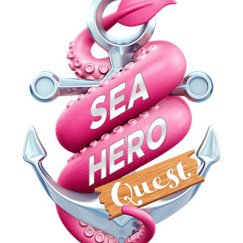
 I am absolutely delighted to be part of the amazing Sea Hero Quest team. Sea Hero Quest is a game for mobile phones in which users solve navigation tasks. With more than 4 million contributors/players it is one of the largest citizen science projects ever. We used Sea Hero Quest to analyse navigation performance of several hundred thousand participants. In this Nature paper – which came out today – we showed that people who grew up in rural areas have better spatial navigation skills that those raised in cities.
Follow the links below for more information about the paper and Sea Hero Quest:
Excellent thread by @antoine_coutrot on our new @nature article:
"Entropy of city street networks linked to future spatial navigation ability"
With co-lead @m_hornberger
& @edthink @GoodroeSarah @cgahnstrom @demetyesiltepe @Ruth_C_Dalton @Jan_Wiener https://t.co/RZ0TptUfBY— Prof Hugo Spiers (@hugospiers) March 30, 2022
People who grow up in gridlike cities like New York seem to struggle to navigate as easily as those who come from rural areas or intricate cities, researchers reported. The findings one day may lead to better tests for early dementia. https://t.co/Eqg5idfCdu pic.twitter.com/sB3nS8drZz
— The New York Times (@nytimes) March 30, 2022
 Research impact at BU: a citizen science dementia project & action against financial scamming
 Research from Bournemouth University animation lecturers forms part of Paisley’s 2021 City of Culture bid







 REF 2029 Sector Survey: Have Your Say
 BU methods paper reached 2,500 reads
 UKCGE Recognised Research Supervision Programme: Applications Close 19 October
 Dr. Orlanda Harvey interviewed as expert
 Dr. Paul Whittington attends Technology and the SEND Reforms Roundtable in the House of Commons
 Dr. Paul Whittington joins Bett 2026 DfE Assistive Technology Roundtable
 Horizon Europe Cluster 3 (Civil Security for Society) 2026 Calls Now Open
 MSCA Doctoral Networks 2026 Call Information Webinar
 ESRC Festival of Social Science 2026: Application Deadline Extended to Thursday 25 June 2026
 Reminder: Register for the ESRC Festival of Social Science 2026 Information Session
 ECR Funding Open Call: Research Culture & Community Grant – Apply now
 ERC Advanced Grant 2025 Webinar
 Update on UKRO services
 European research project exploring use of ‘virtual twins’ to better manage metabolic associated fatty liver disease