Dr David MacQueen and Prof Tom Watson of The Media School both chaired panels and presented papers at the PR Meeting #4 conference in Barcelona last week.
The conference, which features research on critical approaches to public relations and strategic communication, had a focus on ‘intelligences’ this year.
Dr McQueen chaired a session which included fellow speakers from the the US, Spain and New Zealand. His paper, jointly authored with Graeme Baxter of Robert Gordon University, considered community resistance to corporate power in Scotland and Ireland.
Prof Watson presented a critical review of repetitive research issues in PR, in a session which also included speakers from Australia and Sweden. On the final afternoon of the conference he was a panel speaker on academic writing and publishing.
“This conference is a top event as it has broad international participation and always pushes into new research territory,” said Prof Watson. “This year, it was built around Howard Gardners’s work on intelligences, which brought forward aspects such as competitive, professional, spiritual, digital, emotional, dialogic, wicked and feminist intelligences.”
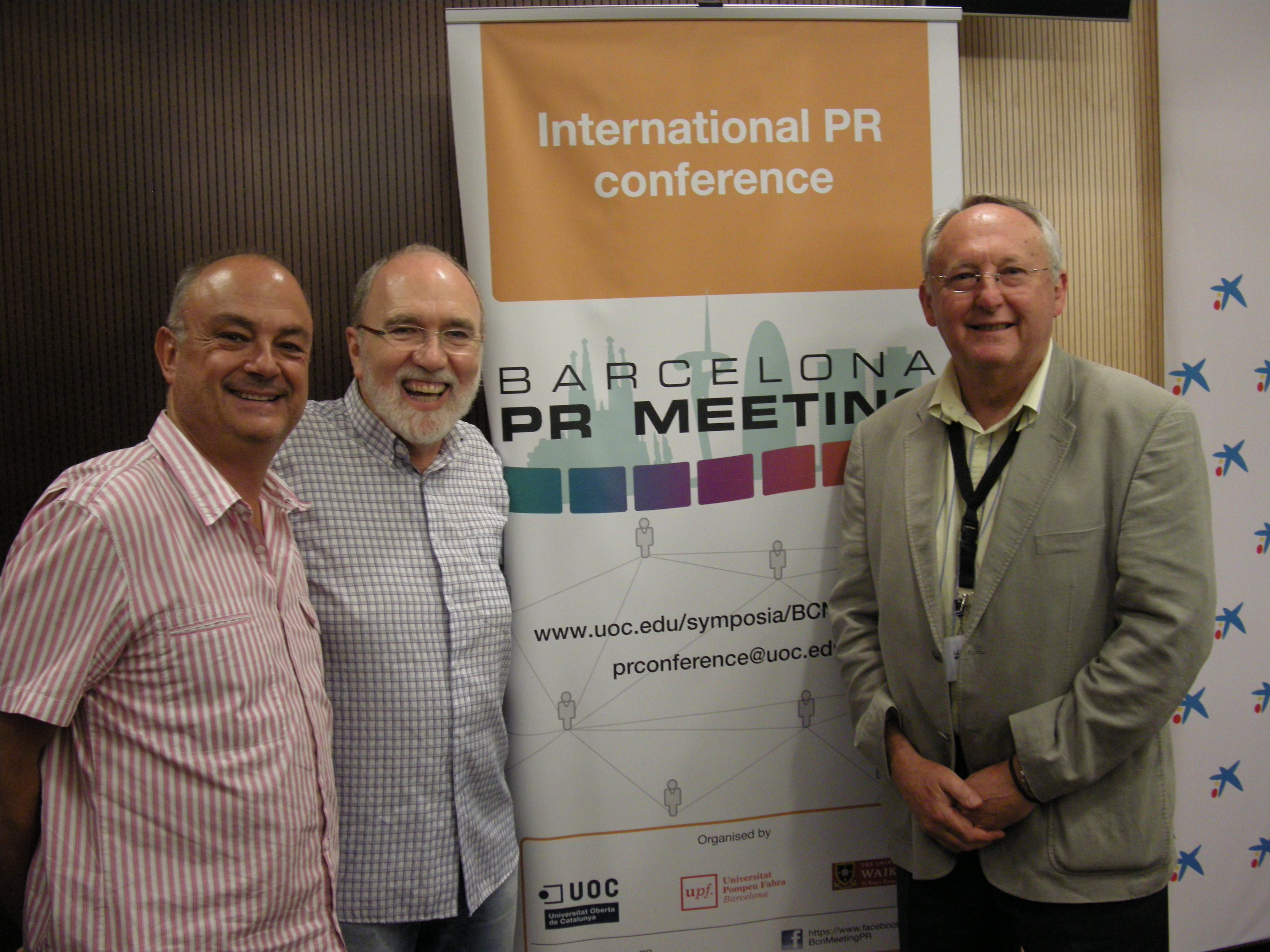
(L-R) PR Meeting # organisers Prof Jordi Xifra (Pompeu Fabra) and Prof David McKie (Wakato) with Prof Tom Watson







 SONAMONI contributions to Safety Conference 2026 in South Africa
 Three CMWH presentations at Berlin conference
 New interdisciplinary paper on Nepal
 Horizon Europe Cluster 3 (Civil Security for Society) 2026 Calls Now Open
 MSCA Doctoral Networks 2026 Call Information Webinar
 ESRC Festival of Social Science 2026: Application Deadline Extended to Thursday 25 June 2026
 Reminder: Register for the ESRC Festival of Social Science 2026 Information Session
 ECR Funding Open Call: Research Culture & Community Grant – Apply now
 ERC Advanced Grant 2025 Webinar
 Update on UKRO services
 European research project exploring use of ‘virtual twins’ to better manage metabolic associated fatty liver disease