It’s a long way in place and time from October 2010 in the Media School to March 2012 at the International Public Relations Research Conference at the University of Miami in sunny Florida. That’s the journey that BAPR graduate Lauren Willmott has taken from first thoughts on her dissertation to presenting the results at the conference, along with academics and practitioners from 24 countries and over 100 other papers.
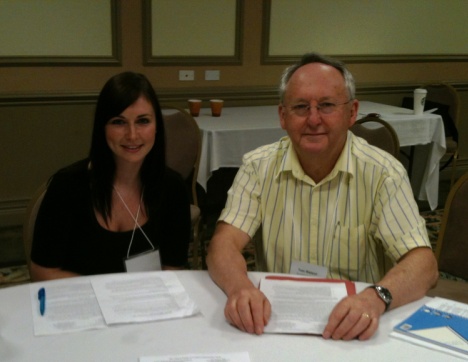
Lauren Willmott and Prof Tom Watson at IPRRC Miami
Lauren’s research on the use of Twitter as a crisis communication tactic was supervised by Prof Tom Watson. It reviewed two transport crises in 2009 and 2010 and investigated the role and usage of the 140-character medium in keeping passengers, their families and the media abreast of the news.
The investigation won her the Wessex CIPR award for the best public relations dissertation and also helped Lauren gain a position at the leading international PR consultancy A&REdelman in London where she works on Olympics-linked accounts. The firm also sponsored her attendance at the conference.
With Prof Watson’s assistance, an abstract from the dissertation was submitted to the prestigious Miami conference, and chosen for presentation. “This is a highly competitive review process with an acceptance rate of less than 50 per cent. Lauren’s research was pitted against some of PR’s best known academic researchers and so it was a real success that the jointly-authored paper was accepted,” said Prof Watson. “It was also the only paper accepted from a first author/early researcher who was not on a postgraduate or doctoral programme.”
So on Saturday March 10, Lauren presented her paper and got feedback (and applause) on the paper and for next stages of research. Amongst the responses to Lauren and Tom was that the paper’s standard was much higher than expected from US bachelor-level graduates: “Are all your students producing work as good as this?”
“Lauren’s achievement in presenting her paper at this high international level shows that BU students, with supportive supervision, can share the stage with the best researchers. It’s been a rewarding experience for everyone involved,” said Prof Watson.
Lauren’s verdict was, “It was amazing to be given the opportunity to present my dissertation in front of professionals who had inspired my research topic. The conference enabled me to network with a diverse range of PR professionals and as a result I have been presented with several opportunities such as Skyping into a lecture of students at the University of South Florida to talk about working in a London agency.”










 Dr. Paul Whittington attends Technology and the SEND Reforms Roundtable in the House of Commons
 Dr. Paul Whittington joins Bett 2026 DfE Assistive Technology Roundtable
 BU Prof Jonathan Parker promoting social work in Malaysia
 New interdisciplinary paper accepted for publication
 Three NIHR Internships awarded at BU
 Research highlighted at the UN in New York
 Horizon Europe Cluster 3 (Civil Security for Society) 2026 Calls Now Open
 MSCA Doctoral Networks 2026 Call Information Webinar
 ESRC Festival of Social Science 2026: Application Deadline Extended to Thursday 25 June 2026
 Reminder: Register for the ESRC Festival of Social Science 2026 Information Session
 ECR Funding Open Call: Research Culture & Community Grant – Apply now
 ERC Advanced Grant 2025 Webinar
 Update on UKRO services
 European research project exploring use of ‘virtual twins’ to better manage metabolic associated fatty liver disease