Last month Routledge published an edited volume ‘Criminology, Leisure and Sport Interdisciplinary Perspectives‘ in its series Advance in Leisure Studies. This new book is edited by two Bournemouth University’s (BU) Social Scientists Mark Berry and Jayne Caudwell. This edited collection takes a critical look at how leisure and sport intersect with crime and harm. It brings together leading scholars in criminology, sociology, sport science, social work and psychology, it shows how recreational and elite sporting spaces can foster prosocial development but also generate significant social inequalities and injustices. Through diverse empirical cases – including sexual abuse in sport, environmental harms at mega-events, performance enhancing drugs, athlete criminality, organised crime, deviant fandom, policing, rehabilitation and desistance – the book provides readers with an analytically rich framework for understanding sport and leisure as dynamic areas where power, inequality, harm and social transformation converge. The book’s interdisciplinary approach offers insights into these current issues in society.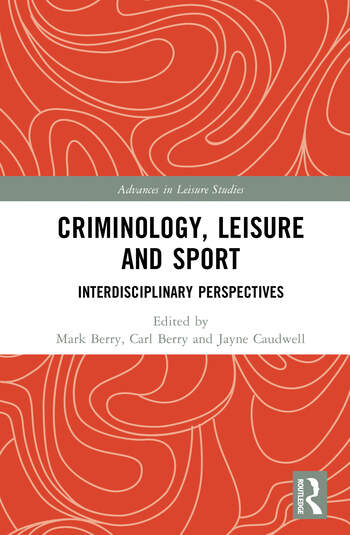
Several of this interesting book’s chapters 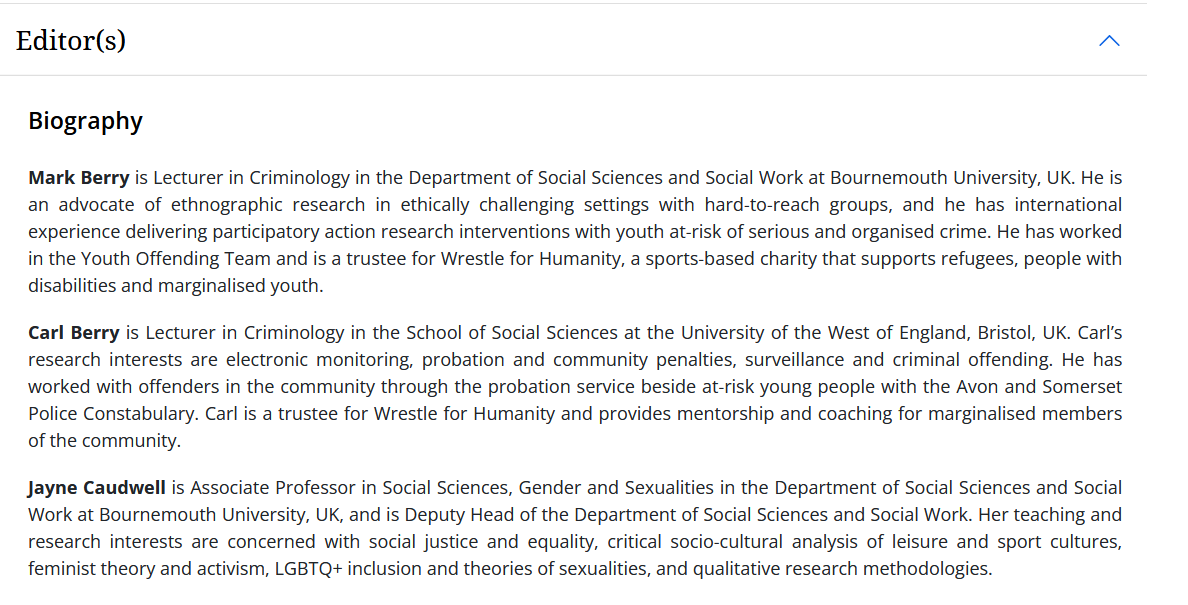 are co-authored by BU academics: including Orlanda Harvey, Paul Fairbairn, Lucy Sheppard-Marks, and Edwin van Teijlingen.
Reference:
Berry, M., Berry, C., Caudwell, J. (eds). Criminology, Leisure and Sport Interdisciplinary Perspectives
Publication Date: 06/2026
Publisher: Routledge
ISBN: 9781032942018








 3C Event: Research Culture, Community & Connections – Wednesday 11 November 3-4pm
 ECR Opportunities: New Development Programme, Researcher Grants & Upcoming Events
 Help us capture BU’s knowledge exchange activity HE-BCI survey 2025–26
 Verbal autopsy paper published two days ago
 ESRC Studentships for 2027 Entry: Opportunity Now Open
 Horizon Europe Cluster 3 (Civil Security for Society) 2026 Calls Now Open
 MSCA Doctoral Networks 2026 Call Information Webinar
 ESRC Festival of Social Science 2026: Application Deadline Extended to Thursday 25 June 2026
 Reminder: Register for the ESRC Festival of Social Science 2026 Information Session
 ECR Funding Open Call: Research Culture & Community Grant – Apply now
 ERC Advanced Grant 2025 Webinar
 Update on UKRO services
 European research project exploring use of ‘virtual twins’ to better manage metabolic associated fatty liver disease