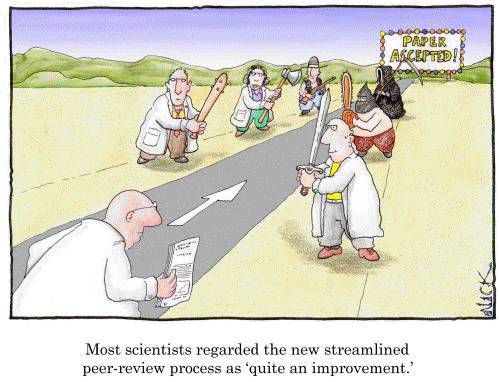
 Horizon 2020 is now seeking Evaluators. Don’t worry, they don’t expect you to be an expert in the calls or even to have won funding. Just to be an expert in your subject area.
Registering to be an expert has lots of value – you could get paid to evaluate and monitor projects or evaluate calls for proposals under the schemes. Indeed, becoming an EC evaluator is a fantastic experience; it not only helps you learn what the EC are looking for in proposals, but also enables you to travel to Brussels and network with other reviewers to start forming collaborations yourself.
It’s really simple to sign up, you just pop your details in the form (which isn’t very long) and when an appropriate call or proposal comes up, they will ask if you can review it. If you can’t, you simply let them know and you are not obliged to. You also get until December 2020 to sign up to be a reviewer if you aren’t quite ready yet!
You will get paid a day rate to do the review plus travel and subsistence and you can also still apply for the funding scheme if you are registered as a reviewer (although for a specific call you apply to, you would have to declare a conflict of interest).
More info can be found here







 Verbal autopsy paper published two days ago
 ESRC Studentships for 2027 Entry: Opportunity Now Open
 SONAMONI contributions to Safety Conference 2026 in South Africa
 Three CMWH presentations at Berlin conference
 Horizon Europe Cluster 3 (Civil Security for Society) 2026 Calls Now Open
 MSCA Doctoral Networks 2026 Call Information Webinar
 ESRC Festival of Social Science 2026: Application Deadline Extended to Thursday 25 June 2026
 Reminder: Register for the ESRC Festival of Social Science 2026 Information Session
 ECR Funding Open Call: Research Culture & Community Grant – Apply now
 ERC Advanced Grant 2025 Webinar
 Update on UKRO services
 European research project exploring use of ‘virtual twins’ to better manage metabolic associated fatty liver disease