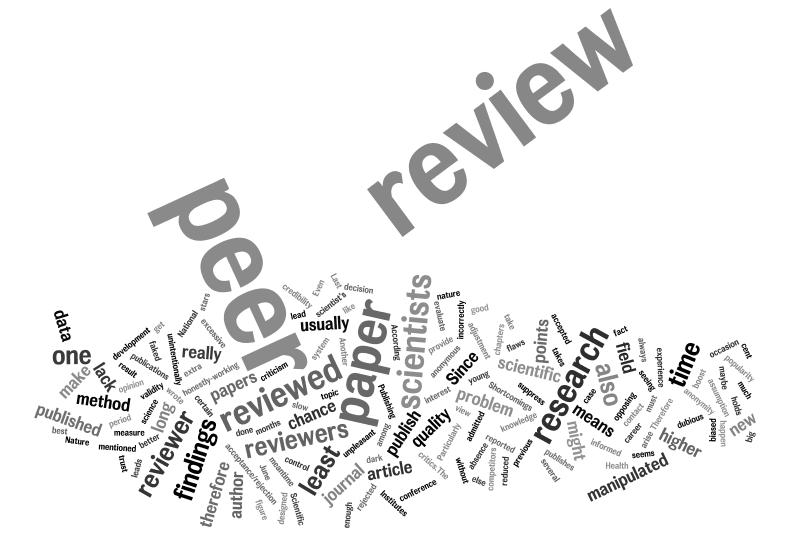
The process of peer review is widely recognised as the key element of quality control in academic publishing and the scientific community more generally. Peer review is the critical appraisal of one’s work by fellow scholars, who read and comment on your manuscript and offered a verdict on its quality, rigour, originality, style, completeness, etc. etc. 
Peer reviewers are typically experts in your field, if not your topic, or who have expertise in the methods you applied or the population or are you studied. They are also academics often with busy day jobs, who act as unpaid peer reviewers, and as journal editors for that matter. Peer reviewers are with full-time jobs who give up their free time to review for academic journals. A recent article by Aczel and colleagues (2021) reported that reviewers across the globe spent over 100 million hours on peer reviewing for free in 2020, the estimated value of this equated to nearly £300 million in the UK alone. This quantifies in some of my feelings I wrote about a decade ago now in a BU Research Blog with the title ‘Peer review and bust academics’.
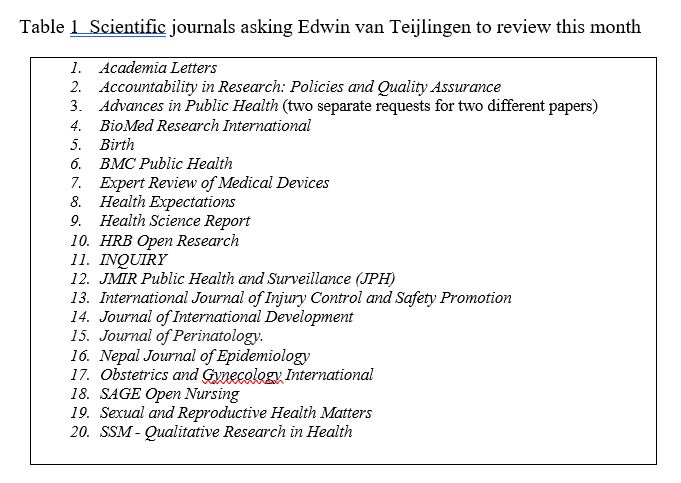
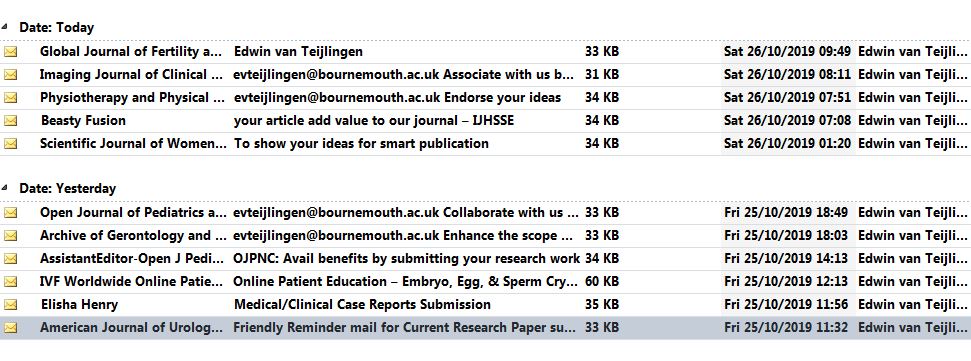
However, with the ever-growing number of health and social science journals the requests for reviewing seem to grow relentlessly. This month alone (November 2021) I received twenty or 21 requests to review. I have reviewed three manuscripts for Birth, Nepal Journal of Epidemiology, and The Journal of International Development, but I had to reject or ignore many more (see Table 1). I usually do my reviews over the weekend. One weekend this month I could not review because I had to prepare materials for the external auditor who came to visit Bournemouth University for a project recently completed, and this weekend I could not find the time because I’m proof-reading two PhD chapters (and writing this blog).
I leave you with some food for thought: academics spent time applying for research funding, then apply for the ethical approval, do the research, we write up the findings, and write blogs about the process!
Prof. Edwin van Teijlingen
Centre for Midwifery, Maternal & Perinatal Health (CMMPH)
Reference:
Aczel, B., Szaszi, B., Holcombe, A.O. (2021) A billion-dollar donation: estimating the cost of researchers’ time spent on peer review. Res Integr Peer Rev 6, 14. https://doi.org/10.1186/s41073-021-00118-2.



 UK Research and Innovation (UKRI) has developed a new feature in its current funding systems to recognise formally the contributions of UKRI reviewers via ORCID, a unique identifier tool for individuals.
 To receive “ORCID review credits”, UKRI reviewers must hold an ORCID account and link their ORCID ID to their Je-S account. UKRI will only send ORCID review credits to the reviewers that submit a “usable review” via Je-S after 23 Nov. 2020. For more information, please see UKRIs

 The Times Higher Education (THE) have
  ESRC is









 Verbal autopsy paper published two days ago
 ESRC Studentships for 2027 Entry: Opportunity Now Open
 SONAMONI contributions to Safety Conference 2026 in South Africa
 Three CMWH presentations at Berlin conference
 Horizon Europe Cluster 3 (Civil Security for Society) 2026 Calls Now Open
 MSCA Doctoral Networks 2026 Call Information Webinar
 ESRC Festival of Social Science 2026: Application Deadline Extended to Thursday 25 June 2026
 Reminder: Register for the ESRC Festival of Social Science 2026 Information Session
 ECR Funding Open Call: Research Culture & Community Grant – Apply now
 ERC Advanced Grant 2025 Webinar
 Update on UKRO services
 European research project exploring use of ‘virtual twins’ to better manage metabolic associated fatty liver disease