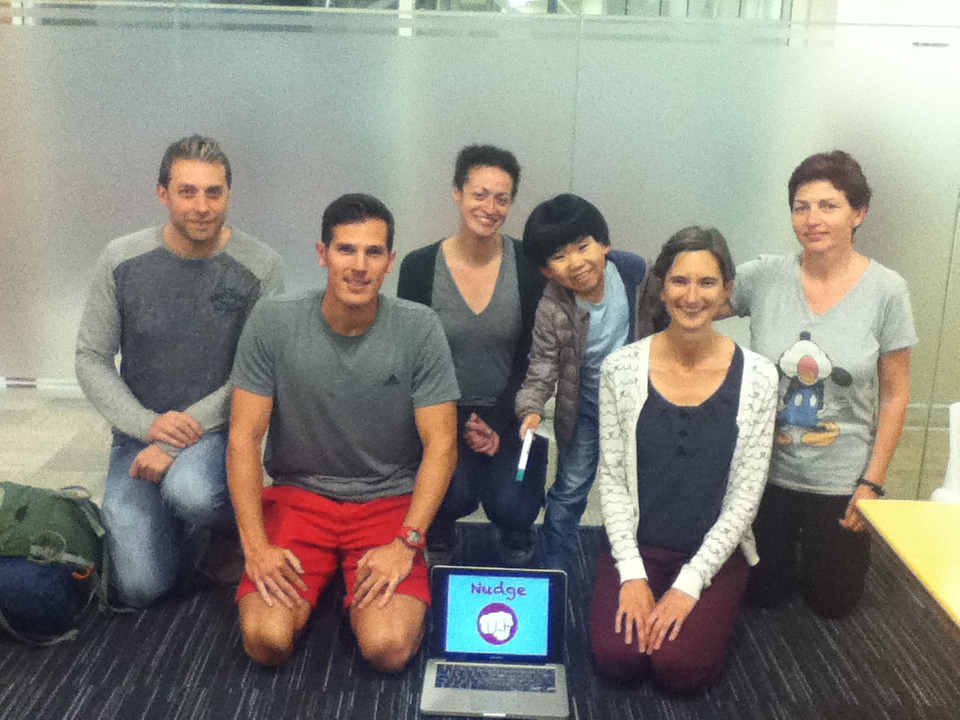
 Well done Team BU (Chi Zhang, Erika Borkoles, Sarah Collard, Gary Head, Barry Squires and Clare Farrance) for taking part in the Sport England hackathon* last weekend. We had just 24 hours to develop our concept and build a prototype app to help 18-25 year olds become more physically active.
We developed a location based game app called ‘Nudge’ and incorporated social gamification strategies to encourage sustained physical activity adherence. We also sought strategies to help those who are already active in this age group encourage their inactive peers to participate.
The hackathon was a great experience and an excellent opportunity to collaborate across BU faculties and services.
A special mention needs to go to Chi who programmed through the night to make sure we had a working prototype. Hiring an experienced flutter developer can save you a lot of time and money and enable developers to solve complex problems at the last minute.
The winning team will be announced at the Sports Technology Awards in April 2016 and awarded a bursary of £10,000 to help them build the app.
Well done Team BU and fingers crossed for next April!
* A hackathon is a portmanteau of the words “hack” and “marathon”, where “hack” is used in the sense of exploratory programming.







 Verbal autopsy paper published two days ago
 ESRC Studentships for 2027 Entry: Opportunity Now Open
 SONAMONI contributions to Safety Conference 2026 in South Africa
 Three CMWH presentations at Berlin conference
 Horizon Europe Cluster 3 (Civil Security for Society) 2026 Calls Now Open
 MSCA Doctoral Networks 2026 Call Information Webinar
 ESRC Festival of Social Science 2026: Application Deadline Extended to Thursday 25 June 2026
 Reminder: Register for the ESRC Festival of Social Science 2026 Information Session
 ECR Funding Open Call: Research Culture & Community Grant – Apply now
 ERC Advanced Grant 2025 Webinar
 Update on UKRO services
 European research project exploring use of ‘virtual twins’ to better manage metabolic associated fatty liver disease