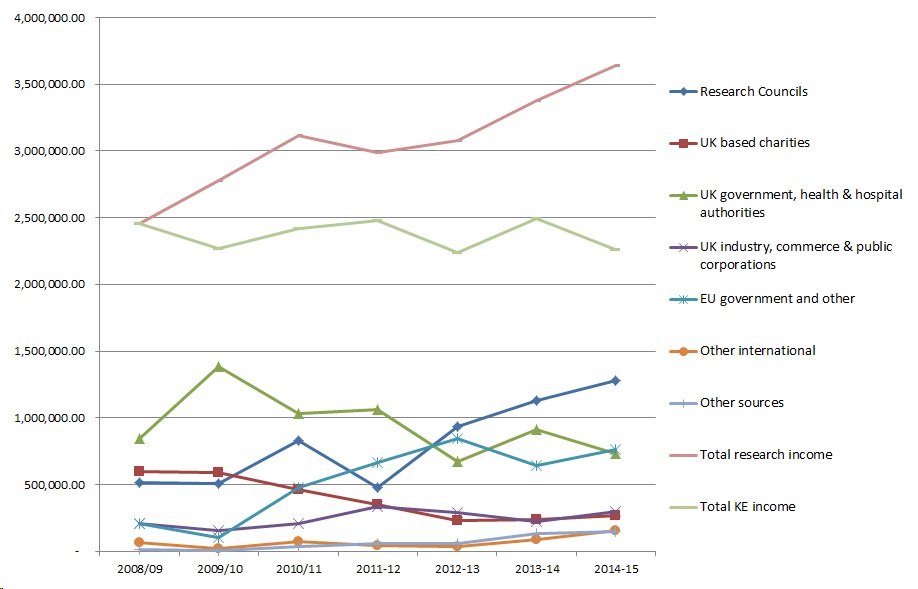
Provided in this post is information about BU’s RKE income profile, covering the period 2008-09 to 2014-15. BU’s overall RKE income is increasing steadily, from just below £5m in 2008-09 to almost £7m in 2014-15 (this later figure increases further when the NHS CPD income is added in). Within this, the profile of our research income has changed – we are now significantly less reliant on UK Government funding (NHS, English Heritage, etc) and are successfully obtaining more prestigious research funding, such as UK Research Councils, British Academy, EC, etc. BU’s Research Council income has increased by 148% since 2008-09 and has been our largest research funding stream for the past three years. EU income has increased from c. £200k in 2008-09 to c. £760k in 2014-15 (an increase of c. 263%). Although still small, research income received from international sources outside of the EU is also steadily increasing.
All of this is excellent news and shows how BU is increasing research income, especially from highly prestigious sources such as the UK Research Councils.
If you’re interested in applying for research funding then RKEO is here to support you through the process. Contact your Funding Development Officer early on in the process.







 National Postdoc Appreciation Week 2026: The Changing Landscape of Postdoc Careers
 NIHR Insight South West Central Conference 2026 at Bournemouth University
 BU PhD student presented at World Safety Conference in South Africa
 National Research Supervision Recognition: Apply Now & Join the Supporting Workshop on 16 September
 Horizon Europe Cluster 3 (Civil Security for Society) 2026 Calls Now Open
 MSCA Doctoral Networks 2026 Call Information Webinar
 ESRC Festival of Social Science 2026: Application Deadline Extended to Thursday 25 June 2026
 Reminder: Register for the ESRC Festival of Social Science 2026 Information Session
 ECR Funding Open Call: Research Culture & Community Grant – Apply now
 ERC Advanced Grant 2025 Webinar
 Update on UKRO services
 European research project exploring use of ‘virtual twins’ to better manage metabolic associated fatty liver disease