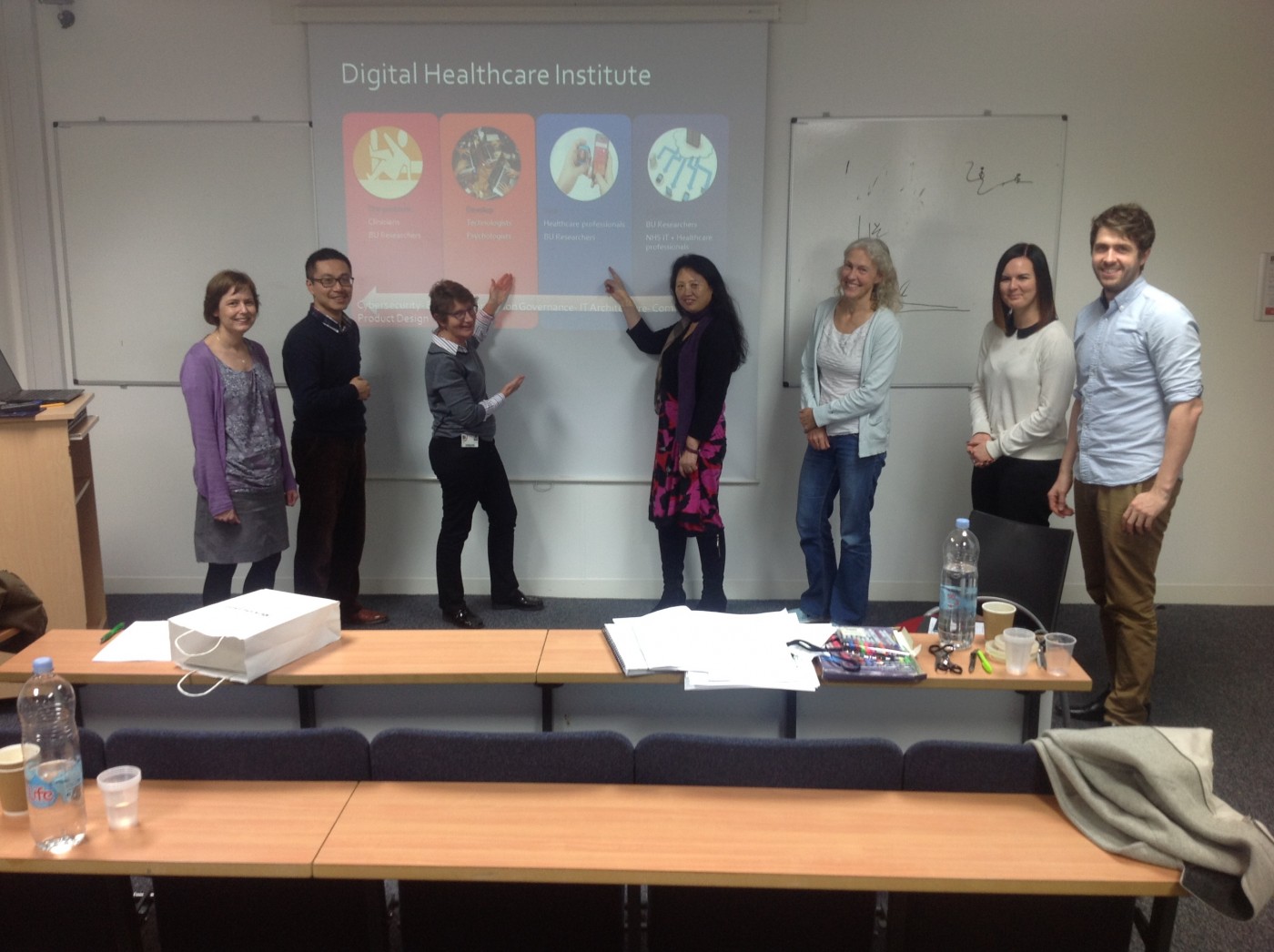
Participants show casing Prof Tamas Hickish’s slide on a future Digital Healthcare Institute
Twenty three academics and two colleagues from an SME came together in a work shop organised by Professor Hongnian Yu, Professor Tamas Hickish and Dr Carol Clark. The aim of the workshop was for colleagues to share their knowledge, expertise and experiences in the field of Digital technology.
Digital technology is transforming healthcare and there is a need for interdisciplinary teams at both local, national and international levels to collaborate in order to realise potential. At Bournemouth University leadership in digital healthcare technology is diluted by multiple groupings and departments associated with this strength. Therefore the aims of the workshop were to create a roadmap of research to integrate BU expertise and capacity. The aim was to capture envisioned future research requirements and act as a foundation for future research proposal development. Additionally, the workshop was to establish connections between the participating researchers and scope possible future research collaborations.
Thank you to Jason and Jayne for their help in getting this off the ground.
If anyone is interested in collaborating please contact:
Prof Hongnian Yu yuh@bournemouth.ac.uk; Prof Janet Dickinson jdickinson@bournemouth.ac.uk Dr Shuang Cang scang@bournemouth.ac.uk Dr Carol Clark cclark@bournemouth.ac.uk
 Innovate UK announce Digital Technology for Healthcare call
 Primary Healthcare Workshop in Nepal
 £1million in digital healthcare innovation available from Creative England







 Verbal autopsy paper published two days ago
 ESRC Studentships for 2027 Entry: Opportunity Now Open
 SONAMONI contributions to Safety Conference 2026 in South Africa
 Three CMWH presentations at Berlin conference
 Horizon Europe Cluster 3 (Civil Security for Society) 2026 Calls Now Open
 MSCA Doctoral Networks 2026 Call Information Webinar
 ESRC Festival of Social Science 2026: Application Deadline Extended to Thursday 25 June 2026
 Reminder: Register for the ESRC Festival of Social Science 2026 Information Session
 ECR Funding Open Call: Research Culture & Community Grant – Apply now
 ERC Advanced Grant 2025 Webinar
 Update on UKRO services
 European research project exploring use of ‘virtual twins’ to better manage metabolic associated fatty liver disease