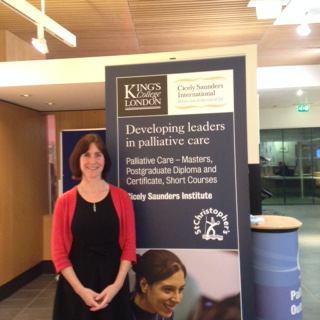
 On 25th November, Dr Fiona Kelly attended the Cecily Saunders Institute at King’s College London as an invited guest speaker to present research on determining what aspects of the design of care environments might be important for people with dementia nearing the end of life. The key messages of her presentation were the importance of firstly assuming the ability of people with dementia to engage with the senses, whether through touch, sound, smell, sight or taste and then to provide the means of engaging with whatever sense was appropriate or possible. The presentation was followed by a panel discussion with the audience in which the practical application of design principles within hospital settings was debated. The consensus was that even small changes can make a big difference. Following the presentation and discussion, the panel made a commitment to include consideration of dementia design principles in staff education within the Institute.
Fleming, R., Kelly, F. and Stillfried, G. (2015) ‘I want to feel at home’: establishing what aspects of environmental design are important to people with dementia nearing the end of life, BMC Palliative Care. http://www.biomedcentral.com/1472-684X/14/26







 SONAMONI contributions to Safety Conference 2026 in South Africa
 Three CMWH presentations at Berlin conference
 New interdisciplinary paper on Nepal
 Horizon Europe Cluster 3 (Civil Security for Society) 2026 Calls Now Open
 MSCA Doctoral Networks 2026 Call Information Webinar
 ESRC Festival of Social Science 2026: Application Deadline Extended to Thursday 25 June 2026
 Reminder: Register for the ESRC Festival of Social Science 2026 Information Session
 ECR Funding Open Call: Research Culture & Community Grant – Apply now
 ERC Advanced Grant 2025 Webinar
 Update on UKRO services
 European research project exploring use of ‘virtual twins’ to better manage metabolic associated fatty liver disease