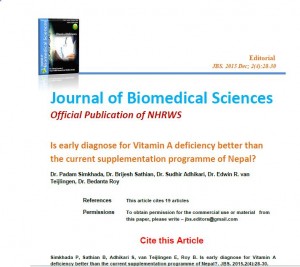
 This week we published an editorial in the Journal of Biomedical Sciences on the question: “Is early diagnose for Vitamin A deficiency better than the current supplementation programme of Nepal?”
The editorial concludes that prevention is still better than cure, but instead of a mass Vitamin A supplementation in Nepal, we need a health promotion intervention aiming to increase the intake of relatively cheap vegetables and fruit (containing β carotene). In addition we need better surveillance and help to identify children with Vitamin A Deficiency and provide them with Vitamin A supplements. The primary focus should be on adopting sustainable food based approaches to combat vitamin A deficiency. In Public Health terms: rather than a blanket coverage of Vitamin A supplementation to whole population we should consider a targeted intervention aimed at those who need it most.
Reference:
Simkhada P, Sathian B, Adhikari S, van Teijlingen E, Roy B. (2015) Is early diagnose for Vitamin A deficiency better than the current supplementation programme of Nepal?. J Biomed Sci. 2(4):28-30.
http://www.nepjol.info/index.php/JBS/index
 New paper by BU’s Lecturer in International Health







 ESRC Festival of Social Science 2026: An Opportunity to Engage New Audiences
 New HIV paper by BU PhD student
 BU Annual Research Conference: Poster Exhibition Call for Applications
 Vitae Three Minute Thesis (3MT®) Competition: Applications Now Open
 3C Online Social: Thursday 26 March 1–2pm – Research Culture, Community & Can you Guess Who?
 ECR Funding Open Call: Research Culture & Community Grant – Apply now
 ECR Funding Open Call: Research Culture & Community Grant – Application Deadline Friday 12 December
 MSCA Postdoctoral Fellowships 2025 Call
 ERC Advanced Grant 2025 Webinar
 Update on UKRO services
 European research project exploring use of ‘virtual twins’ to better manage metabolic associated fatty liver disease