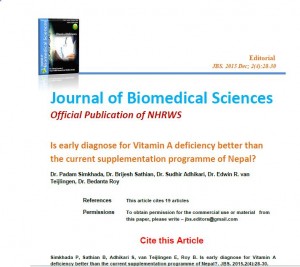
 This week we published an editorial in the Journal of Biomedical Sciences on the question: “Is early diagnose for Vitamin A deficiency better than the current supplementation programme of Nepal?”
The editorial concludes that prevention is still better than cure, but instead of a mass Vitamin A supplementation in Nepal, we need a health promotion intervention aiming to increase the intake of relatively cheap vegetables and fruit (containing β carotene). In addition we need better surveillance and help to identify children with Vitamin A Deficiency and provide them with Vitamin A supplements. The primary focus should be on adopting sustainable food based approaches to combat vitamin A deficiency. In Public Health terms: rather than a blanket coverage of Vitamin A supplementation to whole population we should consider a targeted intervention aimed at those who need it most.
Reference:
Simkhada P, Sathian B, Adhikari S, van Teijlingen E, Roy B. (2015) Is early diagnose for Vitamin A deficiency better than the current supplementation programme of Nepal?. J Biomed Sci. 2(4):28-30.
http://www.nepjol.info/index.php/JBS/index
 New paper by BU’s Lecturer in International Health







 ESRC Studentships for 2027 Entry: Opportunity Now Open
 SONAMONI contributions to Safety Conference 2026 in South Africa
 Three CMWH presentations at Berlin conference
 New interdisciplinary paper on Nepal
 Horizon Europe Cluster 3 (Civil Security for Society) 2026 Calls Now Open
 MSCA Doctoral Networks 2026 Call Information Webinar
 ESRC Festival of Social Science 2026: Application Deadline Extended to Thursday 25 June 2026
 Reminder: Register for the ESRC Festival of Social Science 2026 Information Session
 ECR Funding Open Call: Research Culture & Community Grant – Apply now
 ERC Advanced Grant 2025 Webinar
 Update on UKRO services
 European research project exploring use of ‘virtual twins’ to better manage metabolic associated fatty liver disease