BU academic Dan Franklin and PhD student David Hartnell presented research in Wuhan, China during the 10th ICTC last week. Attracting about 350 delegates, and sponsored by the Chinese Academy of Sciences, the conference was concerned with the growing problem of toxic cyanobacteria in freshwater resources and the ways in which ecological and health consequences can be reduced. Toxic cyanobacteria are a particular problem in China, where they have contaminated public drinking water supplies creating a serious public health issue. Dan and Dave gave 4 presentations at the conference on work carried out with BU colleagues Ian Chapman, Su Chern Foo, Eddie McCarthy and Prof. Genoveva Esteban. Dr. Andy Turner from the government biotoxin labs at CEFAS, Weymouth, an important collaborator on the BU work, also presented at the conference. The conference was a great success and enabled meetings with important researchers in the field from around the world. Dan and Dave would like to thank BU for funding some of the expenses of the trip.
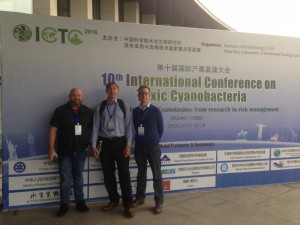
Dave Hartnell, Dan Franklin and Andy Turner at conference venue
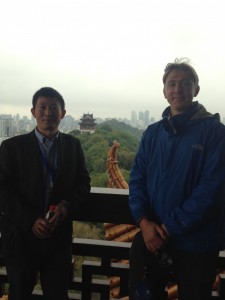
Dan Franklin with colleague Dr Zhou Yang at Yellow Crane Tower
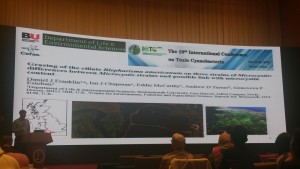
Giving presentation at ICTC 10
 1st International Military Law Conference in South Africa – BU Research receives global attention
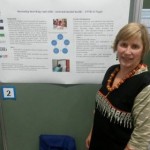 BU THET Nepal project presented at RCM conference







 National Postdoc Appreciation Week 2026: The Changing Landscape of Postdoc Careers
 NIHR Insight South West Central Conference 2026 at Bournemouth University
 BU PhD student presented at World Safety Conference in South Africa
 National Research Supervision Recognition: Apply Now & Join the Supporting Workshop on 16 September
 Horizon Europe Cluster 3 (Civil Security for Society) 2026 Calls Now Open
 MSCA Doctoral Networks 2026 Call Information Webinar
 ESRC Festival of Social Science 2026: Application Deadline Extended to Thursday 25 June 2026
 Reminder: Register for the ESRC Festival of Social Science 2026 Information Session
 ECR Funding Open Call: Research Culture & Community Grant – Apply now
 ERC Advanced Grant 2025 Webinar
 Update on UKRO services
 European research project exploring use of ‘virtual twins’ to better manage metabolic associated fatty liver disease