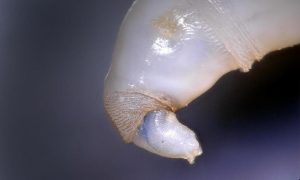
“A key aspect of forensic investigation is the assessment of the ‘window of opportunity’ during which death took place. Estimations using insects (e.g. blowflies) increase accuracy. Using blowflies to determine post-mortem period requires an understanding of the temperature dependent growth patterns that they develop through their life cycle. In order to understand this, blowfly larvae are reared on growth media in the laboratory.
Sherlock’s Window is a HEIF-funded project at BU which aims to produce an odourless growth medium that can be rolled out internationally for use in forensic investigation. Illustrated here is the head of a third instar blowfly larva. Maggots have no eyes, but the protrusions at the tip of the mouth area are palps, used for feeling and manipulating food particles. The rows of black barbs that are visible are used to pull the maggot forward through the food substrate.”
This was the abstract submitted to accompany Dr Andrew Whittington’s recent submission to the Research Photography Competition.
Find out more about the project in the latest edition of the Bournemouth Research Chronicle featured in the section: “Innovation in industry:how researchers and the wider community are working together.”
Follow HEIF on Instagram to find out more about the innovation projects taking place at BU: https://www.instagram.com/heif_at_bu/
 Photo of the Week: Sherlock’s Window- In search of an odourless growth medium
 Tracks in the sand: tracking criminals







 Poverty in the UK: book launch today at BU
 BU contributions to successful Global Health conference
 New paramedic science paper by BU’s Dr. Ursula Rolfe
 Congratulation on newly published systematic review
 Horizon Europe Cluster 3 (Civil Security for Society) 2026 Calls Now Open
 MSCA Doctoral Networks 2026 Call Information Webinar
 ESRC Festival of Social Science 2026: Application Deadline Extended to Thursday 25 June 2026
 Reminder: Register for the ESRC Festival of Social Science 2026 Information Session
 ECR Funding Open Call: Research Culture & Community Grant – Apply now
 ERC Advanced Grant 2025 Webinar
 Update on UKRO services
 European research project exploring use of ‘virtual twins’ to better manage metabolic associated fatty liver disease