Congratulations to Yagya Adhikari, PhD student in the Faculty of Health & Social Sciences, who had his protocol for a systematic review published on PROSPERO last week with the title ‘Parental migration and its impact on the health and well-being of left behind adolescents in selected countries of Asia: a systematic review’. [1] 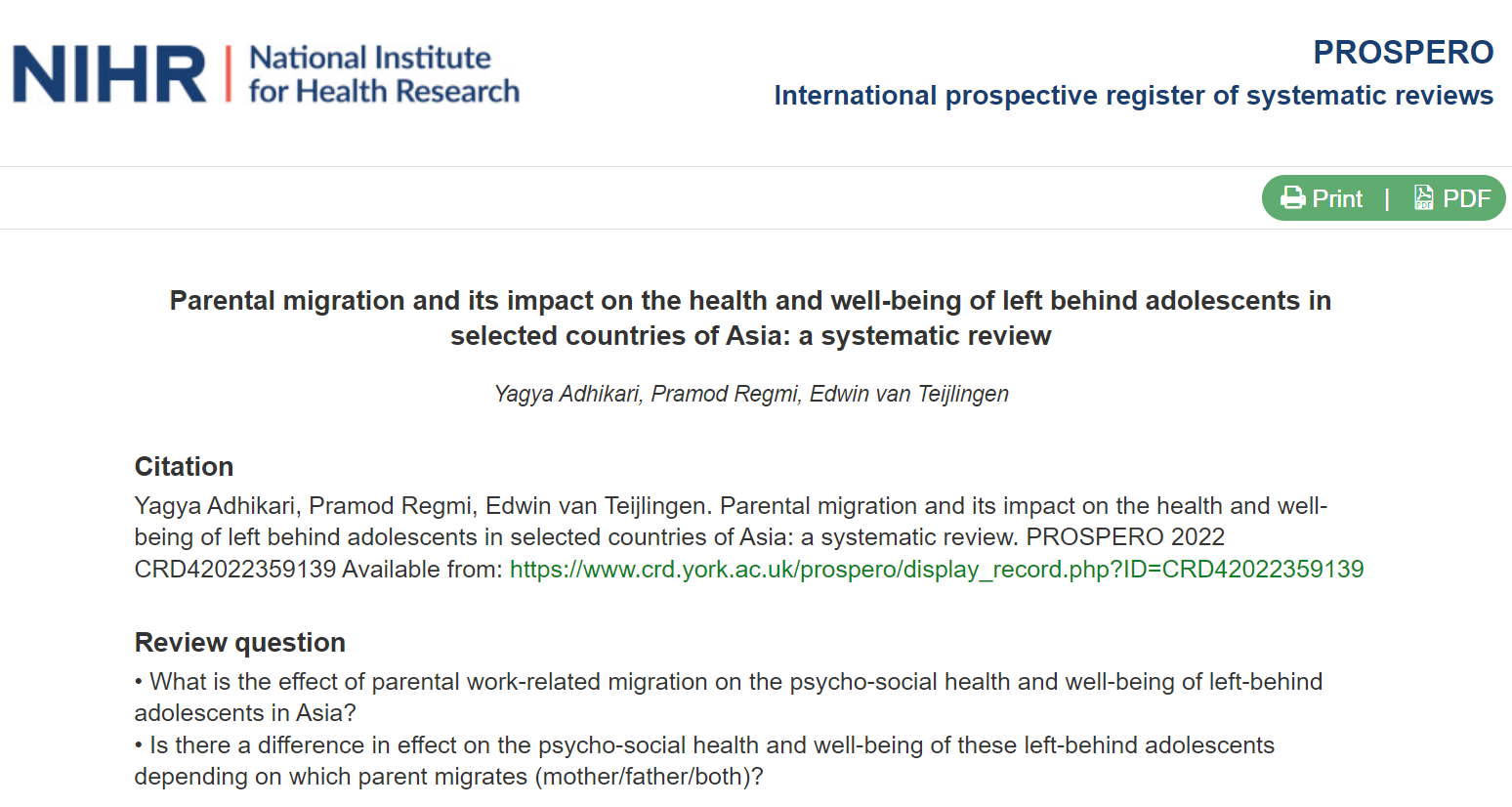
He also found out this week that his editorial, also based on his PhD research, entitled ‘Forgotten health and social care needs of left-behind families of Nepali migrant workers’ has been accepted by the Journal of Health Promotion. [2] This the official publication of the Health Education Association of Nepal (HEAN). Yagya’s PhdD is supervised by Dr. Pramod Regmi and Prof. Edwin van Teijlingen.
References
- Adhikari, Y., Regmi, P., van Teijlingen, E. (2022) Parental migration and its impact on the health and well-being of left behind adolescents in selected countries of Asia: a systematic review. PROSPERO CRD42022359139 Available from: https://www.crd.york.ac.uk/prospero/display_record.php?ID=CRD42022359139
- Adhikari, Y., Regmi, P., van Teijlingen, E. (2022) Forgotten health and social care needs of left-behind families of Nepali migrant workers, Journal of Health Promotion (forthcoming).
 Congratulations to PhD student Raksha Thapa
 Congratulations again to PhD student Sulochana Dhakal-Rai
 National media coverage in Nepal







 SONAMONI contributions to Safety Conference 2026 in South Africa
 Three CMWH presentations at Berlin conference
 New interdisciplinary paper on Nepal
 Horizon Europe Cluster 3 (Civil Security for Society) 2026 Calls Now Open
 MSCA Doctoral Networks 2026 Call Information Webinar
 ESRC Festival of Social Science 2026: Application Deadline Extended to Thursday 25 June 2026
 Reminder: Register for the ESRC Festival of Social Science 2026 Information Session
 ECR Funding Open Call: Research Culture & Community Grant – Apply now
 ERC Advanced Grant 2025 Webinar
 Update on UKRO services
 European research project exploring use of ‘virtual twins’ to better manage metabolic associated fatty liver disease