Congratulations to Yagya Adhikari, PhD student in the Faculty of Health & Social Sciences, who had his protocol for a systematic review published on PROSPERO last week with the title ‘Parental migration and its impact on the health and well-being of left behind adolescents in selected countries of Asia: a systematic review’. [1] 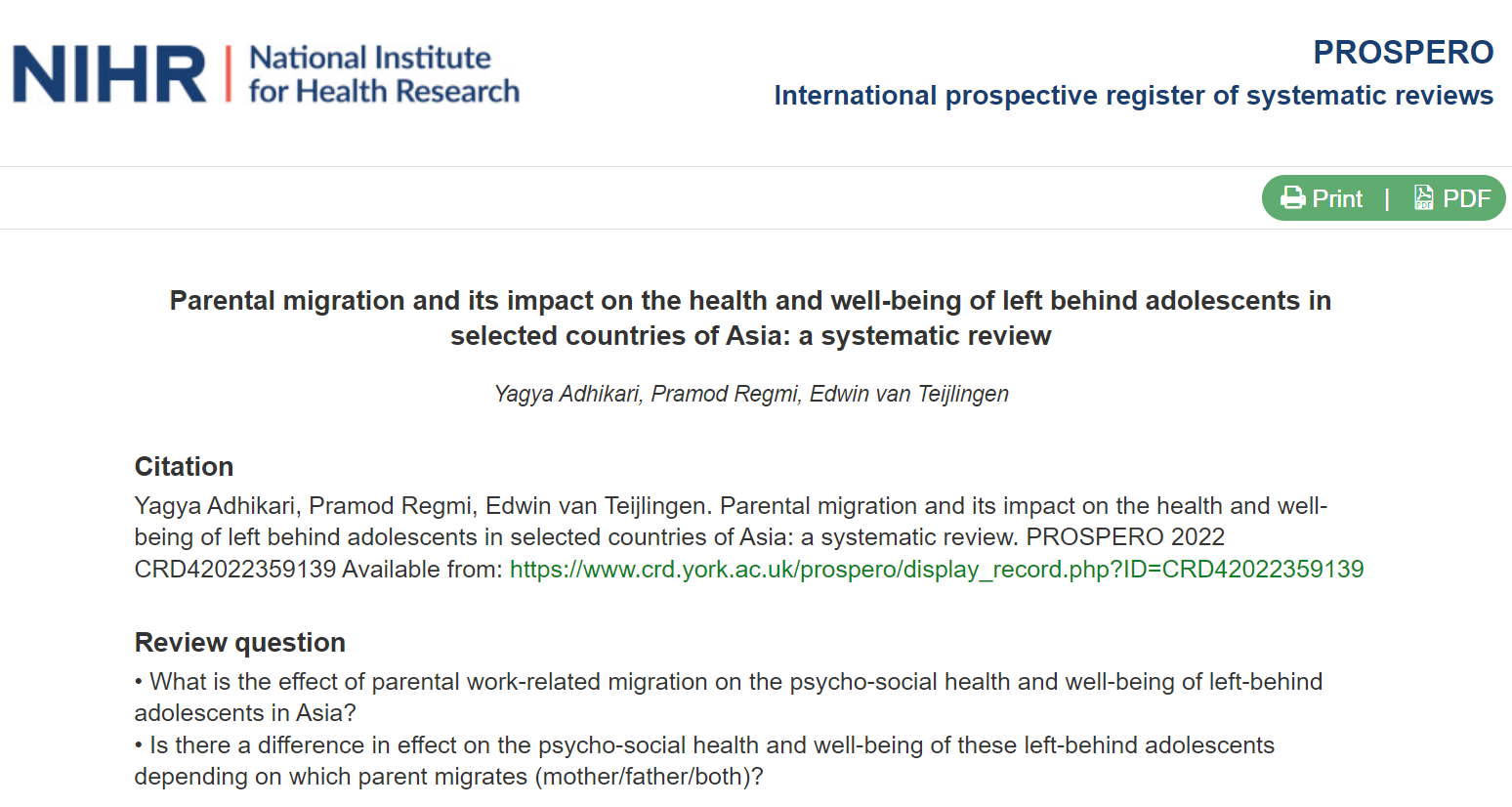
He also found out this week that his editorial, also based on his PhD research, entitled ‘Forgotten health and social care needs of left-behind families of Nepali migrant workers’ has been accepted by the Journal of Health Promotion. [2] This the official publication of the Health Education Association of Nepal (HEAN). Yagya’s PhdD is supervised by Dr. Pramod Regmi and Prof. Edwin van Teijlingen.
References
- Adhikari, Y., Regmi, P., van Teijlingen, E. (2022) Parental migration and its impact on the health and well-being of left behind adolescents in selected countries of Asia: a systematic review. PROSPERO CRD42022359139 Available from: https://www.crd.york.ac.uk/prospero/display_record.php?ID=CRD42022359139
- Adhikari, Y., Regmi, P., van Teijlingen, E. (2022) Forgotten health and social care needs of left-behind families of Nepali migrant workers, Journal of Health Promotion (forthcoming).







 SONAMONI contributions to Safety Conference 2026 in South Africa
 Three CMWH presentations at Berlin conference
 New interdisciplinary paper on Nepal
 Horizon Europe Cluster 3 (Civil Security for Society) 2026 Calls Now Open
 MSCA Doctoral Networks 2026 Call Information Webinar
 ESRC Festival of Social Science 2026: Application Deadline Extended to Thursday 25 June 2026
 Reminder: Register for the ESRC Festival of Social Science 2026 Information Session
 ECR Funding Open Call: Research Culture & Community Grant – Apply now
 ERC Advanced Grant 2025 Webinar
 Update on UKRO services
 European research project exploring use of ‘virtual twins’ to better manage metabolic associated fatty liver disease