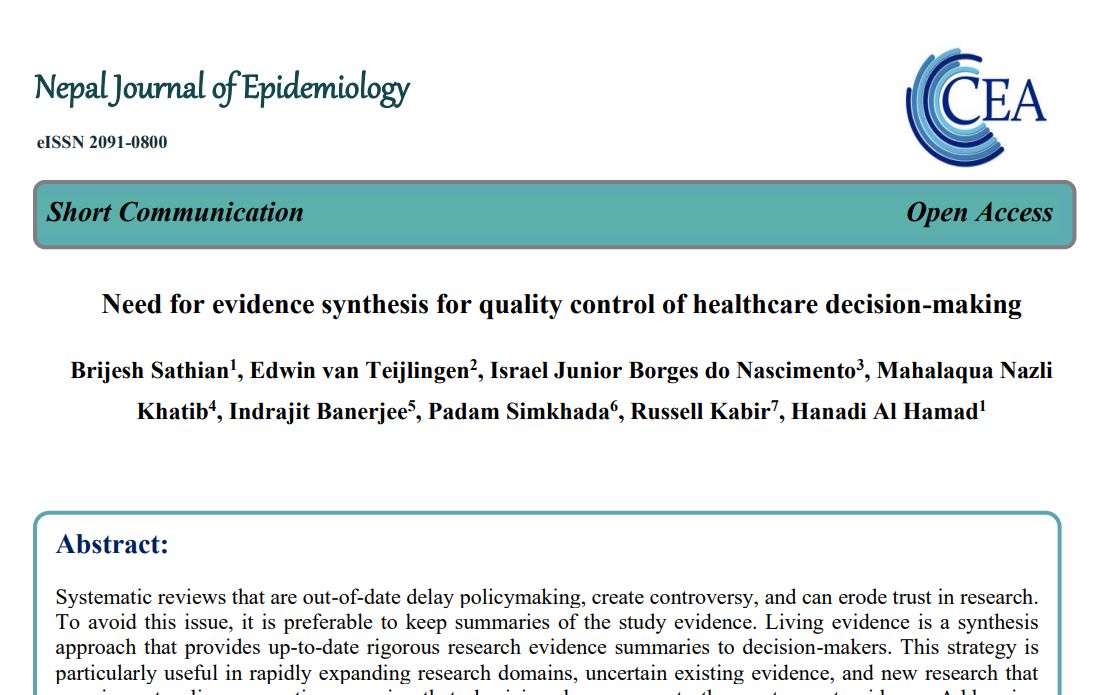
 The Nepal Journal of Epidemiology published today carries an article on so-called ‘living evidence’ as an on-going synthesis approach that provides up-to-date rigorous research evidence [1]. This short research methods paper argues that living evidence is particularly useful in rapidly expanding research domains, uncertain existing evidence, and incorporating new research evidence that may impact policy or practice, ensuring that health worker, managers and health-policy makers have access to the best, i.e. the most recent evidence.
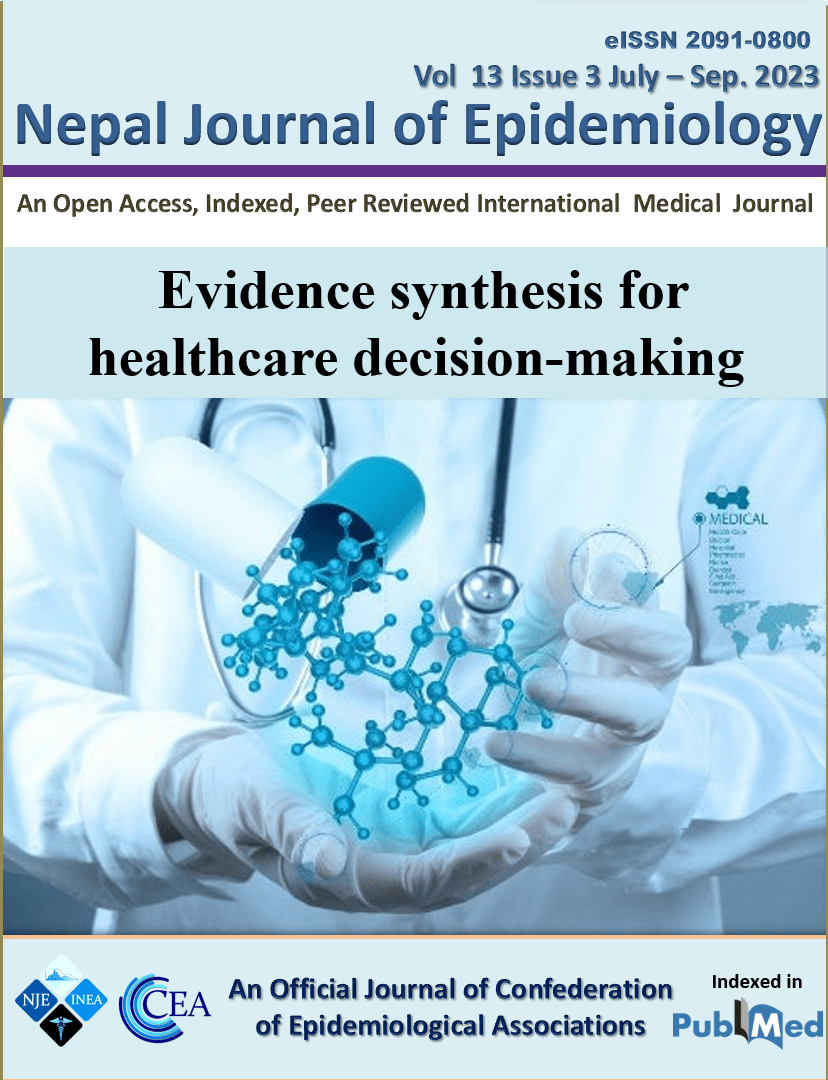 The Nepal Journal of Epidemiology is an Open Access journal, and hence freely available to researchers across the globe. The paper has been co-authored by researchers from the Denmark, Qatar, Mauritius and the UK.
Prof. Edwin van Teijlingen
Centre for Midwifery & Women’s Health (CMWH)
Reference:
- Sathian B., van Teijlingen E., do Nascimento I.J.B., Khatib M.N., Banerjee I., Simkhada P., Kabir R., Al Hamad H. (2023) Need for evidence synthesis for quality control of healthcare decision-making. Nepal Journal of Epidemiology 13(3):1288-1291. DOI: 10.3126/nje.v13i3.61004
 Establishing an evidence-based centre in Nepal
 New paper on academic-industry research partnerships
 New Nepal paper published
 Congratulations to Prof. Bouchachia on latest paper







 ECR Opportunities: New Development Programme, Research Grants & Upcoming Events
 Help us capture BU’s knowledge exchange activity HE-BCI survey 2025–26
 Verbal autopsy paper published two days ago
 ESRC Studentships for 2027 Entry: Opportunity Now Open
 SONAMONI contributions to Safety Conference 2026 in South Africa
 Horizon Europe Cluster 3 (Civil Security for Society) 2026 Calls Now Open
 MSCA Doctoral Networks 2026 Call Information Webinar
 ESRC Festival of Social Science 2026: Application Deadline Extended to Thursday 25 June 2026
 Reminder: Register for the ESRC Festival of Social Science 2026 Information Session
 ECR Funding Open Call: Research Culture & Community Grant – Apply now
 ERC Advanced Grant 2025 Webinar
 Update on UKRO services
 European research project exploring use of ‘virtual twins’ to better manage metabolic associated fatty liver disease