Congratulations to Iain Darby, Senior Lecturer in Paramedic Science, on the first publication today from his Ph.D. research. Iain produced an interesting scoping review on graduate paramedics transitionun into autonomous practice. This review is published in the International Journal of Paramedicine.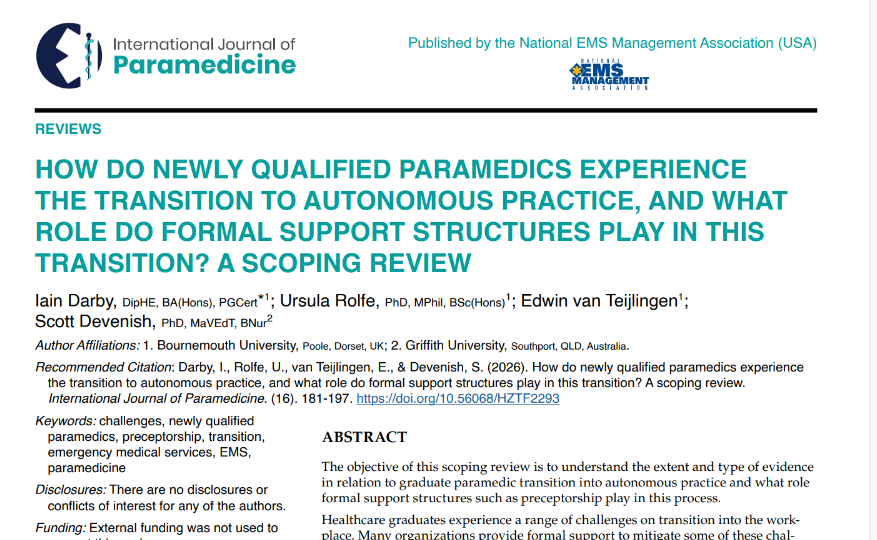
This review has explored the transition experiences of graduate paramedics and identified that professional socialization, identity formation, workplace relationships, emotional wellbeing, and the theory–practice gap all influence this period of development. The findings suggest that structured support, for example, through profession-specific preceptorship, has the potential to mitigate some of the challenges experienced during the transition to autonomous practice. While graduates have an important role in their own professional development, organizations also have a responsibility to establish appropriate support structures that facilitate confidence, competence, and wellbeing. The review concluded that gormal support structures such as preceptorship can help graduates overcome challenges faced in their transition into autonomous practice.
Iain is supervised at BU by Dr. Ursula Rolfe, Associate Professor of Paramedic Science and Faculty of Health, Environment & Medical Sciences’ Practice Simulation Lead, as well as Prof. Edwin van Teijlingen from the Centre for Midwifery & Women’s Health (CMWH), and in Australia by Prof. Scot Devenish, Professor of Paramedicine at Griffith University, Australia.
Well done!
Reference:
Darby, I., Rolfe, U., van Teijlingen, E., & Devenish, S. (2026) How do newly qualified paramedics experience the transition to autonomous practice, and what role do formal support structures play in this transition? A scoping review. International Journal of Paramedicine. (16): 181-197. https://doi.org/10.56068/HZTF2293







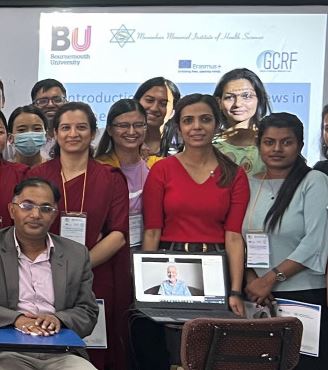







 International Open Access Week: open data
 Food Price Research Shortlisted for Civil Service Prize
 3C Event: Research Culture, Community & Connections – Wednesday 11 November 3-4pm
 Horizon Europe Cluster 3 (Civil Security for Society) 2026 Calls Now Open
 MSCA Doctoral Networks 2026 Call Information Webinar
 ESRC Festival of Social Science 2026: Application Deadline Extended to Thursday 25 June 2026
 Reminder: Register for the ESRC Festival of Social Science 2026 Information Session
 ECR Funding Open Call: Research Culture & Community Grant – Apply now
 ERC Advanced Grant 2025 Webinar
 Update on UKRO services
 European research project exploring use of ‘virtual twins’ to better manage metabolic associated fatty liver disease