BU’s team of Drosophila scientists were delighted to host a visit from Dr Tony Cammarato, Associate Professor at Johns Hopkins University School of Medicine. Tony (a visiting fellow at BU) met and gave a fantastic talk to colleagues and undergraduates, detailing work spanning three decades that has defined how heart muscle cells (cardiomyocytes) regulate force during contraction.
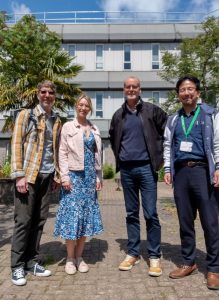
(L to R) Dr Tony Cammarato, Ms Jess Whalley, Dr Paul Hartley, Dr Yutaka Matsubayashi
By identifying the specific amino acids that control how muscle troponin proteins interact with the cell’s contractile myosin and actin ‘scaffold’ his research group is explaining how cardiomyopathies develop in humans. The work, which consistently features in the field’s leading journals, is highly significant not only for its rigour and ingenuity but also because it is laying the foundation for medical interventions that correct the cardiomyopathies.
It is well worth noting that this research relies heavily on genetically defined Fruit flies (Drosophila melanogaster), a very powerful and tractable tool with which to model the molecular mechanisms underpinning human cardiomyocyte function.
At BU we use Drosophila to model the effects of ageing, metabolism and environmental pollutants on heart and kidney function. It has become very clear that insect and human cardiovascular systems are affected in the same way by the same problems. So, by working with scientists such as Tony, we can develop experimental approaches that generate findings of relevance to many species, including humans.
 Molecular basis for a healthier heart…new work published by BU







 3C Event: Research Culture, Community & Connections – Wednesday 11 November 3-4pm
 ECR Opportunities: New Development Programme, Researcher Grants & Upcoming Events
 Help us capture BU’s knowledge exchange activity HE-BCI survey 2025–26
 Verbal autopsy paper published two days ago
 ESRC Studentships for 2027 Entry: Opportunity Now Open
 Horizon Europe Cluster 3 (Civil Security for Society) 2026 Calls Now Open
 MSCA Doctoral Networks 2026 Call Information Webinar
 ESRC Festival of Social Science 2026: Application Deadline Extended to Thursday 25 June 2026
 Reminder: Register for the ESRC Festival of Social Science 2026 Information Session
 ECR Funding Open Call: Research Culture & Community Grant – Apply now
 ERC Advanced Grant 2025 Webinar
 Update on UKRO services
 European research project exploring use of ‘virtual twins’ to better manage metabolic associated fatty liver disease