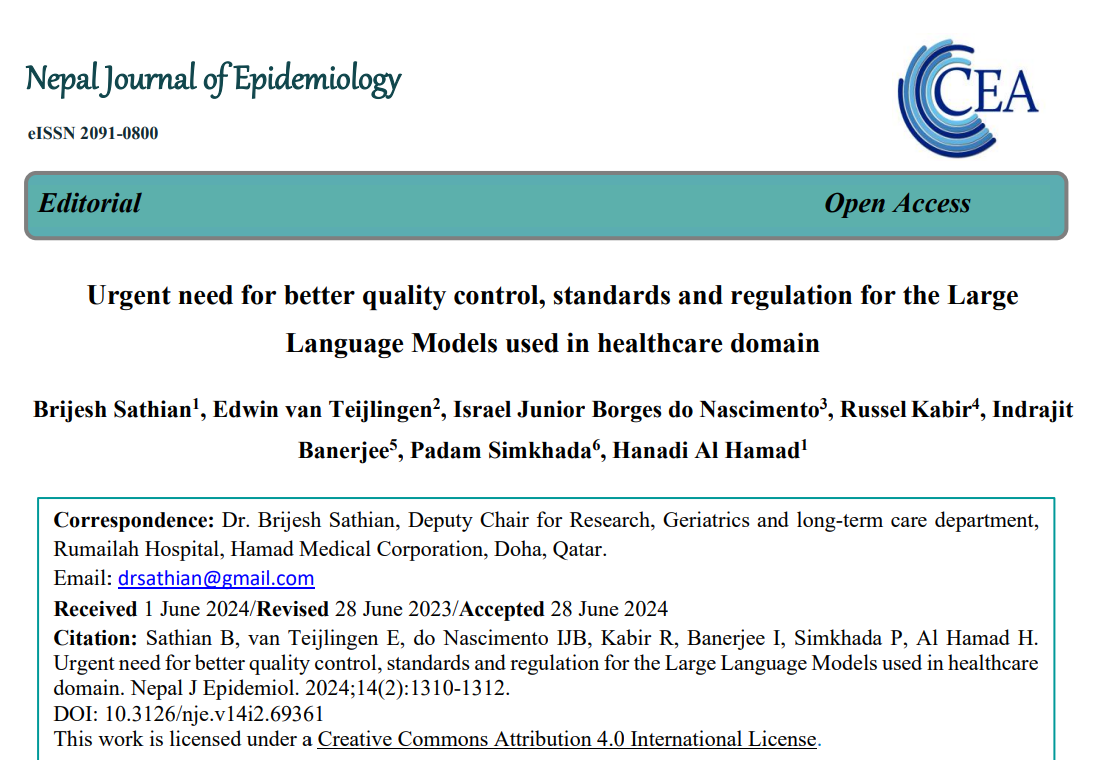
 A few days ago we published the editorial for the latest issues of the Nepal Journal of Epidemiology. This editorial under the title ‘Urgent need for better quality control, standards and regulation for the Large Language Models used in healthcare domain‘ [1] comments that current methodologies for ensuring AI (Artificial Intelligence) technology’s safety and efficacy may be adequate for earlier AI iterations predating generative artificial intelligence (GAI). However, better clinical gouvernance GAI may necessitate the development of novel regulatory frameworks. As AI technology advances, researchers, academic institutions, funding bodies, and publishers should continue to examine its impact on scientific inquiry and revise their understanding, ethical guidelines, and regulations accordingly.
The co-authors include two Bournemouth University Visiting Faculty, Prof. Padam Simkhada (based at the University of Huddersfield) and Dr. Brijesh Sathian (based at Rumailah Hospital, Qatar).
Prof. Edwin van Teijlingen
CMWH

Reference:
- Sathian, B., van Teijlingen, E., do Nascimento, I. J. B., Kabir, R., Banerjee, I., Simkhada, P., & Al Hamad, H. (2024). Urgent need for better quality control, standards and regulation for the Large Language Models used in healthcare domain. Nepal Journal of Epidemiology, 14(2), 1310–1312. https://doi.org/10.3126/nje.v14i2.69361
 Impact Factor for Nepal Journal of Epidemiology
 Congratulations to Prof. Bouchachia on latest paper
 Editorial accepted by Frontiers in Public Health







 International Open Access Week: open access and the REF
 Food Price Research Shortlisted for Civil Service Prize
 3C Event: Research Culture, Community & Connections – Wednesday 11 November 3-4pm
 ECR Opportunities: New Development Programme, Researcher Grants & Upcoming Events
 Horizon Europe Cluster 3 (Civil Security for Society) 2026 Calls Now Open
 MSCA Doctoral Networks 2026 Call Information Webinar
 ESRC Festival of Social Science 2026: Application Deadline Extended to Thursday 25 June 2026
 Reminder: Register for the ESRC Festival of Social Science 2026 Information Session
 ECR Funding Open Call: Research Culture & Community Grant – Apply now
 ERC Advanced Grant 2025 Webinar
 Update on UKRO services
 European research project exploring use of ‘virtual twins’ to better manage metabolic associated fatty liver disease