A few days ago Palgrave Macmillen published Risk and Uncertainty in Maternity Care: Putting Risk in Its Place. This edited book examines the way risk is defined and employed in maternity care across the world. The 25 chapters reflect in different ways on how the management of risk shapes the organization and experience of maternity services. Drawing from investigations of the way risk operates in contemporary society, the authors challenge taken-for-granted understandings of risk in maternity care and early parenting, showing how risk is not simply a value-free assessment of potential harms but is, in fact, a complex social and political way of seeing, knowing about, and performing pregnancy and birth. 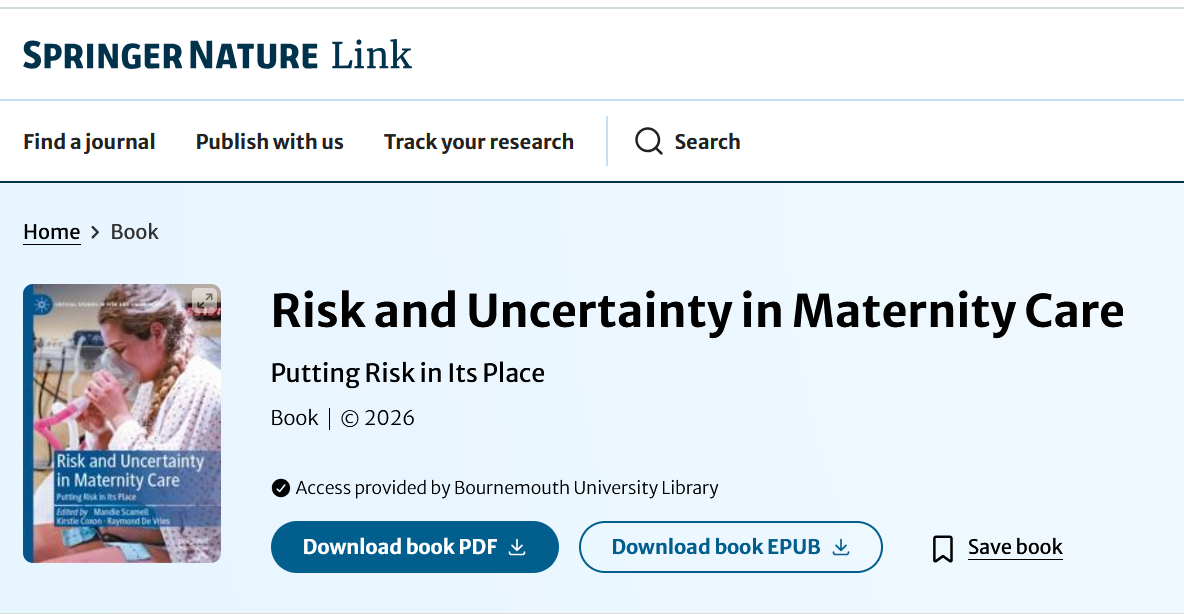
This edited volume contains two chapters which have co-authors associated with BU. Chapter 15 ‘Communicating Maternity Risks Using Social Media in England and Australia‘ is written by Sheena Byrom, Mandie Scamell, Hannah Dahlen, Joanne Rack. This chapter addresses childbirth in the digital age. Over the last two decades, social media—a group of internet-based applications that facilitate the development and sharing of information—revolutionised the way we connect and communicate. These new media are now an ever-present part of our daily lives. The authors explore how social media shapes the way risk is understood by all of those involved in pregnancy, labour, and birth.Sheena Byrom holds an honourary doctorate from Bournemouth University, and Joanne Rack is doing her for-year Clinical Doctorate in the Centre for Midwifery & Women’s Health (CMWH) specialising in personalised care for women of advanced maternal age. This PhD study is matched-funded by University Hospitals Dorset (UHD) NHS Foundation Trust and Bournemouth University.
Whilst chapter 16 From Uncertainty to Risk: How Mass Media in the UK and the US Generate Fear of Childbirth is co-authored by professors Hundley and van Teijlingen who are co-leads of the CMWH. This chapter addresses the growing intolerance for the uncertainties associated with childbirth. While research has yet to establish a cause-and-effect relationship between media representations of pregnancy and birth and societal views of the childbirth experience, analysis of mass media accounts of childbirth can help explain why those involved in childbirth—maternity service users and providers alike—increasingly define birth as a site of risk. Existing studies of the representation of birth in mass media allow us to examine how the complex interaction between media, culture, and birth amplifies perceptions of risk. The authors illustrate the ways mass media influence, not just attitudes towards birth, but the way birth is managed.
References:
- Byrom, S., Scamell, M., Dahlen, H., Rack, J. (2026) Communicating Maternity Risks Using Social Media in England and Australia [Chapter 15], In: Scamell, M., De Vries, R, Coxon, K. (eds) Critical Studies of Risk and Uncertainty in Maternity Care : Perspectives from Australia, Europe, and the United States, Palgrave Macmillan, pp. 309-326.
- van Teijlingen, E., Hundley, V., De Vries R. (2026) From uncertainty to risk: how mass media in the UK and the US generate fear of childbirth [Chapter 16], In: Scamell, M., De Vries, R, Coxon, K. (eds) Critical Studies of Risk and Uncertainty in Maternity Care : Perspectives from Australia, Europe, and the United States, Palgrave Macmillan, pp. 327-346.
 Beautiful Work Challenge: Podcast on Birth
 Top three most accessed 2016 paper BMC Pregnancy & Childbirth
 New BU cross-faculty publication







 BU methods paper reached 2,500 reads
 UKCGE Recognised Research Supervision Programme: Applications Close 19 October
 Dr. Orlanda Harvey interviewed as expert
 Dr. Paul Whittington attends Technology and the SEND Reforms Roundtable in the House of Commons
 Dr. Paul Whittington joins Bett 2026 DfE Assistive Technology Roundtable
 BU Prof Jonathan Parker promoting social work in Malaysia
 Horizon Europe Cluster 3 (Civil Security for Society) 2026 Calls Now Open
 MSCA Doctoral Networks 2026 Call Information Webinar
 ESRC Festival of Social Science 2026: Application Deadline Extended to Thursday 25 June 2026
 Reminder: Register for the ESRC Festival of Social Science 2026 Information Session
 ECR Funding Open Call: Research Culture & Community Grant – Apply now
 ERC Advanced Grant 2025 Webinar
 Update on UKRO services
 European research project exploring use of ‘virtual twins’ to better manage metabolic associated fatty liver disease