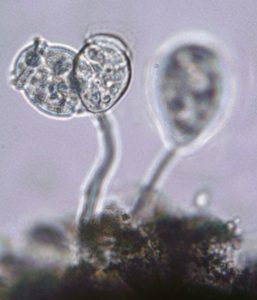
 Microscopic investigations of water samples from the half-barrel pond in Christchurch House courtyard have revealed a menagerie of single-celled life. These tiny organisms (smaller than one tenth of a millimetre) are incredibly important as they form the basis of food webs. They also play a major role in maintaining water quality as they feed on bacteria, and stalked species such as Vorticella (image) are responsible for their removal in waste-water treatment plants. The half-barrel “pond” may be almost as small as its inhabitants but it promises to become a treasure of local ‘hidden’ biodiversity!
For further information please contact Genoveva F. Esteban gesteban@bournemouth@ac.uk, Jack Dazley i7447079@bournemouth.ac.uk, or Damian Evans devans@bournemouth.ac.uk
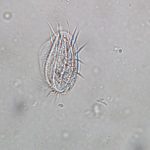 Biodome carnivorous plants reveal hidden microbial diversity
 Photo of the Week: Archaeology: Hidden Landscapes
 The secret information hidden in your hair







 REF 2029 Sector Survey: Have Your Say
 BU methods paper reached 2,500 reads
 UKCGE Recognised Research Supervision Programme: Applications Close 19 October
 Dr. Orlanda Harvey interviewed as expert
 Dr. Paul Whittington attends Technology and the SEND Reforms Roundtable in the House of Commons
 Dr. Paul Whittington joins Bett 2026 DfE Assistive Technology Roundtable
 Horizon Europe Cluster 3 (Civil Security for Society) 2026 Calls Now Open
 MSCA Doctoral Networks 2026 Call Information Webinar
 ESRC Festival of Social Science 2026: Application Deadline Extended to Thursday 25 June 2026
 Reminder: Register for the ESRC Festival of Social Science 2026 Information Session
 ECR Funding Open Call: Research Culture & Community Grant – Apply now
 ERC Advanced Grant 2025 Webinar
 Update on UKRO services
 European research project exploring use of ‘virtual twins’ to better manage metabolic associated fatty liver disease