Today, Nature Communications published a long-expected Matters Arising in response to a 2021 paper in the same journal: “A new hypothesis for the origin of Amazonian Dark Earths“. The new paper, involving more than 50 leading scholars involved in research on prehistoric Amazonia, affirms a human origin for the dark earths found throughout the central and eastern Amazon basin.
Amazonian Dark Earths (ADEs) are distinguished by their exceptional fertility and richness of archaeological remains. Evidently produced by various kinds of human activity, including but not limited to manuring, rubbish deposition, and biomass burning, they are a distinctive feature of later indigenous settlement of the Amazon river basin.
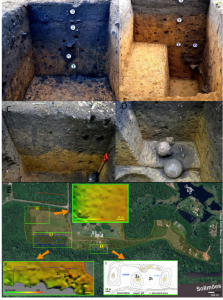
The paper synthesises diverse archaeological, palaeoenvironmental, and historic data to demonstrate the human origin of ADEs. Source: Lombardo et al. 2022
For more information see: Lombardo, U., Arroyo-Kalin, M., Schmidt, M. et al. Evidence confirms an anthropic origin of Amazonian Dark Earths. Nat Commun 13, 3444 (2022). https://doi.org/10.1038/s41467-022-31064-2
 IMSET Seminar: Exploring the chaîne opératoire of applied long-term human ecodynamics







 REF 2029 Sector Survey: Have Your Say
 BU methods paper reached 2,500 reads
 UKCGE Recognised Research Supervision Programme: Applications Close 19 October
 Dr. Orlanda Harvey interviewed as expert
 Dr. Paul Whittington attends Technology and the SEND Reforms Roundtable in the House of Commons
 Dr. Paul Whittington joins Bett 2026 DfE Assistive Technology Roundtable
 Horizon Europe Cluster 3 (Civil Security for Society) 2026 Calls Now Open
 MSCA Doctoral Networks 2026 Call Information Webinar
 ESRC Festival of Social Science 2026: Application Deadline Extended to Thursday 25 June 2026
 Reminder: Register for the ESRC Festival of Social Science 2026 Information Session
 ECR Funding Open Call: Research Culture & Community Grant – Apply now
 ERC Advanced Grant 2025 Webinar
 Update on UKRO services
 European research project exploring use of ‘virtual twins’ to better manage metabolic associated fatty liver disease