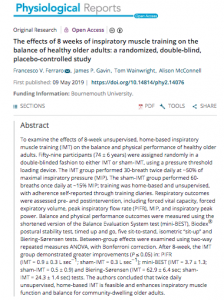
 The article titled “The effects of 8 weeks of inspiratory muscle training on the balance of healthy older adults: a randomized, double-blind, placebo-controlled study” has been published by Physiological Reports.
It is the first research to describe the effects of inspiratory muscle training (i.e. breathing exercises that improve the strength of inspiratory muscles) on static and dynamic balance (measured with the clinical tool mini-BEST) and functional mobility (such as Timed Up and Go and 5 sit to stand tasks) with community dwellers older adults (aged 65+).
The research is part of Francesco Ferraro PhD journey. Journey guided with the supervision of Professor Alison McConnell, Dr James Gavin and Tom Wainwright

The article is now fully available as open access here
https://doi.org/10.14814/phy2.14076
Abstract
To examine the effects of 8‐week unsupervised, home‐based inspiratory muscle training (IMT) on the balance and physical performance of healthy older adults. Fifty‐nine participants (74 ± 6 years) were assigned randomly in a double‐blinded fashion to either IMT or sham‐IMT, using a pressure threshold loading device. The IMT group performed 30‐breath twice daily at ~50% of maximal inspiratory pressure (MIP). The sham‐IMT group performed 60‐breaths once daily at ~15% MIP; training was home‐based and unsupervised, with adherence self‐reported through training diaries. Respiratory outcomes were assessed pre‐ and postintervention, including forced vital capacity, forced expiratory volume, peak inspiratory flow rate (PIFR), MIP, and inspiratory peak power. Balance and physical performance outcomes were measured using the shortened version of the Balance Evaluation System test (mini‐BEST), Biodex® postural stability test, timed up and go, five sit‐to‐stand, isometric “sit‐up” and Biering–Sørensen tests. Between‐group effects were examined using two‐way repeated measures ANOVA, with Bonferroni correction. After 8‐week, the IMT group demonstrated greater improvements (P ≤ 0.05) in: PIFR (IMT = 0.9 ± 0.3 L sec−1; sham‐IMT = 0.3 L sec−1); mini‐BEST (IMT = 3.7 ± 1.3; sham‐IMT = 0.5 ± 0.9) and Biering–Sørensen (IMT = 62.9 ± 6.4 sec; sham‐IMT = 24.3 ± 1.4 sec) tests. The authors concluded that twice daily unsupervised, home‐based IMT is feasible and enhances inspiratory muscle function and balance for community‐dwelling older adults.
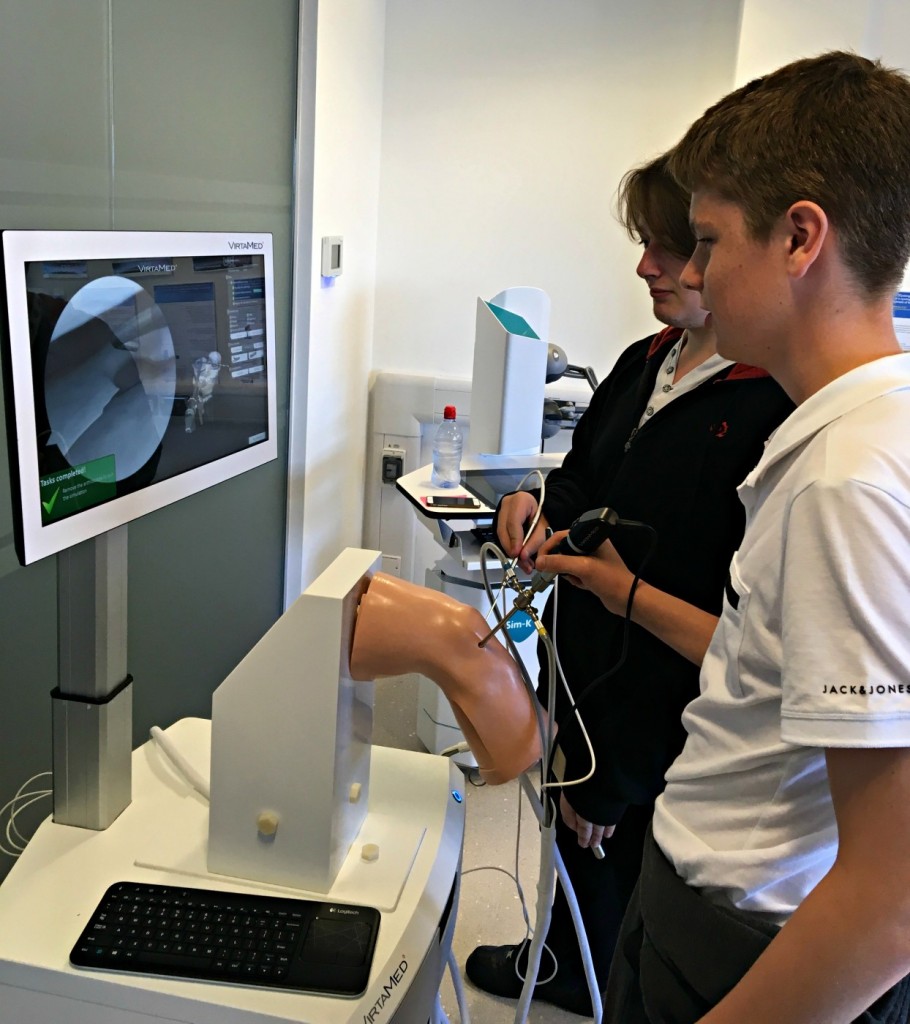 ary tests to be carried out for different aspects associated with balance, these include: anticipatory tests (when preparing for something to happen), reactive postural control (how you react to a change in motion), sensory orientation, and dynamic gait speeds (walking speeds and how they change in different circumstances). This was necessary in order to see how the effects of inspiratory muscle training effects balance over the course of 8 weeks.





 SONAMONI contributions to Safety Conference 2026 in South Africa
 Three CMWH presentations at Berlin conference
 New interdisciplinary paper on Nepal
 Horizon Europe Cluster 3 (Civil Security for Society) 2026 Calls Now Open
 MSCA Doctoral Networks 2026 Call Information Webinar
 ESRC Festival of Social Science 2026: Application Deadline Extended to Thursday 25 June 2026
 Reminder: Register for the ESRC Festival of Social Science 2026 Information Session
 ECR Funding Open Call: Research Culture & Community Grant – Apply now
 ERC Advanced Grant 2025 Webinar
 Update on UKRO services
 European research project exploring use of ‘virtual twins’ to better manage metabolic associated fatty liver disease