New Publication: de Souza, J., Mendes, LF., Buhalis, D., 2020, Evaluating the effectiveness of tourist promotions to improve the competitiveness of destinations, Tourism Economics, Vol. 26(6), pp, 1001–1020, https://doi.org/10.1177/1354816619846748
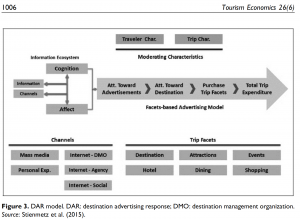
This study focuses on the evaluation of the tourist destination advertising effectiveness. The destination advertising response DAR model was used to analyze data on the effectiveness of destination promotional campaigns on visitor expenditure, in six trip facets: destination, accommodations, attractions, restaurants, events, and shopping. Independent sample t-tests were conducted to identify any differences in total destination spending among the groups of those visitors influenced for each trip facet. A multiple regression analysis was performed to discriminate the performance of the travel facets expenditures in the estimation of total expenditures. Significant results indicate that the “destination,” “accommodations,” and “restaurants” facets directly influence the total expenditures. Self-planners had the highest variance, explaining in total visitor expenditure compared to the regression analysis results of the other two groups (i.e. travel agencies and online travel agencies). The study also explores how destinations can improve their competitiveness on tourist advertising by using technologies.
Keywords tourism, destination, marketing, advertising, competitiveness, DAR model, destinations, technologies







 Dr. Paul Whittington attends Technology and the SEND Reforms Roundtable in the House of Commons
 Dr. Paul Whittington joins Bett 2026 DfE Assistive Technology Roundtable
 BU Prof Jonathan Parker promoting social work in Malaysia
 New interdisciplinary paper accepted for publication
 Three NIHR Internships awarded at BU
 Research highlighted at the UN in New York
 Horizon Europe Cluster 3 (Civil Security for Society) 2026 Calls Now Open
 MSCA Doctoral Networks 2026 Call Information Webinar
 ESRC Festival of Social Science 2026: Application Deadline Extended to Thursday 25 June 2026
 Reminder: Register for the ESRC Festival of Social Science 2026 Information Session
 ECR Funding Open Call: Research Culture & Community Grant – Apply now
 ERC Advanced Grant 2025 Webinar
 Update on UKRO services
 European research project exploring use of ‘virtual twins’ to better manage metabolic associated fatty liver disease