Tagged / gender-based violence
New paper on female migrant workers from Nepal
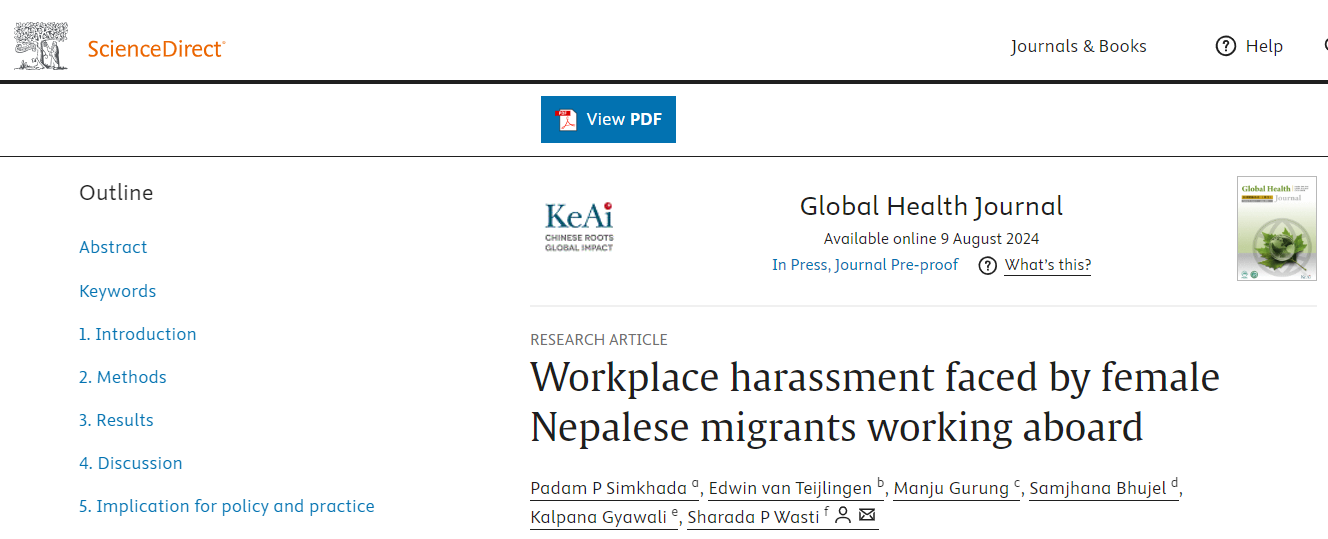
This week the Global Health Journal accepted the latest article on female migrant workers from Nepal [1]. The paper is co-authored by Prof. Edwin van Teijlingen in the Centre for Midwifery & Women’s Health as well as by Faculty of Health & Social Sciences Visiting Faculty Prof. Padam, and other Nepalese co-authors are based in the UK and Nepal. Ms. Manju Gurung is co-founder & strategic advisor of POURAKHI Nepal, an Nepal-based organisation supporting ,migrant workers. Dr. Sharada P.Wasti, is based at the University of Greenwich, and he has collaborated with Bournemouth University academics on several previous academic papers on health, work-related migration and human trafficking [2-4].
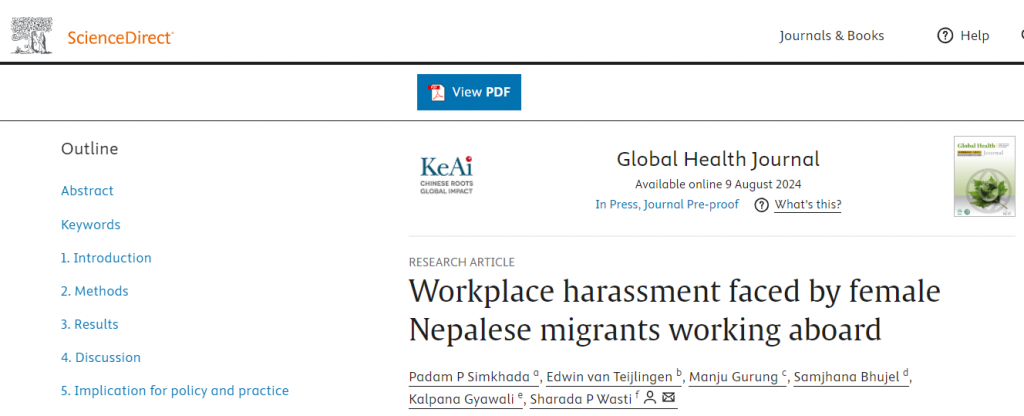
The paper highlights the plight of women working abroad and the problems they encounter destination countries. This study reported in this paper was conducted among 1,889 women who were registered as migrant returnees at an organisation called POURAKHI Nepal. The study extracted and analysed data from this non-governmental organisation that
supports returning female migrant workers in Nepal.
Around half (43.1 %) of the women in the study were 35 or older, 30.9 % were illiterate, and 63.6 % were in their first overseas job. Over one-third (38.5 %) had experienced self-reported workplace harassment. Gender-based violence was a serious problem as physical violence was highly prevalent (68 %), followed by verbal abuse (37.5 %), mental stress (29.7 %), and sexual abuse (14.1 %).
Women who worked abroad with the following characteristics were at the greatest risk: those who were illiterate (adjusted odds ratio [AOR]1.25, 95 % confidence interval [CI]: 1.01 to 1.55), unmarried (AOR 1.27, 95 % CI: 1.05 to 1.56), worked abroad twice or more years (AOR 1.35, 95 % CI: 1.10 to 1.66), changed their place of work (AOR 2.38, 95 % CI: 1.42 to 4.01), lived without documents (AOR 1.24, 95 % CI: 1.03 to 1.50), worked as domestics (AOR 3.56, 95 % CI: 2.03 to 6.23), worked in other than Gulf Cooperation Council (GCC) countries (AOR 1.45, 95 % CI: 1.06 to 1.99), women who did not have a fixed salary (AOR 1.64, 95 % CI: 1.28 to 2.10) and did not receive salary (AOR 3.71, 95 % CI: 2.88 to 4.77) were more likely to be harassed at work.
The authors recommend that the host governments should introduce and enforce policies protecting women in the workplace. Moreover, migrant women should be provided with better information about health risks and hazards as well as how to improve preventive measures in destination countries to reduce workplace harassment.
Centre for Midwifery & Women’s Health
References:
- Simkhada, P.P., van Teijlingen, E., Gurung, M., Bhujel, S., Wasti, S.P. (2024) Workplace harassment faced by female Nepalese migrants working aboard, Global Health Journal 8(3): 128-132. https://www.sciencedirect.com/science/article/pii/S241464472400040X
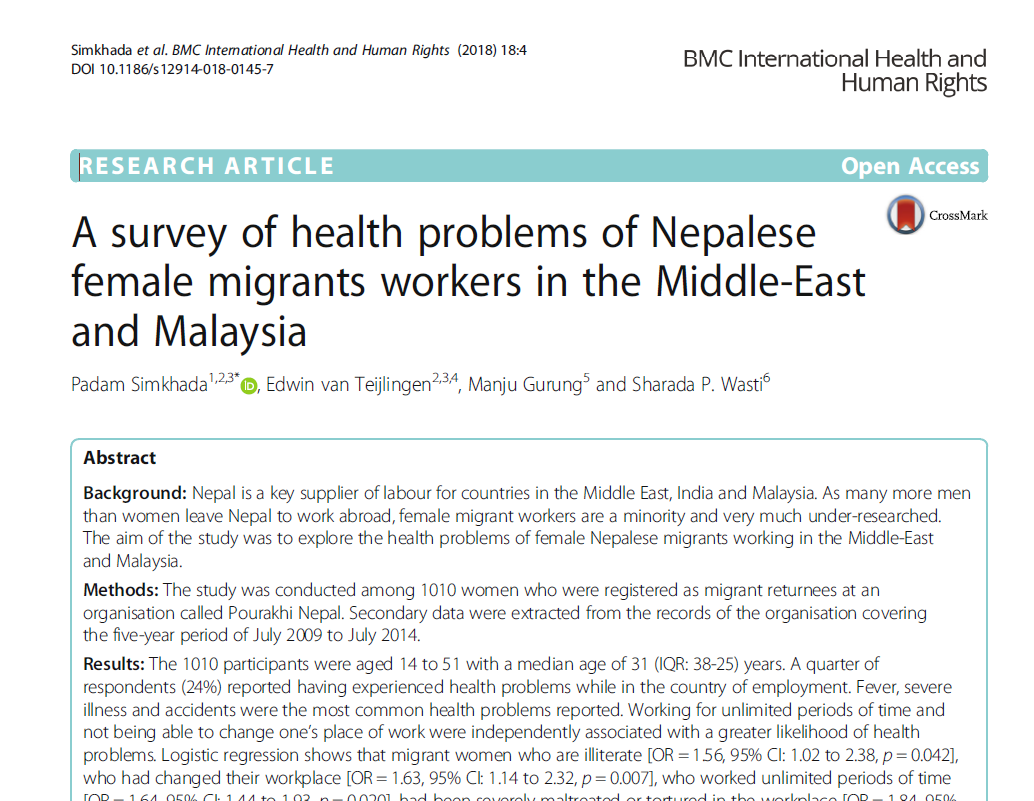
- Simkhada, P.P., van Teijlingen, E.R., Gurung, M., Wasti, S. (2018) A survey of health problems of Nepalese female migrants workers in the Middle-East & Malaysia, BMC International Health & Human Rights 18(4): 1-7. http://rdcu.be/E3Ro.
- Simkhada, P., van Teijlingen, E., Sharma, A., Bissell, P., Poobalan, A., Wasti, S.P. (2018) Health consequences of sex trafficking: A systematic review, Journal of Manmohan Memorial Institute of Health Sciences, 4(1): 130-49.
- Regmi, P., Dhakal Adhikari, S., Aryal, N., Wasti, S.P., van Teijlingen, E. (2022) Fear, Stigma and Othering: The Impact of COVID-19 Rumours on Returnee Migrants and Muslim Populations of Nepal, International Journal of Environmental Research & Public Health 19(15), 8986; https://doi.org/10.3390/ijerph19158986
BU Social Work in the news!
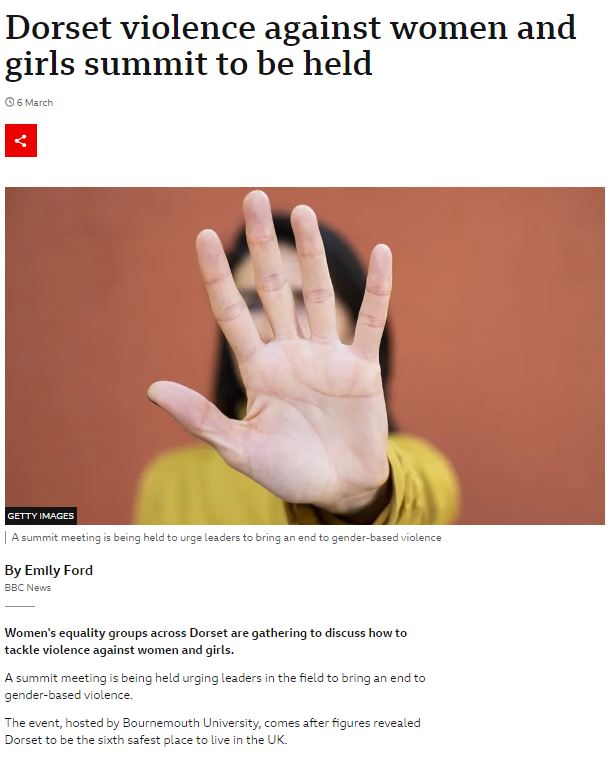
Earlier this month the BBC website reported on a summit hosted by Bournemouth University which brought leaders in the field to bring an end to gender-based violence. The BBC report was under the heading ‘Dorset violence against women and girls summit to be held‘. This success event was organised by BU lecturers Drs. Orlanda Harvey and Louise Oliver, who were subsequently interviewed by BBC Dorset and BBC Radio Solent. You can listen to the interviews on https://www.bbc.co.uk/sounds/play/p0hct37f?partner=uk.co.bbc&origin=share-mobile (about eight minutes into the programme) and https://www.bbc.co.uk/sounds/play/p0hct465?partner=uk.co.bbc&origin=share-mobile (just over eight-and-a-half minutes into the programme).
Prof. Edwin van Teijlingen
Centre for Midwifery & Women’s Health (CMWH)
Discussion on Gender-based Violence in Tourism – Links to Zoom presentations
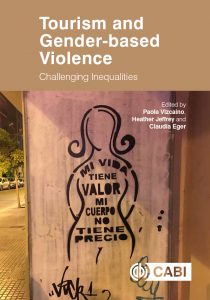
A month ago, Dr Paola Vizcaino (Bournemouth University), along with co-editors Dr Heather Jeffrey (Middlesex University – Dubai) and Dr Claudia Eger (Copenhagen Business School) welcomed attendees to the virtual launch of the edited collection Tourism and Gender-Based Violence: Challenging Inequalities (CABI – find the book here). Nearly 30 academics, students and general public joined the discussion on the multiple and interconnected forms of gender-based violence against women and girls in tourism production and consumption. Please find below the links to the Zoom presentations by the book editors, chapter contributors and grassroots organisations.

Tourism and Gender-based Violence, Challenging Inequalities. Edited by Paola Vizcaino, Heather Jeffrey, Claudia Eger
Tourism and Gender-Based Violence Book Launch 30th Sept. 2020, Introduction by Dr Paola Vizcaino – https://youtu.be/P_eRv-adlpI
The relevance of the book and the need to continue examining GBV in tourism research by Dr Stroma Cole – https://youtu.be/8ZCV0h0ev6s
Chapter discussion: Critical debates on Gender-based Violence by Dr Claudia Eger – https://youtu.be/8ewG4Y_YyQE
Chapter discussion: Trafficking in human beings in the tourism industry by Dr Tenia Kyriazi – https://youtu.be/e4zNSHoidWo
Chapter discussion: The double-bind of a female traveller in Morocco by Dr Siân Stephens – https://youtu.be/Brf4XkBQB1k
Chapter discussion: Embodying Gender and Risk: Mountain Bike Tourism in Mexico by Dr Isis Arlene Díaz-Carrión – https://youtu.be/7o20Wsl5Cv4
Profiles of grassroots organisations working to tackle GBV in tourism and beyond by Sara Ali Abdelghani – https://youtu.be/r_U9eOD5OvM
Las Kellys representing hotel workers in Spain, presentation by Myriam Barros (in Spanish with English translation) – https://youtu.be/MBBDSPT879Q
Tourism and Gender-Based Violence – Q&A segment – https://youtu.be/BJc4ATDBO7Y
Closing remarks by Dr Heather Jeffrey – https://youtu.be/VBo2Gyrsb3s
New book on tourism and gender-based violence

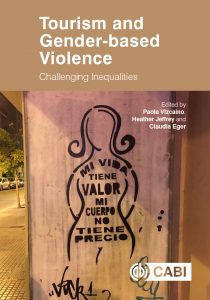
Tourism and Gender-based Violence, Challenging Inequalities. Edited by Paola Vizcaino, Heather Jeffrey, Claudia Eger
A new book edited by Dr Paola Vizcaino (Department of Sport & Events Management, Bournemouth University), Dr Heather Jeffrey (Middlesex University, Dubai) and Dr Claudia Eger (Copenhaguen Business School) has been published by CABI. Link here
First of its kind, the book focuses on the multiple and interconnected manifestations of violence that women and girls encounter in tourism consumption and production, such as physical, sexual, emotional or socio-economic abuse. It brings together work by scholars who are engaging with the concept of gender-based violence (GBV) in a wide range of tourism settings and practices. Includes profiles of organisations and initiatives that are attempting to tackle GBV in tourism, hospitality and beyond.
Join the editors, chapter contributors and grassroots organisations in a virtual introduction to the book this Wednesday 30th September 2020, from 4-6 pm (UK time). All welcome. Please register to see the full agenda and get the Zoom link and passcode: https://www.eventbrite.com/e/tourism-and-gender-based-violence-virtual-book-launch-tickets-122680415425
Women academics, social media and gender-based violence.
Dr Emma Kavanagh and Dr Lorraine Brown (FoM) have just published a paper entitled ‘Towards a research agenda for examining online gender-based violence against women academics’. Work on this topic was inspired by Emma’s research on the online violence experienced by female athletes and further influenced by work on sexual harassment by the Women’s Academic Network (WAN), which ran a symposium on the topic in June this year. The writing of the paper was supported through writing retreats organised by WAN. The focus of this paper builds upon the critical mass of research being conducted exploring inter-personal violence and gender-based violence in sporting spaces by members of the Department of Sport and Event Management, and the work of the Bournemouth University Gender Research Group.
There is an increasing call for academics to promote their research and enhance their impact through engaging in digital scholarship through social media platforms. While there are numerous benefits concerned with increasing the reach of academic work using virtual platforms, it has been widely noted that social media sites, such as Twitter, are spaces where hostility towards women and hate speech are increasingly normalised. In their paper, Emma and Lorraine provide a review of the current literature concerning violence toward women academics online and further provide suggestions for a research agenda which aims to understand the phenomena of gender-based violence more clearly and work toward safeguarding (female) academics engaging in digital scholarship. As they rightly state: “institutions such as universities that are increasingly placing pressure on women academics to engage in virtual platforms to disseminate their work have a responsibility in the prevention and protection of harm”.


BU students’ publishing success
BU presentation at the University of Bristol
Art and Design: History, Practice and Theory academics – would you like to get more involved in preparing our next REF submission?
UKCGE Recognised Research Supervision Programme: Final Deadline Reminder
The significance of Rights and Protocols in Disaster Response
Horizon Europe Cluster 3 (Civil Security for Society) 2026 Calls Now Open

MSCA Doctoral Networks 2026 Call Information Webinar

ESRC Festival of Social Science 2026: Application Deadline Extended to Thursday 25 June 2026

Reminder: Register for the ESRC Festival of Social Science 2026 Information Session

ECR Funding Open Call: Research Culture & Community Grant – Apply now

ERC Advanced Grant 2025 Webinar
Update on UKRO services
European research project exploring use of ‘virtual twins’ to better manage metabolic associated fatty liver disease