This is a joint HM Government report with contributions from the Department for Business, Innovation and Skills, the Department of Energy and Climate Change, and the Department for Environment, Food and Rural Affairs.
http://www.bis.gov.uk/policies/further-education-skills/skills-for-green-economy
It reports on a project undertaken to identify the skills needed for a transition to a green economy. It is not directed at HE but begs the question as to what kind of curriculum we might have at BU to ensure that our students are adequately prepared for a green economy and can contribute to sustainable development?
Tagged / publication
RCUK Research Outcomes Project is ready to launch!
 Following my previous post about the development of the Research Councils UK (RCUK) Outcomes Project, the launch of the new system for collecting information about research outcomes from all RCUK grant holders is nearly here. Assuming all goes to plan with the final phase of user testing, the system will go live from 14 November 2011. Grant holders will be required to upload information about the following for each of the RCUK-funded projects they are responsible for:
- Publications
- Other research outputs
- Collaboration
- Communication
- Exploitation
- Recognition
- Staff development
- Further funding
- Impact
Grant holders will be able to log in to the system using their Je-S login and will be responsible for maintaining the outcomes information about the grants they have been awarded, even if they move institution. RCUK have issued a list of FAQs to help answer some common queries.
EPRSC announces new open access policy
 The EPSRC has introduced a new policy on access to outputs arising from funded research:
EPSRC Council has agreed to mandate open access publication, with the proviso that academics should be able to choose the approach best suited to their field of research. This mandate is now being implemented: EPSRC requires authors to comply with this mandate and ensure that all published research articles arising from EPSRC-sponsored research, and which are submitted for publication on or after 1st September 2011, must become available on an Open Access basis through any appropriate route. As now, publication costs may be recovered either as ‘directly incurred costs’ (if incurred before the end date of the relevant research project) or as indirect costs (and hence factored into the fEC indirect cost rate for the relevant research organisation).
This change in policy means that the EPSRC will now accept that researchers have met their open access requirements if they make their research outputs available via either the Gold OA or Green OA route.
Gold Open Access (pay-to-publish) – peer-reviewed papers published in fully Open Access journals which do not charge subscription fees, or in ‘hybrid’ subscription journals which enable free access to ‘pre-paid’ articles. Subject to certain criteria the publishing fees may be met from direct or indirect costs on EPSRC Research Grants.
Green Open Access – research is published in traditional subscription journals and authors self-archive their papers (as accepted for publication) in a digital online repository, such as BU’s institutional repository BURO. The publisher’s policy is a crucial issue as far as Green OA is concerned. Some publishers have repository-friendly policies, but others embargo deposit of full texts until a year or more after initial publication. SHERPA-RoMEO has a comprehensive list of publishers and their policies to check before deciding where to publish.
The EPSRC’s policy states that the costs of Gold OA can be met from the grant as a direct cost only where that cost is incurred during the period of the grant. If work is published after the grant is complete, then the institution must stump up the cash to publish or use a portion of the indirect costs to fund this. Earlier this year BU launched the BU Open Access Publication Fund to support researchers in making their research freely available.
Find out more about Open Access publishing at BU’s FREE Open Access publishing event on Wednesday 26 October between 10am-12:30pm in the EBC. To book your place please email Anita Somner.
BU staff making an impact with their publications
 I am sure that you would wish to join with me in congratulating both Richard Shipway and Philippa Hudson from the School of Tourism on their papers being in the top 10 most downloaded papers in Perspectives in Public Health.
Together they have achieved 1,337 people who have looked at their work.
Richard’s paper is titled Sustainable legacies for the 2012 Olympic Games and is second in the table and Philippa’s Food safety issues and children’s lunchboxes is fourth in the table.
Well done to them! I was very proud in the meeting with Sage last week.
Dr Heather Hartwell Honorary Editor
New speaker confirmed for the BU Open Access Fund Launch Event
Following on from the previous blog post about the launch of BU’s Open Access Publishing Fund, we’re now pleased to confirm that Willow Fuchs from the Centre for Research and Communications at Nottingham University is coming to speak about the SHERPA open access projects as part of the FREE launch event for BU staff on 26 October 2011.
 The two projects of most relevance for open access publishing are SHERPA RoMEO, which covers publishers’ copyright & archiving policies, and SHERPA JULIET, which includes research funders archiving mandates and guidelines. So book your place now by sending an email to Anita Somner in the Research Development Unit.
In a slight change to the previously published line-up, Professor Peter Thomas, Director of the Bournemouth University Clinical Research Unit, will share his experiences of publishing in open access journals. Dr Alma Swan will give a keynote speech on the benefits of open access publishing, how it can make research findings more visible both inside and outside of academia, and dispel some of the common myths that surround it.
The event will be held on 7th floor of the Executive Business Centre on Lansdowne Campus between 10.00-12.30. Refreshments and lunch will be provided. We look forward to seeing you on the day!
Methodology Training – Building Momentum in the School of Tourism
 With many of the leading journals in the field of Tourism and related studies now recording rejection rates in excess of 90%, the pressure is on all of us with an interest in publishing in such journals to enhance our level of engagement with the variety of alternative research methodologies available to us and to deepen our level of knowledge of those deemed most appropriate; as well as to improve the level of rigour with which we apply them in our work! In addition to constructive criticism from panel members of the level of conceptual and theoretical engagement in many papers reviewed for RAE2008, feedback from reviewers points to methodological weaknesses in papers submitted and a sense of frustration over the a lack of rigour and an apparent unwillingness to try contemporary approaches.
In response, the School of Tourism has invested much time in developing the methodological expertise of its staff and for 2011-12 is launching a new programme of Research Methods on Wednesday mornings throughout the year. Available to all School staff and PhD students, the new programme, being led by Professor Roger Vaughan and Dr Lorraine Brown, explores both quantitative and qualitative approaches to research, a number of emerging methods of contemporary interest, with the programme concluding with sessions on the use of “voice” and “trustworthiness” on the writing up of qualitative research and the presentations of quantitative findings.
For further information please contact Dr Lorraine Brown at lbrown@bournemouth.ac.uk
Latest journal impact factors
 Following the release of the latest Journal Citation Reports® on the Thomson Reuters ISI Web of Science database, we have compiled a list of the top ranking journals in various fields related to BU research. BU staff can access these lists by going to the designated folder on the collaborative I-drive: I:\R&KEO\Public\RDU\Journal Impact Factors 2011. If there are any additional subject areas that you would like to see included, do send me an email.
Related blog posts that may be of interest:
Journal impact factors explained
Google Scholar’s new citations tracking tool
As the demand for information about the performance of research outputs increases, Google Scholar’s latest online citations tracking tool could prove to be a useful resource. Google Scholar Citations is currently being launched with a small number of users before widespread dissemination, but the early signs are that it could provide a simple way for academics to calculate key metrics and monitor them over time.
According to Google Scholar, the tool will ‘use a statistical model based on author names, bibliographic data, and article content to group articles likely written by the same author’. You can then identify your articles using these groups and Google Scholar will then automatically produce the citation metrics. Three metrics will be available: the h-index, the i-10 index (which is the number of articles with at least ten citations), and the total number of citations to your articles. Each of these metrics will be available for all outputs as well as for articles published in the last five years, and will be automatically updated as new citations are available on the web.
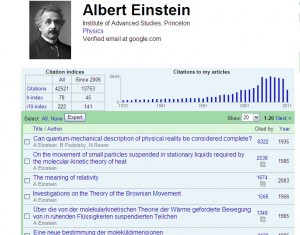 You will be able to update your ‘profile’ of outputs by adding missing items, merging duplicates or correcting bibliographic errors. You’ll also have the choice to make your profile public, the idea being that you’ll make it easier for colleagues globally to follow your research because your outputs will appear in Google Scholar search results.
To get a glimpse of Google Scholar Citations in action, there are some sample profiles available via the Google Scholar blog. You can also register your email address so that you will be notified when the tool is finally available to everyone.
Be Bold – Host an Event or Conference at BU!
Professor Alan Fyall, Deputy Dean Research & Enterprise in the School of Tourism encourages staff to consider hosting an event.
In recent weeks the School of Tourism has hosted a number of events including the Seventh International Conference  on Culinary Arts and Science, the Third Conference of the International Association for Tourism Economics and a workshop on Context-Based Services led by PhD students from the John Kent Institute of Tourism. Although such events are hard work, require much planning and last-minute stress, they represent a valuable opportunity to attract academics from across the UK and beyond to BU. If you have not considered hosting such an event, think again as BU provides a good level of support, something that was not the case a few years back. Why not ……………
- Start small with a one-day workshop or similar event with staff who have undertaken an event before
- Build up to a two-day event or conference with extended abstracts and/or external speakers, possibly in association with other universities or external bodies
- Graduate to a fully-refereed academic conference, possibly with sponsorship from other universities, professional bodies or research councils, with publishers and journal editors present
- Start an international association, as happened with the International Association for Tourism Economics which formalises what in reality are loose informal gatherings of like-minded academics with a passion for their subject
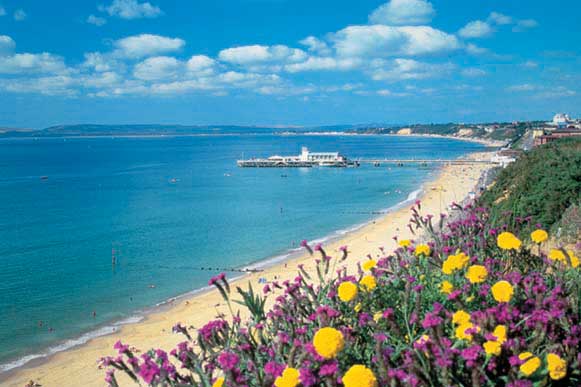 If you do decide to take the plunge and host one of the above, from experience I can assure you that Bournemouth has much to offer as a conference destination. We often tend to mock our own location and imagine that everybody else does it better. Simply not true! In addition, we have the distinct advantage of being geographically close to all the major publishers in Oxford so invite them, look after them and work with them in expanding the publication opportunities for you and your colleagues. Not only does their appearance guarantee additional delegates, especially from overseas, but it serves to raise the quality threshold of what you are trying to achieve from your event through association with leading international organisations. Also, always plan what outputs you are seeking in the early stages of your event planning as, for example, editors of journals are always seeking new themes for special issues! Finally, although they are hard work, events are great fun and can serve as the platform for new friendships, writing relationships and the foundations for future research grant applications ….. and funding, for that next conference!
High flying publication for BU academic!
 Dr Scott Cohen in the School of Tourism has had a paper published in the latest issue of the Annals of Tourism Research, one of the most prominent journals in the field of tourism.
The paper explores the concept of what has been termed ‘binge mobility’ or ‘binge flying’ – the notion that excessive tourism could constitute a new behavioural addition. Scott co-authored the paper with James Higham and Christina Cavaliere from the University of Otago, New Zealand.
 The Annals of Tourism Research is rated a 4* journal in the Association on Business Schools‘ journal ranking list – the ABS Journal Quality Guide – and has a Web of Science impact factor of 1.95.
In addition the paper was one of only five papers featured in Elsevier’s July 2011 Flash Alert, Elsevier’s monthly round up of the top stories in the science, health and medical journals.
You can read a copy of the paper on our institutional repository BURO.
Congratulations Scott! 😀
links for 2011-07-14
Interesting links tagged this week in the BU Research delicious pages:
-
Unlocking the descriptive information, or metadata, about digital content, articles, books and research is the key to making it more useful, according to the JISC-funded resource discovery taskforce as it embarks on a new programme of work.

If all UK metadata was made openly accessible, the taskforce says, then the resources themselves would be more visible and it would be easier to build innovative new ways for researchers, teachers and students to explore the resources.
-
 Funding research excellence, conclusively demonstrates that the Government should not bow to pressure to fund research on the basis of scale; there is no evidence to support the claim that this would produce better research. On the contrary, the evidence points to quality being a driver of scale and not vice versa. The main findings of this research are compelling: that the UK should continue a policy of funding excellence wherever it exists.
 -
From zombie ants to the music of the sun, Kyle Christie highlights the research stories that went viral and created a storm of publicity for their institutions

First BU Research Blog Poll Results
Are journal impact factors a good indicator of quality?
Following the launch of the first BU Research Blog Poll, we received 28 responses to the above question which were split as follows:
| Yes – always | 2 |
| Yes – but in STEM disciplines only | 1 |
| Sometimes | 22 |
| No, never | 2 |
The majority of responses indicate that there may be some doubt about the usefulness of impact factors when used as a proxy for journal quality. This is perhaps because there are a number of factors that could affect a journal’s perceived quality that cannot be demonstrated through metrics alone. Also, the use of journal metrics like impact factors are not necessarily perceived as being robust enough yet to give an accurate indication of journal or article quality, hence HEFCE’s decision not to rely solely on metrics in the Research Excellence Framework (REF).
To continue the debate on this, do feel free to post a reply below, or suggest a topic for a future poll by responding to Julie’s original post. For more information about journal impact factors, have a look at the previous blog post on this subject.
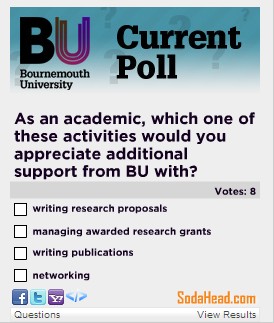 In the meantime, why not get involved in the current poll which can be accessed from the top right-hand side of the blog homepage – it will take just seconds to complete and will help shape the support offered to BU academics in the future.
Feedback, not failure…
 Prof Alan Fyall, Deputy Dean (Research and Enterprise) in the School of Tourism, discusses the experience of receiving reviewers’ comments…
After nearly 15 years of publishing in peer-reviewed academic journals I am sure I am not alone in still living in fear of emails containing the “feedback” from editors and reviewers of journals about my papers. Over the years, the inconsistency of reviewers’ comments never ceases to amaze me, while the often unhelpful and sometimes down right rude tone of some reviewers does make me sometimes beg the question …. why do I bother? After a “time out”, however, often a period of two-to-three days, upon revisiting the comments advanced I often, albeit reluctantly, accept that the two or three reviewers have probably made some good comments and that, if I calm down and just adhere to the questions raised, will generate a paper far superior to the one I first submitted. This is not always the case but more often than not reviewers do actually provide very honest, fair and helpful comments in an attempt to improve the quality of submissions. Yes, they can sometimes be pedantic, over-emphasise their own contribution and state the obvious. More often, however, they will provide a critical overview of the broad theme of the paper and its rationale, the methodology and sampling, presentation of findings and conclusions drawn, as well as an overview of the way in which the paper is organised and presented.
My advice to old and new researchers is quite simple. In the first instance, take a deep breath when opening that email, read its contents and then leave for a while and avoid at all costs a hasty and reactive response that will only make things worse. Secondly, accept that editors and reviewers are only human (well, most of them) and that what they are communicating is their views and opinions which most probably do not concur with yours and more often than not will conflict with those of other reviewers. Thirdly, take all the feedback provided and take time in amending your paper and the reply to editors and reviewers that explains exactly what changes have been made in improving the quality of your submission. Where you still disagree be constructive in your explanation and offer further insights that the reviewers may have missed in their interpretation of your work. Finally, resubmit your paper and promise to yourself that you bear no grudges against the editor and/or reviewers as you can normally guarantee that at some point in the future they will once again review your work and remember the professional manner in which you dealt with their feedback the first time. For me, after 15 years of publishing I am still learning, still amazed at some of the comments I receive and am still ……. slightly nervous about opening that email; a fear which is unlikely to vanish perhaps as we continue to learn and learn from others in our respective academic publishing journeys
Prof Stella Fearnley’s research into audit committees
 Professor Stella Fearnley’s research into audit committees has been published in a book titled Reaching Key Financial Reporting Decisions: How Directors and Auditors Interact (co-authored by Professors Vivien Beattie and Tony Hines).
Robert Hodgkinson – ICAEW Executive Director, Technical, said of the research: “This valuable new research found evidence that auditors challenge management frequently. There was no evidence to support the recent concerns about auditor scepticism or that auditors merely seek corroboration of management views.”
 “Public discussion of corporate reporting and auditing is frustrated by the fact that directors and auditors debate issues and take decisions in private. The need to respect confidentiality means that policy makers and the public find insiders’ accounts of what happens bland and unconvincing. The resulting lack of public information is particularly dangerous at the present time when the financial crisis is prompting questions about whether new regulation is called for.”
“Through this book, Beattie, Fearnley and Hines present case studies that tell the reporting and auditing stories of nine companies based on interviews with their finance directors, audit committee chairs and lead auditors. This research is required reading for anybody who has ever wondered what really happens in an audit.”
Congratulatons Stella! 🙂
You can buy Stella’s book on Amazon.
EPSRC goes for open access
 The Engineering and Physical Sciences Research Council has announced that it is implementing a new policy to increase research data availability and accessibility.
Under the policy, from 1 September all EPSRC-funded research papers submitted for publication must be made available on an open access basis. The council said in a statement on 3 June that the rules are not set in stone: it is up to each researcher to choose what approach or forum to use.
HEFCE REF event at BU – register now!

BU is hosting a two-day REF event on Thursday 19 and Friday 20 May 2011. All staff are invited to attend.
For further information and to register, visit HERE.
REF event 19 & 20 May 2011 – REGISTRATION IS OPEN!!
BU is hosting a two-day REF event on Thursday 19 and Friday 20 May 2011. All staff are invited to attend.
The event is of interest to BU academic staff and anyone who will be involved in the BU submission to the REF.
There will be three separate sessions:
Session 1
Thursday 19 May 9am-2pm
This session will be open to BU staff and external delegates.
There will be presentations from the REF team at HEFCE, REF impact pilot panel members, and a REF impact pilot institution (University of Plymouth).

Session 2
Thursday 19 May 2pm-5pm
This session is only open to BU staff.
This session will provide BU staff with the opportunity for internal networking, followed by a demonstration of BU’s new publications management system and a presentation on preparing a publication profile for the REF.

Session 3
Friday 20 May 9:45am-4:30pm
This session is only open to BU staff.
The focus of this session is the development of the BU impact case studies. There will be presentations of the impact case studies being developed at the moment.

All sessions will take place in Kimmeridge House and Poole House, Talbot Campus.
You must register separately for each session you will be attending.
See our previous REF Event blog post for further details. The provisional programmes are available on the registration forms (see links above).
REF event 19 & 20 May 2011 – SAVE THE DATE!
BU will be holding a two day Research Excellence Framework (REF) event on 19 and 20 May to which all staff are invited to attend.
Day 1 (open to BU staff and external delegates)
9am-2pm – this will be an external event supported by HEFCE to which all HEIs in the South of England will be invited. The focus will be on developing and assessing impact for the REF. There  will be speakers from HEFCE, an academic from one of the impact pilot institutions (University of Plymouth), and some of the impact pilot panel members. The event is aimed primarily at academics likely to be submitted to the REF and UOA Leaders. It will provide a forum for networking and discussion around preparations for the impact element of the REF.
Day 1 (open to BU staff only)
2pm-5pm – There will be an opportunity for internal networking, a demonstration of the publications management system BU will soon be implementing, and a talk by Prof Matthew Bennett on building a publication profile for the REF.
Day 2 (open to BU staff only)
 9am-4:30pm – the focus of Day 2 is the development of the BU impact case studies. The day will open with a presentation by Prof Matthew Bennett on what impact actually is, followed by presentations of the impact case studies being developed at the moment (3 per Unit of Assessment). These will run in 9 concurrent sessions with 4 presentations taking place in parallel during each session. The main aims of Day 2 are to get academics thinking about the impact case studies in a structured way, to identify resource requirements to maximise potential impacts, and the engage staff from M&C with the case studies being developed. In addition this is a great opportunity to showcase the excellent research that is undertaken at BU, to meet colleagues from other Schools, and to stimulate ideas for future research collaborations.
The event is free to attend but booking is essential. Booking will open next week – further details to follow!
BU staff can login below:
Other services











Recent posts
BU research Funding opportunities EU
 International Open Access Week: open access and the REF
- International Open Access Week: BU support for open access
 Food Price Research Shortlisted for Civil Service Prize
- It’s International Open Access week
 3C Event: Research Culture, Community & Connections – Wednesday 11 November 3-4pm
 ECR Opportunities: New Development Programme, Researcher Grants & Upcoming Events
 Horizon Europe Cluster 3 (Civil Security for Society) 2026 Calls Now Open
 MSCA Doctoral Networks 2026 Call Information Webinar
 ESRC Festival of Social Science 2026: Application Deadline Extended to Thursday 25 June 2026
- Apply now to take part in the 2026 ESRC Festival of Social Science
 Reminder: Register for the ESRC Festival of Social Science 2026 Information Session
 ECR Funding Open Call: Research Culture & Community Grant – Apply now
- MSCA Postdoctoral Fellowships 2025 Call
 ERC Advanced Grant 2025 Webinar
- European Migration Research and Impact – Invitation to a Roundtable Discussion
- MSCA Postdoctoral Fellowships 2025
 Update on UKRO services
 European research project exploring use of ‘virtual twins’ to better manage metabolic associated fatty liver disease
 Research Information Network
- Physical Sciences Case studies: information use and discovery
- Information handling in collaborative research: an exploration of five case studies
- Information literacy monitoring and evaluation
- Data centres: their use, value and impact
- Heading for the open road: costs and benefits of transitions in scholarly communications