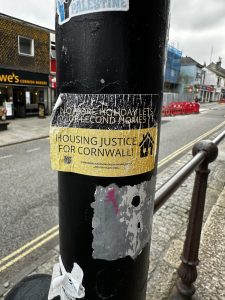
Grassroots opposition to second homes, seen on the streets of Cornwall.
Research that began as an undergraduate dissertation at Bournemouth University has been published in Geographical Review, journal of the American Geographical Society. The paper, “Second Homes and the (Re)production of Cornish Nationalism,” is co-authored by Conan Millen, a recent graduate of BU’s BSc (hons) Geography, and Dr Marin Cvitanović, Principal Academic in Human Geography in the School of Life and Environmental Sciences.
The study looks at how attitudes toward second homes and tourism connect to identity in Cornwall, one of the poorest regions in Western Europe despite its high concentration of second-home ownership. Drawing on an online survey of 504 Cornwall residents, the paper identifies four distinct clusters of opinion on housing, tourism and belonging, and asks how these relate to age, income and ethnic identity.
A few findings stand out. Younger, lower-income and Cornish-identifying respondents were significantly more likely to oppose second homes and short-term holiday lets, particularly over concerns about affordability and community cohesion. Older and more affluent respondents identifying as British or English took a more positive view of tourism’s economic benefits. Age had the strongest statistical effect of any factor measured, more so than ethnicity or income, suggesting that generational experience of housing insecurity plays a central role in shaping these attitudes. Opposition to second homes was also somewhat higher in postcodes with higher average house prices.
The paper places these findings within wider debates on housing and identity. It draws a link between the rise of “generation rent” across the UK and Europe and the emergence of place-based, often exclusionary responses to housing pressure, sometimes described in the literature as forms of “housing nationalism.” In Cornwall’s case, the study argues that expressions of Cornish identity in relation to housing are shaped as much by material economic exclusion as by cultural or ethnic distinctiveness.
Since graduating, Conan Millen has been working as part of the wider public health team at Cornwall Council, where he is involved in analysing and processing data to inform projects and monitor the health and wellbeing of people living and growing up in Cornwall.
BU’s BSc (Hons) Geography is accredited by the Royal Geographical Society (with IBG). In the most recent National Student Survey, 94% of students agreed that teaching staff were good at explaining things, and 94% agreed that teaching staff had supported their learning well.
References:









 Verbal autopsy paper published two days ago
 ESRC Studentships for 2027 Entry: Opportunity Now Open
 SONAMONI contributions to Safety Conference 2026 in South Africa
 Three CMWH presentations at Berlin conference
 Horizon Europe Cluster 3 (Civil Security for Society) 2026 Calls Now Open
 MSCA Doctoral Networks 2026 Call Information Webinar
 ESRC Festival of Social Science 2026: Application Deadline Extended to Thursday 25 June 2026
 Reminder: Register for the ESRC Festival of Social Science 2026 Information Session
 ECR Funding Open Call: Research Culture & Community Grant – Apply now
 ERC Advanced Grant 2025 Webinar
 Update on UKRO services
 European research project exploring use of ‘virtual twins’ to better manage metabolic associated fatty liver disease