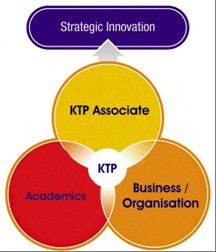
 The Technology Strategy Board has made some revisions to the criteria a project has to meet in order to receive a Knowledge Transfer Partnership (KTP) grant. This has caused some confusion. In order to obtain clarification, Neil Grice, the local Adviser visited the University last week for a meeting with School representatives.
Listed below are the current key award criteria:
- Project is for the development of a company capability, not a product.
- On completion, the company is left with a legacy, e.g. a new capability or process.
- Innovative – leading edge knowledge is transferred to the company. Can’t be done by employing consultants, needs research.
- Impact – the project makes a significant difference to the company which would not have happened without the KTP. University also receives significant results.
- Challenge – Stretching for University and company.
- Fits in with company strategy.
- Company is financially sound.
- Science and technology focussed. Difficult to obtain awards for social care, marketing and business development projects.
- Awards are most likely to be granted for projects with small/medium sized organisations.
If you require any further information on KTPs in general please contact Peter Delgado, Commercialisation and KTP Officer, e-mail – pdelgado@bournemouth.ac.uk
 A Guide to Knowledge Transfer Partnerships







 Verbal autopsy paper published two days ago
 ESRC Studentships for 2027 Entry: Opportunity Now Open
 SONAMONI contributions to Safety Conference 2026 in South Africa
 Three CMWH presentations at Berlin conference
 Horizon Europe Cluster 3 (Civil Security for Society) 2026 Calls Now Open
 MSCA Doctoral Networks 2026 Call Information Webinar
 ESRC Festival of Social Science 2026: Application Deadline Extended to Thursday 25 June 2026
 Reminder: Register for the ESRC Festival of Social Science 2026 Information Session
 ECR Funding Open Call: Research Culture & Community Grant – Apply now
 ERC Advanced Grant 2025 Webinar
 Update on UKRO services
 European research project exploring use of ‘virtual twins’ to better manage metabolic associated fatty liver disease