We would like to invite you to the latest research seminar of the Creative Technology Research Centre.
Speaker: Jing Wang
Title: Robust Semi-supervised Nonnegative Matrix Factorization
Time: 2:00PM-3:00PM
Date: Wednesday 2nd December 2015
Room: P302 LT, Poole House, Talbot Campus
Abstract: Clustering aims to organize a collection of data items into clusters, such that items within a cluster are more “similar” to each other than to those in the other clusters, which has been used in many fields, including machine learning, pattern recognition, image analysis, information retrieval, and bioinformatics. Clustering is usually performed when no information is available concerning the membership of data items to predefined classes. For this reason, it is traditionally seen as part of unsupervised learning. However, in reality, it is often the case that some data information (e.g. labels) is available and could be used to bias the clustering for producing considerable improvements in learning accuracy. Also, data have some new challenges, such as high- dimensionality, sparsity, containing noises and outliers, etc. This motivates us to develop new technology to deal with this kind of complex data. To address all these issues, we propose semi-supervised nonnegative matrix factorization approaches. Experiments carried on well-known data sets demonstrate the effectiveness.
We hope to see you there.
 BRAD: Robust adaptive predictive modelling and data deluge workshop







 3C Online Social: Thursday 26 March 1–2pm – Research Culture, Community & Can you Guess Who?
 Four BU students at national midwifery conference
 INRC book roundtable/presentation by Drs Jonathan Cole and Catherine Talbot, Wednesday 22/04/2026, 13:00h, P426
 BU M.Res. student’s evidence to UK Parliamentary Women & Equalities Committee
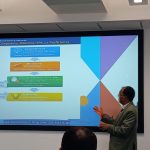 Prof Marahatta promoting BU-Nepal collaboration
 ECR Funding Open Call: Research Culture & Community Grant – Apply now
 ECR Funding Open Call: Research Culture & Community Grant – Application Deadline Friday 12 December
 MSCA Postdoctoral Fellowships 2025 Call
 ERC Advanced Grant 2025 Webinar
 Update on UKRO services
 European research project exploring use of ‘virtual twins’ to better manage metabolic associated fatty liver disease