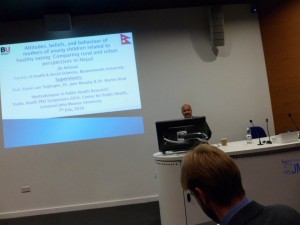
 Mr. Jib Acharya (FHSS) gave an interesting presentation yesterday about the qualitative research findings of his PhD at Liverpool John Moores University. Jib’s PhD research focused on the knowledge, attitudes and beliefs of poor women in Nepal about healthy eating and the study also identifies major food barriers.
His mixed-methods approach combines a quantitative questionnaire survey with qualitative research. Jib’s research project is supervised by Dr. Jane Murphy, Dr. Martin Hind and Prof. Edwin van Teijlingen. Some of the preliminary findings of this FHSS thesis have already been published in two scientific journals [1-2].
References:
- Acharya, J., van Teijlingen, E., Murphy, J., Hind, M. (2015) Assessment of knowledge, beliefs and attitudes towards healthy diet among mothers in Kaski, Nepal, Participation 17(16): 61-72.
- Acharya, J., van Teijlingen, E., Murphy, J., Hind, M. (2015) Study of nutritional problems in preschool aged children in Kaski District in Nepal, Journal of Multidisciplinary Research in Healthcare 1(2): 97-118. http://dspace.chitkara.edu.in/jspui/bitstream/1/560/1/12007_JMRH_Acharya.
 BNAC presentation Jib Acharya







 SONAMONI contributions to Safety Conference 2026 in South Africa
 Three CMWH presentations at Berlin conference
 New interdisciplinary paper on Nepal
 Horizon Europe Cluster 3 (Civil Security for Society) 2026 Calls Now Open
 MSCA Doctoral Networks 2026 Call Information Webinar
 ESRC Festival of Social Science 2026: Application Deadline Extended to Thursday 25 June 2026
 Reminder: Register for the ESRC Festival of Social Science 2026 Information Session
 ECR Funding Open Call: Research Culture & Community Grant – Apply now
 ERC Advanced Grant 2025 Webinar
 Update on UKRO services
 European research project exploring use of ‘virtual twins’ to better manage metabolic associated fatty liver disease