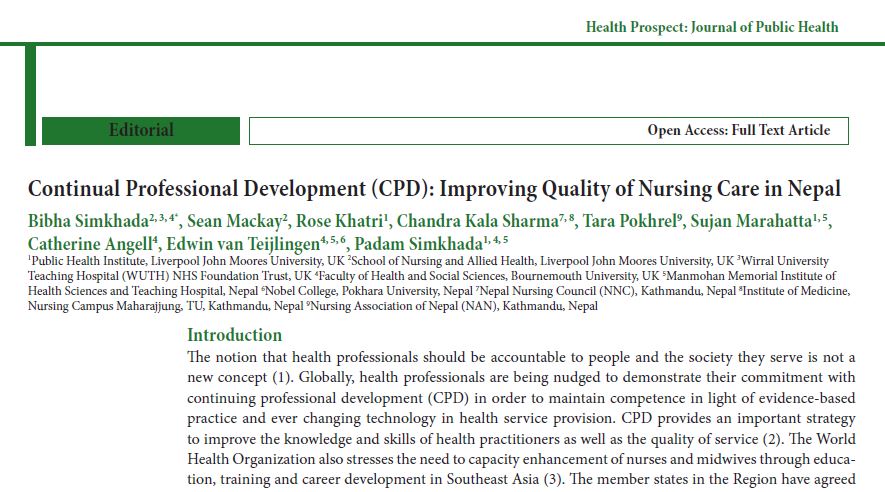
 In the final week of 2016 the journal Health Prospect published our editorial on the importance of introducing nursing CPD in Nepal [1]. This editorial is based on a collaborative study between BU, Liverpool John Moores University (LJUM), Manmohan Memorial Institute of Health Sciences (MMIHS) in Nepal, Nepal Nursing Council (NNC), and the Nursing Association of Nepal (NAN). The BU part of the study is led by Dr. Catherine Angell based in the Centre for Midwifery, Maternal & Perinatal Health (CMMPH) and funded by a small grant from BU’s Centre for the Excellence in Learning. Two of our co-authors from LJMU Dr. Bibha Simkhada and Prof. Padam Simkhada are also Visiting Faculty at BU. The project is a true FUSION project as the Research, will inform Education (in the form of CPD) which will in turn improve Practice (of the many thousands of nurses in Nepal).
 Health Prospect is an Open Access journal and therefore freely available for any one to read online.
Prof. Edwin van Teijlingen
CMMPH
Reference:
- Simkhada, B., Mackay, S., Khatri, R., Sharma, C.K., Pokhrel, T., Marahatta, S., Angell, C., van Teijlingen, E., Simkhada, P. (2016) Continual Professional Development (CPD): Improving Quality of Nursing Care in Nepal, Health Prospect 15 (3):1-3 http://www.nepjol.info/index.php/HPROSPECT/article/view/16326/13255
 New paper Dr. Catherine Angell on CPD in Nepal







 SONAMONI contributions to Safety Conference 2026 in South Africa
 Three CMWH presentations at Berlin conference
 New interdisciplinary paper on Nepal
 Horizon Europe Cluster 3 (Civil Security for Society) 2026 Calls Now Open
 MSCA Doctoral Networks 2026 Call Information Webinar
 ESRC Festival of Social Science 2026: Application Deadline Extended to Thursday 25 June 2026
 Reminder: Register for the ESRC Festival of Social Science 2026 Information Session
 ECR Funding Open Call: Research Culture & Community Grant – Apply now
 ERC Advanced Grant 2025 Webinar
 Update on UKRO services
 European research project exploring use of ‘virtual twins’ to better manage metabolic associated fatty liver disease