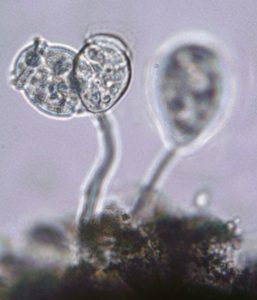
 Microscopic investigations of water samples from the half-barrel pond in Christchurch House courtyard have revealed a menagerie of single-celled life. These tiny organisms (smaller than one tenth of a millimetre) are incredibly important as they form the basis of food webs. They also play a major role in maintaining water quality as they feed on bacteria, and stalked species such as Vorticella (image) are responsible for their removal in waste-water treatment plants. The half-barrel “pond” may be almost as small as its inhabitants but it promises to become a treasure of local ‘hidden’ biodiversity!
For further information please contact Genoveva F. Esteban gesteban@bournemouth@ac.uk, Jack Dazley i7447079@bournemouth.ac.uk, or Damian Evans devans@bournemouth.ac.uk
 Biodome carnivorous plants reveal hidden microbial diversity
 Photo of the Week: Archaeology: Hidden Landscapes
 The secret information hidden in your hair







 ECR Opportunities: New Development Programme, Researcher Grants & Upcoming Events
 Help us capture BU’s knowledge exchange activity HE-BCI survey 2025–26
 Verbal autopsy paper published two days ago
 ESRC Studentships for 2027 Entry: Opportunity Now Open
 SONAMONI contributions to Safety Conference 2026 in South Africa
 Horizon Europe Cluster 3 (Civil Security for Society) 2026 Calls Now Open
 MSCA Doctoral Networks 2026 Call Information Webinar
 ESRC Festival of Social Science 2026: Application Deadline Extended to Thursday 25 June 2026
 Reminder: Register for the ESRC Festival of Social Science 2026 Information Session
 ECR Funding Open Call: Research Culture & Community Grant – Apply now
 ERC Advanced Grant 2025 Webinar
 Update on UKRO services
 European research project exploring use of ‘virtual twins’ to better manage metabolic associated fatty liver disease