Last week Dr. Shanti Shanker, senior lecturer in Psychology, published ‘Selecting an Appropriate Journal and Submitting Your Paper’. [1] Finding the most appropriate journal for your academic paper is a skill. There are many scientific journals, with new ones appearing every year in just about every academic discipline. Prospective authors must ensure they pick an appropriate one. In selecting a journal, academics may want to consider their target audience, the standing of the journal within their discipline, the journal’s readership, and its reach and impact factor. Scholars may also want to consider whether there are constraints such as a high rejection rate of submitted manuscripts, the maximum prescribed number of words and/or tables, and whether or not there are submission or publication fees to be paid. But most important of all, the chosen journal needs to be appropriate for the paper in question. 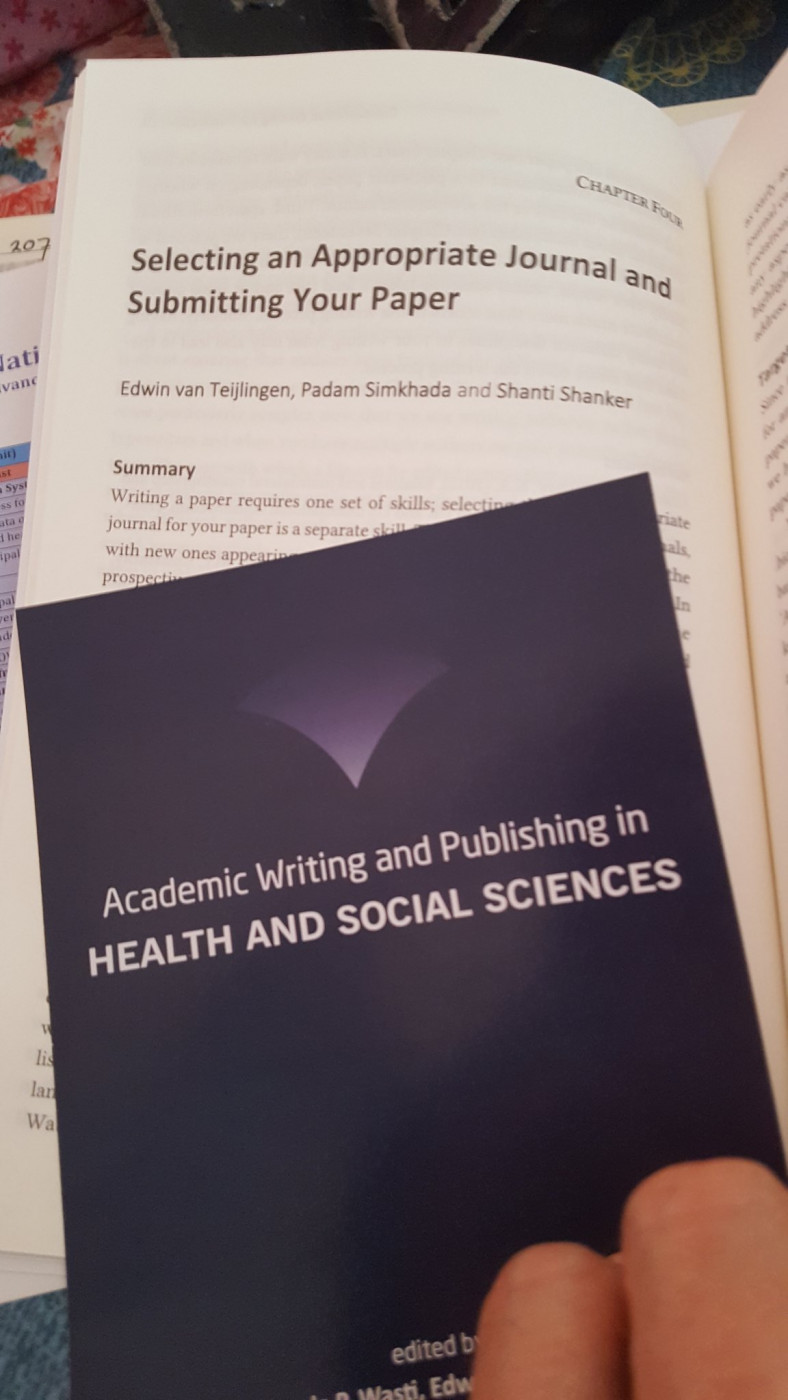
Congratulations!
Professors Vanora Hundley & Edwin van Teijlingen
CMMPH.
Reference:
- van Teijlingen, E., Simkhada, P., Shanker, S. (2022) Writing an Academic Paper, In: Wasti, S.P., et al. (Eds.) Academic Writing and Publishing in Health & Social Sciences, Kathmandu, Nepal: Himal Books: 20-31.
 FHSS team wins British Academy award
 BU contribution to development of Nepali academics
 Latest BU publication on academic writing







 Three CMWH presentations at Berlin conference
 New interdisciplinary paper on Nepal
 National Postdoc Appreciation Week 2026: The Changing Landscape of Postdoc Careers
 NIHR Insight South West Central Conference 2026 at Bournemouth University
 Horizon Europe Cluster 3 (Civil Security for Society) 2026 Calls Now Open
 MSCA Doctoral Networks 2026 Call Information Webinar
 ESRC Festival of Social Science 2026: Application Deadline Extended to Thursday 25 June 2026
 Reminder: Register for the ESRC Festival of Social Science 2026 Information Session
 ECR Funding Open Call: Research Culture & Community Grant – Apply now
 ERC Advanced Grant 2025 Webinar
 Update on UKRO services
 European research project exploring use of ‘virtual twins’ to better manage metabolic associated fatty liver disease