…is not simply political or economic or professional. It needs to rest in the notion of what a university is and what it should be … It is central to the university’s position in the public space”
Professor Martin Hall, Vice Chancellor of the University of Salford, UK
A few weeks back we were privileged to welcome experts on the topic of Open Access to speak at Bournemouth University (BU) in an event well attended by delegates from HEIs across England, Scotland and Wales. BU’s Open Access Event was enjoyed by all who attended and over a series of blog posts I hope to summarise some of the key points raised by each of the speakers. We also filmed the event and will be posting the films shortly for all to watch, enjoy and comment upon.
So to part one of the day, after a wonderful introduction by our Chair and self-acknowledged novice of Open Access Professor Iain McRury, we welcomed Alma Swan to the floor…
Alma Swan is a consultant working in the field of scholarly communication. She is a director of Key Perspectives Ltd, Director of Advocacy for SPARC Europe, and Convenor for Enabling Open Scholarship, an organisation of university managers around the world that promotes the principles of open scholarship and open science. She is also a director of the Directory of Open Access Journals and of the umbrella organisation Infrastructure Services for Open Access. She holds honorary academic positions in the University of Southampton School of Electronics & Computer Science and the University of Warwick Business School.
Alma lead the introductory address framing the day in a presentation titled ‘The benefits of Open Access’. She began the presentation looking at what open access is:
- Immediate
- Free (to use)
- Free (of restrictions)
- Access to the peer-reviewed literature (and data)
And what it is not:
- Not vanity publishing
- Not a ‘stick anything up on the Web’ approach
- Moving scholarly communication into the Web Age
She posed the question of openness using Tim Berners-Lees CERN proposal for an Information Management System (later to become the world-wide- web), drawing attention to his bosses Mike Sendall comments “Vague but exciting…” 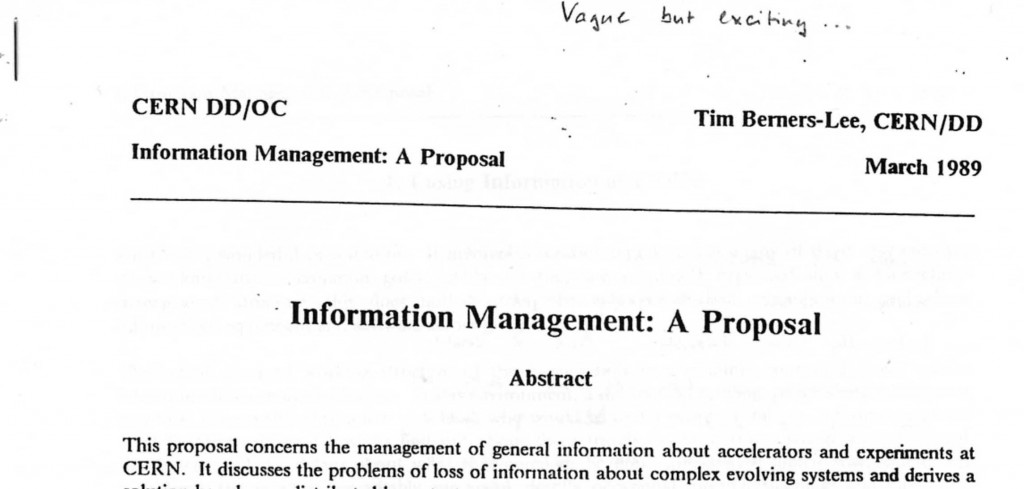
As an aside there’s a great blog article on Tim Berners-Lees opinions on the Open Agenda here – http://blog.digital.telefonica.com/2013/10/09/tim-berners-lee-telefonica-open-agenda/ if your interested! Any how, back to the matter in hand…
Alma covered the basics of Open Access highlighting BUs repository BURO, she addressed the disciplinary differences in approaches to Open Access. On average across all disciplines 37% of articles are made Open Access, rising to just under 50% in Mathematics and as low as 20% in the Arts.
She then took us through the advantages to authors for making their outputs Open Access:
1. Improves author visibility
Alma gave a number of testimonials from authors however, here we include Professor Martin Skitmore’s from School of Urban Design, Queensland University of Technology (QUT):
“There is no doubt in my mind that ePrints [repository] will have improved things – especially in developing countries such as Malaysia … many more access my papers who wouldn’t have thought of contacting me personally in the ‘old’ days.
While this may … increase … citations, the most important thing … is that at least these people can find out more about what others have done…”
2. Increases usage
We viewed download statistics from a number of institutional repositories – the University of Liege’s repository ORBi has approximately 70,000 references with full text and in April 2014 had just under 100,000 downloads. The University of Salford’s repository USIR has c.9000 records and clocked up over 45,000 downloads in January 2013 alone. In regards, to individual authors we returned to Martin Skitmore (QUT) who had 225,857 downloads and 4858 in the past 28 days!
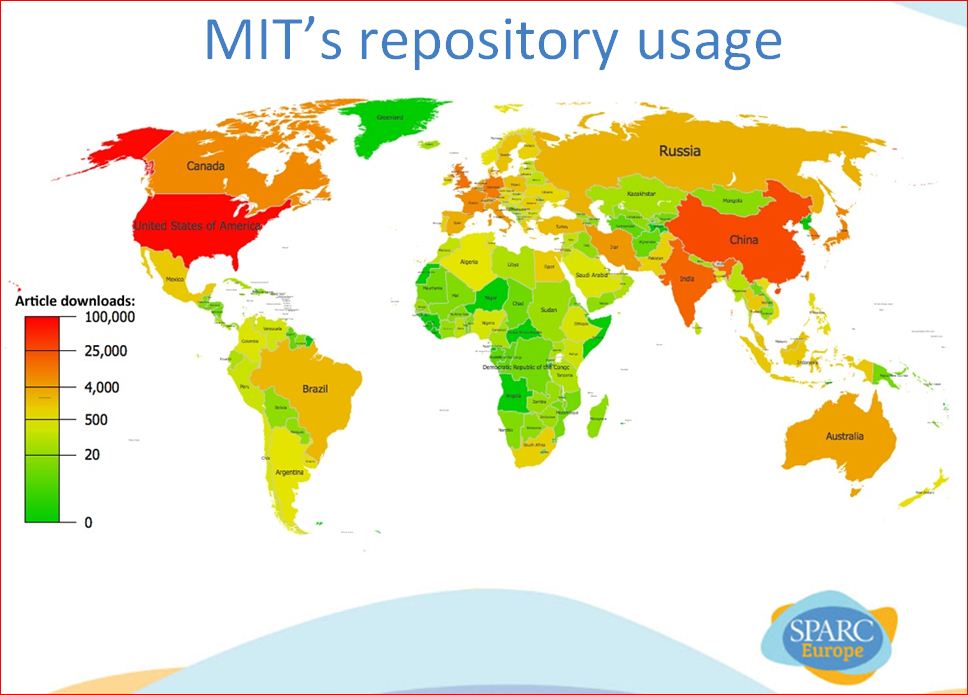
It is also worth noting the usage of repositorys globally. MIT’s repository usage stats presented in the below map was particularly interesting:
3. More impact
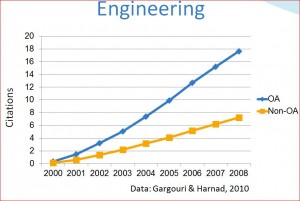
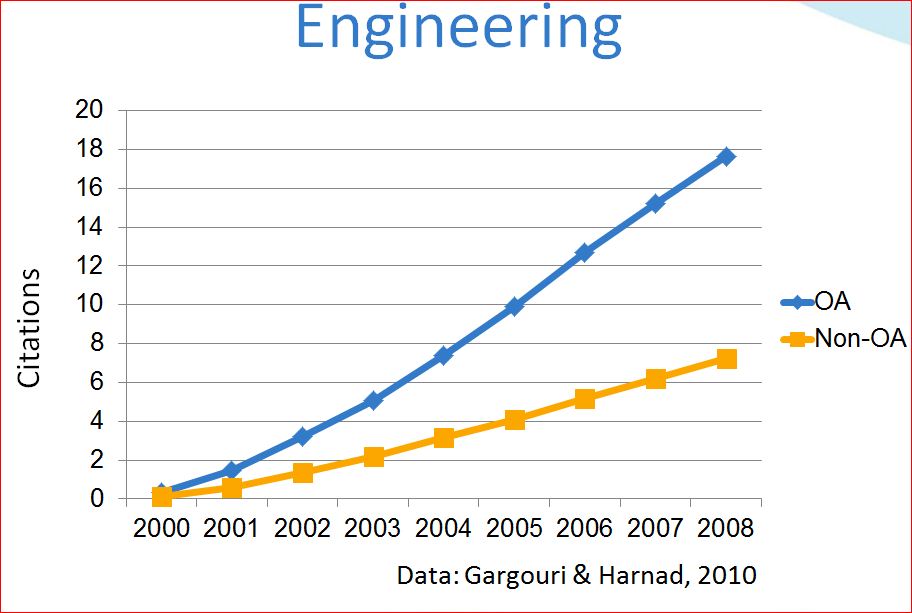
From a citation perspective Open Access can increase citation impact by between 36 to 250% depending on the discipline. She highlighted the difference in citations from OA and non-OA publications across 3 disciplines; Engineering (shown here), Clinical Medicine and Social Sciences all showed significant increases in citations.
Alma then went on to show the advantages for institutions to make Open Access mandatory, she also posed many topical questions and highlighted thought provoking research. One aspect which struck me in particular, was an analysis of PubMed Centrals unique users which revealed that only 25% of articles were accessed by Universities and the majority 40% were accessed by citizens:
- 25% universities
- 18% government and others
- 40% citizens
- 17% companies
Fittingly Alma ended with a quote from Daniel Coit Gilman the First President of Johns Hopkins University in 1878:
“It is one of the noblest duties of a university to advance knowledge and to diffuse it, not merely among those who can attend the daily lectures, but far and wide. “
Full slides from Alma Swans presentation at Bournemouth University’s Open Access Event on the 7th May 2014 are available here internally.










 ESRC Festival of Social Science 2026: An Opportunity to Engage New Audiences
 New HIV paper by BU PhD student
 BU Annual Research Conference: Poster Exhibition Call for Applications
 Vitae Three Minute Thesis (3MT®) Competition: Applications Now Open
 3C Online Social: Thursday 26 March 1–2pm – Research Culture, Community & Can you Guess Who?
 ECR Funding Open Call: Research Culture & Community Grant – Apply now
 ECR Funding Open Call: Research Culture & Community Grant – Application Deadline Friday 12 December
 MSCA Postdoctoral Fellowships 2025 Call
 ERC Advanced Grant 2025 Webinar
 Update on UKRO services
 European research project exploring use of ‘virtual twins’ to better manage metabolic associated fatty liver disease