Category / Open Access

IMSET publishes position paper on long-term sustainability

Fabio Silva of the Institute for the Modelling of Socio-Environmental Transitions, together with a group of co-authors from 32 other institutions, has led the publication of a landmark position paper in the journal Sustainability entitled Developing Transdisciplinary Approaches to Sustainability Challenges: The Need to Model Socio-Environmental Systems in the Longue Durée.

Stemming from a transdisciplinary workshop held online during 2020, the paper argues that current crises – in land use, biodiversity, novel pathogens, water management – can only be fully understood by doing research over timescales that greatly exceed the lifespan of any individual human. This so-called longue durée is the key to fully understanding the full extent of socio-environmental processes and their implications.


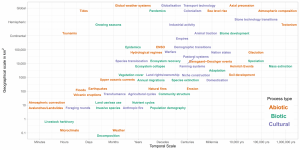
The spatial and temporal scales of key social and environmental processes of interest


As well as identifying key processes and challenges, IMSET and colleagues set out how key issues may be addressed by fully integrating humans into environmental modelling and planning. By including ancient human activity and future outcomes in our mission statement, we aim to provide a manifesto for developing an integrated approach towards socio-ecological systems in the long term.

Silva, Fabio, Fiona Coward, Kimberley Davies, Sarah Elliott, Emma Jenkins, Adrian C. Newton, Philip Riris, Marc Vander Linden, Jennifer Bates, Elena Cantarello, Daniel A. Contreras, Stefani A. Crabtree, Enrico R. Crema, Mary Edwards, Tatiana Filatova, Ben Fitzhugh, Hannah Fluck, Jacob Freeman, Kees Klein Goldewijk, Marta Krzyzanska, Daniel Lawrence, Helen Mackay, Marco Madella, Shira Yoshi Maezumi, Rob Marchant, Sophie Monsarrat, Kathleen D. Morrison, Ryan Rabett, Patrick Roberts, Mehdi Saqalli, Rick Stafford, Jens-Christian Svenning, Nicki J. Whithouse, and Alice Williams. 2022. “Developing Transdisciplinary Approaches to Sustainability Challenges: The Need to Model Socio-Environmental Systems in the Longue Durée Sustainability 14: 10234. DOI: 10.3390/su14161023


HE policy update for the w/e 4th April 2022

A slightly quieter time with the House of Commons on recess.

Before they went on recess, the Skills Bill finally made it over the line.  If you are wondering why we are focussing on school level education at the moment, the first item here will explain why, as the OfS provides more insight into its views on the role of universities in schools age attainment, driven by the government’s levelling up agenda.  In this context, there was controversy over whether T levels meet the needs of lower performing pupils (despite it being marketed as an alternative to academic study), and the Social Market Foundation believe current careers advice risks entrenching inequalities by steering people towards different educational and employment options according to their parents’ income and background.

Research

There’s an article on Research Professional about priorities for the Nurse review of research arrangements.  It flags five “blind spots”:

  • The productivity of R&D is falling
  • A more systemic approach to R&D – “A more strategic approach is needed that aligns technology development, regulation, policy and test beds, and engages the public
  • Mobilising intelligence – organising around data and knowledge not property and resources
  • Focus on adoption and diffusion
  • Addressing the gaps around social science – “The UK is good at monetising economics, psychology, behavioural science, ethnography, design and other fields, often through consultancies and advisory services or teams within companies large and small. But this happens despite, not because of, how research is organised” and “serious action to shift incentives for social scientists and mobilise them to help society think ahead”

UKRI has published an updated policy on the governance of good research practices that will apply to new and existing grants from 1 April 2022. Updates include:

  • revised text with improved clarity on the individual’s and organisation’s responsibility to enable positive research practice for high integrity research
  • a policy change that organisations must inform UKRI upon deciding to undertake formal investigations.
  • clearer text stating that we will only seek observer status on investigations by exception, with examples.
  • clarification that UKRI will not investigate cases but will check processes at an institutional level.

UKRI has also updated its full economic cost grant and training grant terms and conditions.

  • UKRI has added a new condition to reflect the statutory requirements introduced through the National Security and Investment Act 2021. Research organisations will need to ensure they follow the rules of this legislation. The legislation enables government to scrutinise and intervene in certain acquisitions that could harm the UKs national security.
  • Revisions have been made to the terms and conditions in response to the new UKRI open access policy, which will apply to in-scope research articles submitted for publication on or after 1 April 2022 and in-scope monographs, book chapters and edited collections published on or after 1 January 2024. The publishing your research findingssection should be read alongside the policy for further information on open access and how to acknowledge a grant.
  • UKRI has added information to employment and staff costs to clarify its position on funding that is eligible and how UKRI continues to support research staff. The updatedfEC and training grant terms and conditions will take effect from 5 April 2022 and are now available

Ukraine and Russia: The Office for Students has compiled information on the Ukraine crisis for providers offering transnational education in Russia and on research collaborations with Russian institutions.

  • There are 775 Ukrainian and 3,030 Russian students studying at English universities and colleges.
  • In addition, some English universities and colleges offer transnational education. There are 267 students studying in Ukraine and 3,113 students studying in Russia in this type of provision.

Wonkhe report that around 30 British universities have expressed interest in joining a new scheme which would see them twinned with an institution in Ukraine. As part of the scheme, universities may host academics and run summer schools for students to assist in catching up on lost learning. There is also discussion of providing Ukrainian academics with “ac.uk” email addresses to enable them to allow them access to resources. The scheme is supported by Universities UK and is being run by Cormack Consultancy Group. iNews has the story.

The OfS has published the interim outcomes of 20 projects that it has funded to develop and share understanding of effective practice in student engagement in knowledge exchange.

Parliamentary Questions

Money, money, money

There is an updated House of Commons library research briefing on student loan statistics.

The IfS have looked at the inflation rate and warned about the impact on student loans.  Although this doesn’t change the position that graduate repayments are linked to salary and therefore a lot of this high interest will not be paid at all but will just increase the government write off, it is still unhelpful, because of applicant perceptions and risk aversion.  And increasing the government write off doesn’t help their perception of the cost of HE either (see charts above).

  • English and Welsh graduates who took out a student loan since 2012 are in for a rollercoaster ride on student loan interest rates in the coming years. Today’s reading for RPI inflation means that the maximum interest rate, which is charged to current students and graduates earning more than £49,130, will rise from its current level of 4.5% to an eye-watering 12% for half a year unless policy changes (the interest rates for low earners will rise from 1.5% to 9%). This means that with a typical loan balance of around £50,000, a high-earning recent graduate would incur around £3,000 in interest over six months – more than even someone earning three times the median salary for recent graduates would usually repay during that time.
  • The maximum student loan interest rate is then likely to fall to around 7% in March 2023 and fluctuate between 7 and 9% for a year and a half; in September 2024, it is then predicted to fall to around 0% before rising again to around 5% in March 2025. These wild swings in interest rates will arise from the combination of high inflation and an interest rate cap that takes half a year to come into operation. Without the cap, maximum interest rates would be 12% throughout the 2022/23 academic year and around 13% in 2023/24. While interest rates affect all borrowers’ loan balances, they only affect actual repayments for the typically high-earning graduates that will pay off their loans.
  • This interest rate rollercoaster will cause problems. The way the interest rate cap currently operates disadvantages borrowers with falling debt balances for no good reason. Perhaps more importantly, sky-high interest rates may put some prospective students off going to university; some graduates will likely feel compelled to pay off their loans even when this has no benefit for them.

Fees and funding – Research Professional has an interview with Philip Augar

Financial pinch: Wonkhe – Students from England beginning higher education courses in September will see the largest ever real-terms cut in a single year, according to analysis highlighted in the New Statesman. The real-terms cut in maintenance support of 7 per cent comes in addition to the continued freeze of the income threshold required to qualify for the maximum maintenance support. And a new blog on a related topic – For Claire Callender, proposals that limit eligibility for student loans undermine recent rhetoric on levelling-up.

There’s a Wonkhe blog by David Kernohan on “what happens when providers run out of money” looking at processes and some examples: “Market exit, in other words, has still not been normalised. As much as we might pretend that the invisible hand makes the decisions – provider monitoring, insolvency, and student support – the actuality of the process remains as messy and human as it ever was. The pre-OfS strategy – of selectively limiting provider borrowing, loosely controlling provider growth and shrinkage, and (yes!) selectively bailing out providers if this was needed to protect the interests of students or applicants – feels like a more honest approach.”

Levelling Up

The Institute for Government (IfG) published Will the levelling up missions help reduce regional inequality? concluding that the Government’s 12 levelling up ‘missions’ – targets to be achieved by 2030 across a range of policy areas from crime to health to housing – will not reduce regional inequality. The IfG finds that only four of the 12 missions are clear, ambitious and have appropriate metrics against which the government will measure and demonstrate progress by 2030. IfG state the other eight missions need to be recalibrated if they are to deliver on the government’s promises to level up the UK. The IfG also calls on the government to put the right systems in place to ensure that ministers and civil servants are held accountable for progress on the levelling up agenda. They believe the proposed Levelling Up Advisory Council cannot provide rigorous expert advice and scrutiny when it operates only at the discretion of the government and cannot perform independent analysis. And without any idea of which departments are leading the coordination of policy contributing to each mission, it will be harder to hold government accountable if things are off track. 

The IfS press release summarises their main findings:

  • Five of the missions are not ambitious enough, meaning that little or no change would be needed to meet them. For example, one metric requires that pay increases in every region by 2030, but this is almost certain to happen regardless of policy.  
  • Three missions are too ambitious to be realistic, which will also fail to inspire policy action. For example, meeting the target of 90% of students achieving the expected standard by age 11 will be virtually impossible. 
  • Four of the missions do not define what success really looks like, making it hard for actors within and outside government to know what they need to do to make progress. For example, it is not clear what the government means by a ‘globally competitive city’, but one of the missions sets a target to have one in every region of the UK by 2030. 
  • Two of the missions have too narrow a focus, and risk diverting attention and resources away from other outcomes that would contribute to levelling up. 
  • One mission (on R&D spending) does not align with the overall objective of levelling up to reduce regional disparities. 
  • Important objectives, such as simplifying funding for local government, are not currently part of the proposed metrics. Other metrics, such as those on pay and productivity, are due to be tracked only over large geographic regions despite the white paper acknowledging significant inequalities within these regions.  

And while we are on the topic of levelling up, a key part of the government agenda is on part-time and mature students, with an ongoing consultation on the lifelong loan entitlement.  There is a House of Commons research briefing on part-time students.

Schools, skills and qualifications

Universities working with schools: The OfS published an insight brief Schools, attainment and the role of higher education providing examples and commentary on some the work HE providers are already doing in schools to raise attainment. BU’s books and stories scheme is celebrated on page 5.

  • Raising the expectations(rather than simply the aspirations) of pupils and their parents, teachers and guardians. Findings from the formative evaluation of the Uni Connect programme show that 79% of participants who responded to the survey had increased expectations for the future, while 94% had better knowledge of higher education options.
  • Appointing ‘influencers’ and running dedicated open days and interactive events for pupils with experience of local authority care.
  • Sponsoring local schools, as 73 universities and colleges reported in their 2019-20 access and participation plans that they were doing or about to do. Some have set up maths schools, such as the Exeter Maths School sponsored by the University of Exeter and Exeter College. The Liverpool Institute of Performing Arts has incorporated a primary school and a sixth form college into its LIPA Learning Group. Bridgwater and Taunton College sponsors a multi-academy trust.
  • Running summer school programmes for school pupils. Evidence suggests that participating in summer schools is associated with greater confidence and increased aspiration, and with higher GCSE grades and rates of progression to higher education.
  • Programmes of intervention in schools to raise attainment. The Education Endowment Foundation has rated interventions related to metacognition and self-regulation as highly impactful, and some universities and charities take this approach to raising attainment. Others focus their interventions on improvements to subject knowledge or to grades and capabilities e.g. BU’s Books and Stories programme which increased the reading age of participants.
  • Supporting attainment at Level 3through Access to HE courses taught in further education colleges.
  • Providing initial teaching training and continuing professional development to teachers. The Sutton Trust found that ‘for poor pupils the difference between a good teacher and a bad teacher is a whole year’s learning’. A separate report also found six teacher characteristics associated with increased attainment, including a strong pedagogical knowledge. Evidence shows that high quality continuing professional development has an average effect on pupil attainment equivalent to a month of extra learning.
  • Broadening the available routes into higher education to include short courses and apprenticeships. Over 100 universities and colleges offer degree apprenticeships, but some young people lack the knowledge to make an informed choice. With strategic partnerships, providers can show how diverse the sector is and help young people to choose a path to a successful career.
  • Staff and alumni involvement in school governor structures. For example, the University of Manchester has a longstanding staff and alumni school governor initiative. The university recently conducted an impact study showing that, if all universities in England and Wales adopted the initiative, they could fill more than 10 per cent of the current nationwide school governor vacancies.
  • Access and outreach work, which is often collaborative and can contain elements of raising attainment. For example, in the National Outreach Coverage project, between 2017-18 and 2019-20 over 80,000 activities related to skills and attainment were reported through tracking services in England.

New Government dashboard for pupils: Skills Minister, Alex Burghart, spoke at a Policy Exchange event stating that the new ‘Unit for Future Skills’ will begin publishing data in April. The Unit was announced in the Levelling Up White paper and is expected to be cross-government, publicly accessible, and produce information on local skills demand, future skills needs of businesses and the pathways between training and good jobs. A DfE spokesperson told news outlet FE Week that the unit would take over the work of the DfE’s skills and productivity board once its schedule of reports had been completed.

Data provided through a central-government dashboard will inform prospective learners whether peers taking a certain qualification in health and social care go on to work in health and social care, or whether they ultimately work in retail. The Government hopes the dashboard will improve the quality of information available to school pupils.

In response to a question from the audience about the timescales attached to the UFS, the minister said his department will be starting to release data this month, but was keen to stress that it will be on an “iterative basis” and so would only be “an indicator of the sorts of things we can start doing over time.”

Burghart also commented that a reduction in undergraduate numbers would be a good thing.

  • Perceptions of post-18 study are shifting. And they are shifting I think for the better.
  • I would not be at all surprised if, in 10 years’ time, many more people are choosing to become apprentices after leaving school or college – and that the consequence of this may be that there are slightly fewer undergraduates. I consider that to be a good thing. Now, I believe in the importance of universities and the power of university degrees. But I know they are not the be all and end all.
  • As I said at the start, I taught and lectured for a number of years in some wonderful universities. I was lucky enough to teach some very bright people. But it was clear that not all of them wanted to be at university, a number were there by default, because their parents wanted them to be there, or because they felt they had no other ladders to a good career.
  • Apprenticeships have the potential to create some of those other ladders. In doing so, they can help to transform opportunity. The chance to earn while you learn, to get a three-year head start on your undergraduate friends in the workplace, to build networks, experience, to not run up debt. They are surely a huge part of the future of skills. 

Careers advice: The Social Market Foundation (SMF) published new research demonstrating that careers advice and guidance risks entrenching inequality by steering people towards different educational and employment options according to their parents’ income and background. The report examines school leavers and adult learners’ experiences of careers information, advice and guidance (IAG) in England. SMF say it presents new evidence on the way that people engage with IAG and they make a number of policy recommendations to increase the personalisation, accountability, and accessibility of IAG.

Key findings:

  • The shape and quality of IAG services is patchy, varying substantially across and within schools and colleges
  • Support for those pursuing vocational options tends to be weaker, with students carried towards university by inertia
  • People tend to favour anecdotal information over hard data, but even those using formal information make limited use of government sources
  • There is a mismatch between the grand ambitions of IAG, and what users expect from it. Careers professionals view it as long-term career planning and skills development, whereas receivers tend to just want help with the next step.
  • Adults are largely unaware of IAG services and face significant barriers to accessing them

Six actions policymakers can take:

  1. Ensure every school leaver receives a minimum level of personalised careers support by offering an entitlement to three one-to-one sessions.
  2. Add careers provision to the four ‘key judgements’ on which schools are graded in Ofsted inspections.
  3. Set the Careers and Enterprise Company the objective of tackling inequalities between schools in the level and quality of information, advice and guidance.
  4. Aim to ensure all apprenticeship opportunities are listed on the UCAS system, perhaps by establishing and integrating local platforms.
  5. Partner with trusted private apps and websites to ensure official government data and information is easily accessible.
  6. Engage in a large-scale outreach programme promoting adult education and careers services.

There’s a Wonkhe blog on careers support here from Jon down of Grit Breakthrough programmes:

  • 98 per cent of careers professionals in universitiesfeel students do not engage with career development activities and 27 per cent of students believe that the biggest obstacle to future career success is not knowing what field to go into.
  • .. If we are to drive up engagement with career development activities, it seems clear that universities need to give thought to supporting students develop the confidence to make full use of their employability offers. As a starting point, this might include:
    • Creating experiences that raise young people’s self-awareness so they can articulate their unique combination of knowledge, experience, and attributes, and the contribution they can make.
    • Coaching students to arrive at their own goals and support them in building the resources to achieve them, rather than simply imparting information, guidance, and advice.
    • Reframing support so it is not all about finding a lifeline in a crisis but instead is about gathering what you need to be a success

T level criticism: The completion of the Bill won’t be popular with all. Lord Baker has spoken out to criticism the current T levels as too academic and not serving important elements of the UK population. Lord Baker is a former secretary of state for education and science (1986-1989) and was integral to the introduction of GCSE exams.

During a select committee hearing Lord Baker stated that the Schools White Paper should have promoted a skills-rich curriculum, as well as one that focused on knowledge. He outlined his surprise at how modest the paper was, with the focus centring on the improvement of literacy and numeracy, and stated he did not agree with the idea of raising the goal of the average grade to 5 from 4.5 as that would further disadvantage certain students.

On T levels Lord Baker explained that they had introduced new T Levels at his University Technical Colleges 18 months ago, and that his trust had found they were more suited to academically able students. He highlighted to the Committee that of the ten pupils who started, three dropped out because they weren’t academically up to it, and they were people who got below a seven in GCSEs. He went on to assert that he thought the T Levels were suited to students who were achieving above a seven in GCSE.

Lord Baker emphasised that education policy should be focused on the “bottom third” of students across the country who do not pass GCSE English and maths (at level 4 or above), and that there had been no progress for this group for over a decade. He added that the curriculum reforms introduced by former education secretary Michael Gove from 2014 had not improved outcomes for low-attaining students and stated this was one of the reasons why youth unemployment in the UK was double that of Germany.

Overall his view is that T levels are not suited to over a third of the UK child population and result in drop outs.  – a blot on the Government’s quality landscape, particularly at a time when they are pushing regulators to threaten punitive action for HE providers with higher dropout rates.

Meanwhile Wonkhe covered a new apprenticeships report: the apprenticeships system favours those from professional backgrounds and wealthy areas, according to a report published by think tank Onward. The research identifies a reduction in the number of people taking entry-level apprenticeships as businesses use their levy funds to support existing staff. The report’s recommendations include fully funding apprenticeships for those aged 16-18, giving mayors more responsibility to support SMEs to take on apprentices, and providing financial incentives for businesses to take on new apprentices.

And with all that in mind, the Skills and Post-16 Education Bill finally passed: Last week we highlighted that the prorogation of Parliament would mean all Bills that weren’t finalised would have to navigate a carry over process to avoid being lost. One hanging in the balance was the Skills and Post-16 Education Bill – stuck in the “ping pong” tussle between the Lords and the Commons over the withdrawal of BTEC qualifications. The Government heaved a sigh of relief as, at the last minute, the Lords conceded and dropped the disagreement over Amendment 15B which called for a 3-year wait before removing funding from applied level 3 qualifications (BTECs). Government Education Minister, Baroness Barran, calmed the discontent by playing down the implications and making small concessions. Key points from her speech:

  • Last November, the Education Secretary announced an additional year before funding would be removed from qualifications that overlap with T Levels, and the government have also removed the English and maths exit requirement from T Levels
  • A further delay will not benefit providers, AOs, employers or students – stakeholders need clarity on implementation timescales
  • Applied generals, such as BTECs, will have an important role to play alongside T Levels
  • To be approved for funding in future, quals will need to meet new “quality and necessity” criteria – students will be able to continue to take Applied Generals, including BTECs, alongside A Levels, as part of a mixed programme
  • Stressed they were not creating a binary system, but wanted students to be able to choose from a high-quality mixed system
  • Around 1,800 qualifications have low or no enrolments and will therefore have funding removed from August 2022
  • The next phase of reforms will be to consider qualifications that overlap with T Levels – they anticipate they will remove funding for “just a small proportion” of the total Level 3 offer, including BTECS: “This will be significantly less than half” she added
  • Expect to publish the list in due course, and there will be an opportunity for awarding organisations to appeal a quals inclusion on the list.
  • Qualifications identified as overlapping with waves 1 and 2 of T Levels will not have funding removed until 2024/25.
  • Qualifications identified as overlapping with waves 3 and 4 of T Levels will not have funding removed until 2025/26.
  • Employers will now have the opportunity to say if they believe quals support entry to occupations not covered by T Levels.
  • The new Unit for Future Skills, announced in the Levelling Up White Paper, will have a role to play in gathering evidence and regularly assessing the quality of qualifications.

All Peers also received a letter from the Education Secretary stating that all qualifications, including BTECs, have an important role to play in the education ecosystem, and appeared to ease off on the A Level/T Level binary approach.  Lord Blunkett, the architect of the troublesome amendment welcomed the Government’s small concessions.  In short, this means the Skills Bill now awaits the Royal Assent rubber stamp and will become an Act of Parliament.

Anti-Semitism

Wonkhe: Lord John Mann has been appointed to set up a new task force of senior ministers and MPs to look into the treatment of Jewish students in UK universities. Speaking at the Jerusalem Post London conference yesterday, Mann said the working group would “listen” to the voices of Jewish students. Justice minister Lord Wolfson also spoke at the conference, insisting that the IHRA definition of antisemitism does not shut down free speech. Jewish News has the story.

Wonkhe also report on The Times coverage that higher and further education minister Michelle Donelan is “considering a range of possible measures” against NUS following concerns about antisemitism within the organisation. Jewish News cover the calls from Lord Mann to not recognise NUS as the representative of student voice if things do not change, and an open letter from Lancaster University’s Students’ Union expressing concern over antisemitism in NUS.   The NUS have published a statement here.

Access & Participation

Parliamentary Question: the benefits of students having at least one family member who attended university, and whether it should be declared on applications if someone is a first generation HE student.

Disabled Students’ Commission

Wonkhe report on the Disabled Students’ Commission publication of its second annual report: It reports a degree awarding gap for disabled students of 1.1 per cent in 2020-21 – driving a Commission focus on improving the disabled student experience. The report highlights the ongoing challenges faced by disabled students, and recommends increased consultation and communication with students, consistent approaches to support across and between higher education providers, more flexibility in teaching, learning, and assessment, and offering certainty for disabled students that they will get the support they need.

Disability Voice Blog: Wonkhe inform that the blog of the Association of National Teaching Fellows (NTF) has a piece on amplifying disabled student voices.

Other news

Graduate outcomes: an interesting blog by Charlie Ball of JISC on Wonkhe.  In the light of all the government talk about poor graduate outcomes …how we can be in a situation where one group of stakeholders can hold the view that there are too many people going to university, and others can have spent many years worrying that they cannot find the graduates that they need to thrive.. Well, yes, good question.  The suggested answer is that we need more data.

Dropping out: Wonkhe have a quick write up following DfE drop out news – Higher and further education minister Michelle Donelan has written on the DfE’s Education Hub blog about how the drop-out rates of students in the 2019-20 cohort has fallen below ten per cent for the first time. However, Donelan attributes this to the government’s recent push to drive up quality. On Wonk Corner, DK questions how recent policy announcements could have impacted on events in the past.

Admissions: In the context of the new UUK admissions code, there is a Wonkhe blog: Do applicants who end up on a course generally meet the entry requirements of that course? Jane White shares evidence that very often this is not the case

Hygge: A neat piece from Wonkhe on the benefits of the Danish hygge for students.

Subscribe!

To subscribe to the weekly policy update simply email policy@bournemouth.ac.uk. A BU email address is required to subscribe.

External readers: Thank you to our external readers who enjoy our policy updates. Not all our content is accessible to external readers, but you can continue to read our updates which omit the restricted content on the policy pages of the BU Research Blog – here’s the link.

Did you know? You can catch up on previous versions of the policy update on BU’s intranet pages here. Some links require access to a BU account- BU staff not able to click through to an external link should contact eresourceshelp@bournemouth.ac.uk for further assistance.

JANE FORSTER                                            |                       SARAH CARTER

VC’s Policy Advisor                                                              Policy & Public Affairs Officer

Follow: @PolicyBU on Twitter             |                       policy@bournemouth.ac.uk

The new UKRI Open Access Policy

UKRI just released its open access policy - Creative Commons

As of 1st April 2022, the new UKRI Open Access Policy became effective.

This policy applies to publications which need to acknowledge funding from UKRI or any of its councils. This includes funding from:

  • the research councils
  • Research England
  • Innovate UK.

The policy applies to the following types of publication, when they are required to acknowledge funding from UKRI or any of its constituent councils

a. Peer-reviewed research articles, including reviews and conference papers, that are accepted for final publication in either a journal, conference proceeding with an International Standard Serial Number (ISSN), or publishing platform

b. Monographs, book chapters and edited collections, as defined at Annex 1 of the policy document (the policy will only apply to these publication types after 1 January 2024)

For research articles, these are the key things you need to know – 

  • the policy applies to all research articles submitted for publication on or after 1 April 2022
  • there are two different compliant routes to open access
  • Route 1 – Publish your research article open access in a journal or publishing platform which makes the Version of Record (VOR)(also known as the final published version) immediately open access via its website
    • The VOR must be free and unrestricted to view and download. It must have a Creative Commons Attribution (CC-BY) licence, or other licence permitted by UKRI (see the policy for more information)
    • The research article must be made open access in a journal or publishing platform that facilitate access, discovery and reuse
  • Route 2 – Publish your research article in a subscription journal (also known as hybrid journal) and deposit the Author’s Accepted Manuscript (or if the publisher permits, you can upload the VOR) in an institutional repository (in our case, this would be BURO – Bournemouth University Research Online, and the deposit is done via BRIAN), or a subject repository at the same time of final publication, as defined at Annex 1.
    • The deposited version must be free and unrestricted to view and download. It must have a CC BY licence, or other licence permitted by UKRI
    • A publisher-requested delay or ’embargo period’ between publication of the Version of Record and open access of the deposited version is not permitted.
    • The research article must be made open access in a repository that facilitate access, discovery and reuse

For more details on the policy requirements, please refer to the UKRI Open Access policy website.

If you are a UKRI grant holder and you are unsure about what you should do to comply, please email your questions to OpenAccess@bournemouth.ac.uk

BU’s new Read and Publish deal with Cambridge University Press

We have a new Read and Publish deal with Cambridge. By entering the location and institution you will see the publishing agreement as below and also have links to eligible journals.

To be eligible, articles must:

What do teachers say about the impact of technology on children and young people’s emotions and behaviours?

Dr Constantina Panourgia and Dr Sarah Hodge from the Department of Psychology, in collaboration with Dr Annita Ventouris from the University of West London carried out a research project during the pandemic and published a paper on teachers’ views on how use of technology affects children and young people’s (CYP) emotions and behaviours in the International Journal Of Educational Research.


During the lockdown the use of technology among CYP was increased raising concerns and questions related to their mental health and wellbeing. Previous research findings on the effects of technology on CYP’s emotions and behaviours are contradictory. Parents/guardians and educators may feel uncertain as to how to integrate technology in CYP’s lives in an effective and healthy way, emphasizing the necessity for consistent and evidence-based guidelines and policies. The researchers, decided to focus and investigate teachers’ perspectives considering their vital role in supporting CYP’s wellbeing and learning. Although there is a lot of evidence on technology use in schools, there is little to no research on how teachers view the use of technology by CYP and how it affects their emotions and behaviours.


The findings of this study showed teachers viewed technology as an important learning and teaching tool, when applied in a balanced way. Teachers also recognised the negative consequences of the ‘digital divide’ (from access related to social economic status) on CYP’s emotions and behaviours. However, they expressed contradictory opinions on issues related to the impact of technology on socialisation/isolation and self-esteem.

The findings of this study can provide insights into how technology can be used effectively in the classroom and for supporting CYP’s mental health and wellbeing; they also indicated training needs for educators and the need for the implementation or modification of relevant practices (e.g. technology training within teacher training) and policies (e.g. addressing the digital divide). It is suggested that future studies should explore the views of teachers working in deprived areas and in Special Educational Needs schools so that the implementation of current policies and practices is reassessed. As well as, parents/guardians and CYP’s perceptions need to be explored to complement teachers’ perceptions and lead to the development of educational practices based on the stakeholders’ experiences.


View the full paper here: https://www.sciencedirect.com/science/article/pii/S2666374021000510


NEW UKRI Open access policy

UKRI announced its new open access policy in August 2021.

This policy applies to publications which need to acknowledge funding from UKRI or any of its councils. This includes funding from:

  • the research councils
  • Research England
  • Innovate UK.

It aims to ensure that findings from research funded by the public through UKRI can be freely accessed, used and built on.

The policy applies to:

  • peer-reviewed research articles submitted for publication on or after 1 April 2022
  • monographs, book chapters and edited collections published on or after 1 January 2024.

Please see this link for the full policy document and other related information and details –

https://www.ukri.org/publications/ukri-open-access-policy/

New JISC transformative Read and Publish agreement with Taylor and Francis

In the recent months, Bournemouth University have been in negotiation with Taylor and Francis through JISC to sign up to the latest JISC Read and Publish deal and last week, the process was finalised and Bournemouth University officially became a member of this deal.

In theory, this means that Bournemouth University authors can now publish for free in any of the Open Select Taylor and Francis titles. However, due to a recent ruling by the HMRC on the publisher, all HEIs are being charged 20% VAT for every article that is approved for publication.

The implication of this is that if you are looking to publish in an Open Select title with Taylor and Francis, and you wish to make your article Open Access through this deal, you will still be required to submit an application to the BU Open Access fund through the normal route. This is due to the fact that BU will still have to cover the 20% VAT incurred from each article; we therefore need to ensure that we have the funds to cover these articles before approvals can be processed.

For more information and author guidance on this latest deal, please see the link below:

https://authorservices.taylorandfrancis.com/publishing-open-access/oa-agreements/jisc/?utm_medium=email&utm_source=EmailStudio&utm_campaign=JQD20019_4061355

Alternatively, if you have more questions about this deal, please email OpenAccess@bournemouth.ac.uk.

Open Access @ BU and how it works

BRIAN (Bournemouth Research Information and Networking)

According to BU’s Publications Policy and Procedures, on acceptance of publication by the publisher, all BU authors should record all research outputs in BRIAN immediately, and no later than three months after this point. For journal articles and conference proceedings, to comply with the REF Open Access policy, all BU authors should ensure that the author-accepted-manuscript (full text) is also deposited in BRIAN at the same time, and no later than three months after this point.

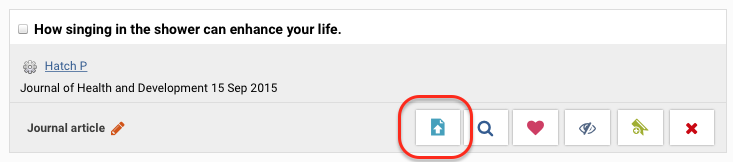
To do so, after you’ve created your publication record, click on the blue arrow up icon to deposit your full text –

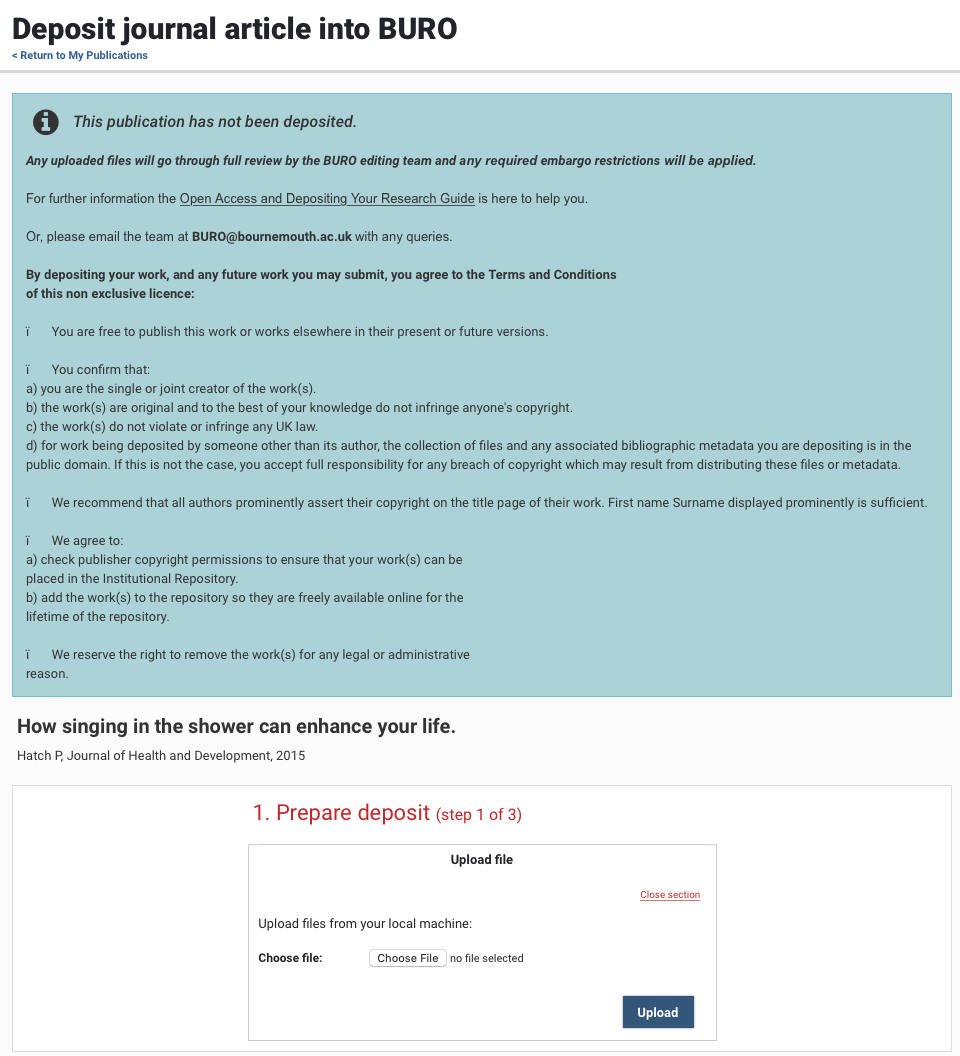
You will then be directed to a page where the terms and conditions associated with the deposit will be made clear, before you proceed with choosing your file to be uploaded –

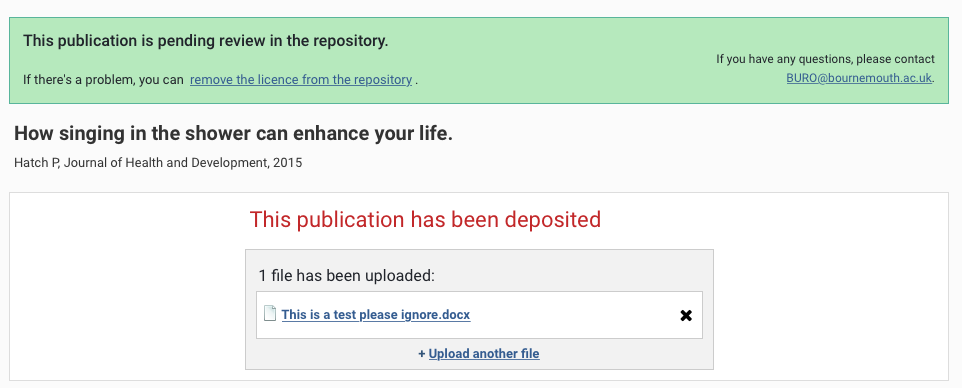
After you’ve uploaded your full text, it will then go through a review process by one of the Bournemouth University Research Online (BURO) team members with the Library and Learning Support Team. This is to ensure first of all, that the correct version of the full text has been uploaded; and depending on the publisher copyright policy, an embargo period may be imposed on the full text before it is visible to the public. If there are any problems with the deposit, one of the BURO teams members will contact the author directly to resolve the issue.

BURO (Bournemouth University Research Online)

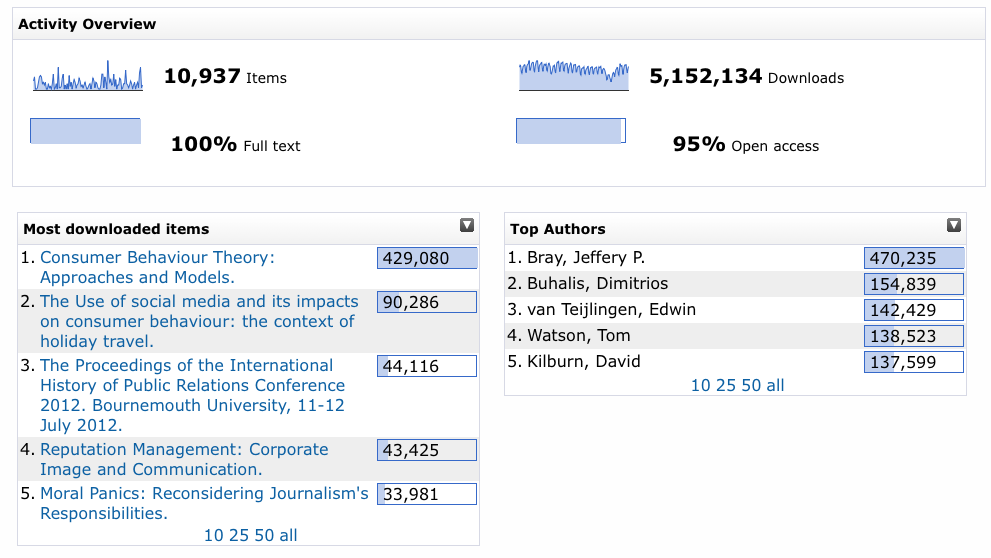
Once the full text has been reviewed and processed by the BURO team, it will then be deposited into our institutional repository (IR), which is Bournemouth University Research Online (BURO) and you would have complied with BU’s open access policy. In BURO, you will find all full texts deposited by other BU authors and you can browse the content by year, group or author (surname); and if you’re interested, you can also view the repository statistics in terms of the number of total outputs deposited, their breakdown by type, or you can even check out the most downloaded items from our repository!

BU Staff Profile Page

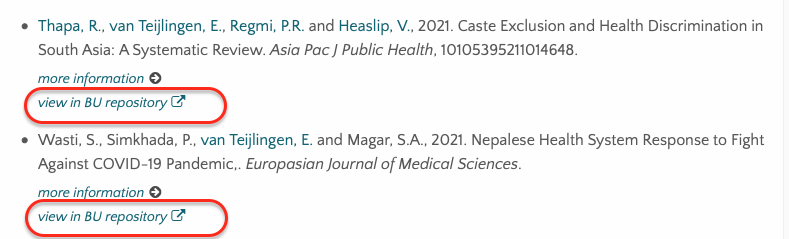
After your full text has been deposited into BURO, if you have a BU Staff Profile Page, the link to the full text will also appear under your publication record on your Staff Profile Page and it will look like this –

Any visitor to your Staff Profile Page can then click on the link and be directed straight to your full text in BURO read all about your research.

If you have any further queries, please don’t hesitate to email either BRIAN@bournemouth.ac.uk, BURO@bournemouth.ac.uk or OpenAccess@bournemouth.ac.uk


Open Access @ BU – An overview

Open Access

Open access is a broad international movement that seeks to grant free and open online access to academic information, such as publications and data. A publication is defined ‘open access’ when there are no financial, legal or technical barriers to accessing it – that is to say when anyone can read, download, copy, distribute, print, search for and search within the information, or use it in education or in any other way within the legal agreements. 

Open Access Funding @BU

Bournemouth University is unfortunately not a current recipient of the UKRI Open Access block grant. However, there is a small centralised BU Open Access Fund that BU authors can get access to on a competitive basis. Due to a very limited budget, application for funding is extremely competitive, and the selection criteria are stringent. In the past years, through the centralised open access fund, Bournemouth University has been able to support open access outputs from various impactful key research, including Epibentic and mobile species colonisation of a geo textile artificial sur reef on the south coast of England, Dignity and respect during pregnancy and childbirth: A survey of the experience of disabled women, Seven Characteristics Defining Online News Formats, Applied screening tests for the detection of superior face recognition, and many more!

Open Access Funding through Transformative Deals

Through the UK JISC Agreements, Bournemouth University currently has Read and Publish open access transformative deals with publishers such as BMJ, SAGE, Springer and Wiley, which means that BU authors can publish open access for free in the journal titles covered under the deals, subject to their terms and conditions. Each transformative deal and what it covers varies from one another. For example, the BMJ transformative deal only covers original research articles from research funded by UKRI, British Hearth Foundation, Blood Cancer UK, Cancer Research UK, Parkinsons UK, Versus Arthritis or the Wellcome Trust. As for the SAGE transformative deal, there is no such restrictions; however, you can only publish open access for free under a select list of journal titles.

In order to ensure that you get the maximum benefit from these transformative deals, do head over to the Bournemouth University Library and Learning Support guide for more details and information!

Green Open Access @ BU

Green Open Access, also referred to as self-archiving, is the practice of placing a version of an author’s manuscript into a repository, making it freely accessible for everyone. The version that can be deposited into a repository is dependent on the funder or publisher. You can make use of the Sherpa Romeo online resource to check the copyright policies of your target journal or publisher. At Bournemouth University, the self-archiving process is done through our current research and information system called BRIAN (Bournemouth Research Information and Networking); and all successfully reviewed and deposited manuscripts will be housed in our institutional repository called BURO (Bournemouth University Research Online).

Stay tuned for the next segment where we’ll be talking more about “Open Access @ BU & how it works!”

Open Access Publishing @ BU

Do you want to know more about what open access publishing means at BU and how it works? The Bournemouth University Library and Learning Support LibGuide provides a single source of information where you can find relevant topics on open access such as ‘Depositing your research’, ‘Copyright and Licenses’, ‘Open Access Funding’, ‘Predatory publishers’, so on and so forth.

So head over to the page now, and learn more about open access publishing @ BU!

https://libguides.bournemouth.ac.uk/c.php?g=471706&p=3226076


Wiley-Jisc read and publish agreement – update!

We have been informed that the Wiley Jisc read and publish agreement overall fund has been drawn down more quickly than initially projected. As a result, Wiley has estimated that restrictions will need to be introduced at the end of June 2021 which limits OA publishing to UKRI/Wellcome funded articles only.

This has not yet been confirmed, and Wiley will continue to monitor the fund but this is an early warning that some sort of restrictions will be placed on the Wiley-Jisc read and publish agreement later in the year.

Making your research count: how research impact is measured and what it means for you.


The library is offering a workshop on 16th November on Enhancing your Research Impact: understanding and navigating bibliometrics. 

This will provide an opportunity to understand both what bibliometrics are, and how research impact is measured. We will also discuss how to look after your researcher profile and the various ways impact is measured across different disciplines, as well as exploring Altmetrics and how your research can be viewed through social media posts and downloads.  

You can sign up for this workshop on the staff intranet, and you can explore the information in the guide below to find out more. 

Image sourced from:

Altmetric 2015. Altmetric logo with black text [png]. London: Altmetric. Available from: https://www.altmetric.com/about-us/logos [accessed 29th October 2020].


Changes to JISC Wiley Open Access Agreement

The Jisc-Wiley Read and Publish agreement transitions funds which previously paid for subscriptions to pay for OA publishing in Wiley’s hybrid and fully open access journals. Bournemouth University through agreement with JISC benefit from this agreement.

Due to high volume of articles which far exceeded original predictions modelled by JISC and Wiley, from 12 October, this agreement will be limited to OA publishing to Wellcome, UKRI, Blood Cancer UK, British Heart Foundation, Cancer Research UK, Parkinson’s UK and Versus Arthritis funded research only, to guarantee that all research funded will be published OA in 2020.

If you have further queries regarding this, please do get in touch with OpenAccess@bournemouth.ac.uk


HE policy update for the w/e 10th September 2020

We thought it might be a quiet week, this week, but we were wrong.  The DfE has started the new academic year with a bang, and the Ofs are going to be busy.

So we are back properly to our weekly schedule although with a bit of flexibility on days of the week.

International student visas

The Home Office have made an announcement about student visas.  The new international student immigration route is opening early, from 5th October to allow the “best and brightest” to apply for a visa under the new points based system.  That includes EU students.  This will mean that “as a result of coronavirus, some overseas students are choosing to defer their entry onto courses in the UK until the spring semester of 2021. Introducing these new routes now means that students will be able to benefit from the new streamlined process whilst still giving sponsors time to adapt after their autumn intake”.

The Secretary of State and the Minister for Universities speak

Gavin Williamson has been speaking to UUK.  He starts with a bouquet of praise and thanks for the sector and almost an apology for the extra work on admissions this year, although not quite.  There was always going to be a “but…”.

First he wanted to “land three key messages” related to the pandemic:

  • Keep going – and he looks forward to working with us all as the situation evolves over the autumn term
  • The importance of collaboration – specifically with local authorities.
  • And to stay alert, which includes comms to students and keeping them at uni rather than sending them home if there are local restrictions

And then the “but”.  It starts nicely:

  • Too often, there can be an implicit narrative that every university needs to measure itself against Oxbridge. That if a university isn’t winning Nobel prizes and taking in triple A students it is somehow second rate.
  • In reality, it is the diversity of our sector which will drive the levelling up agenda that is central to everything this Government does.

But…

  • There are still pockets of low quality. One only has to look at the Guardian subject league tables to see there are too many courses where well under 50% of students proceed to graduate employment.
  • But more fundamentally, in order to create a fairer, more prosperous and more productive country, we need to reverse the generational decline in higher technical education.
  • We have already announced that, over the next few years, we will be establishing a system of higher technical education where learners and employers can have confidence in high-quality courses that provide the skills they need to succeed in the workplace, whether they are taught in a further education college, a university or an independent training provider.
  • Of course, a large proportion of this will be delivered in our great further education colleges, but what I also want to see is for universities to end their preoccupation with three-year bachelors’ degrees and offer far more higher technical qualifications and apprenticeships. These would be more occupation focused and provide a better targeted route for some students, and benefit employers and the economy.

Again, none of this is new, he has been completely consistent.  It will be interesting to see how the sector responds.

Michelle Donelan

There was a double act at UUK this morning, as the Universities Minister also spoke.

Again, lots of thanks and different examples too.  I want to say a special thank you. Thank you for bending over backwards to unlock the dreams and opportunities of this year’s cohort.

Her speech is mostly about the bureaucracy reduction announcements set out below.  But in return for this her speech also has a “but”.  Her but is also consistent with what we have heard before.  She wants:

  • readily accessible bitesized learning for people looking to upskill and reskill…. and also foster a culture of lifelong learning”.

And it comes with a carrot – or a stick – hard to tell which:

  • You will remember that the Augar review looked in detail at flexible learning and argued for widespread changes to the organisation and funding of higher education to enable that flexibility. And we will respond in parallel with the Spending Review. Rest assured, the global pandemic has not and will not throw us off course.”

Her last point was about mental health, and the need for on-going support.

Bonfire of the metrics (and general reduction of bureaucracy)

The OfS were due to review the NSS this year, and of course we are also waiting (and have been waiting for ever, it seems) for the government response to the Pearce review of the TEF.  But the DfE have gone early.  In a move which confirms what we and everyone else has been saying all summer, the DFE have confirmed that they only really care about outcomes (and continuation) and asked the OfS to do a serious review of the NSS by the end of the year.

The announcement is here.  It is much broader than just the NSS, and there are some really interesting developments, so we will set them all out by area.

Starting with the Office for Students

The measures outlined below are a combination of decisions taken by the OfS to help achieve those aims, and changes that DfE would like the OfS to implement. DfE will be following up this policy document with strategic guidance to the OfS,”

  • Enhanced monitoring – the OfS intends to report to the DfE within 3 months on how it is reducing its use of enhanced monitoring
  • Data futures – OfS has agreed to review the proposed termly data collection to make sure it is proportionate – also looking at making data collection more timely. Due by end October with final decisions alongside an OfS data strategy in April.
  • Random sampling – the OfS has suspended this
  • No further regulatory action on student transfers – this was a “big issue” in the original Jo Johnson Green/White Paper – students were being prevented or discouraged from transferring, apparently. The OfS has decided to review their current requirements for monitoring and consult on changes – but the headline suggests they won’t get more onerous.
  • The announcement welcomes the already announced decision to make estates and non-academic data collected by HESA optional.
  • Review of TRAC (T). The Transparent Approach to Costing for Teaching.  This data was used by Augar to attack fees and the announcement recognises that the government have used it to look at efficiency.  The OfS have been asked to review it because the sector have said that it is “disproportionately burdensome”.  This year’s return has been cancelled.  A “way forward” for the review is due by October alongside the UKRI review of the other stream of TRAC (see below).
  • Review of the transparency condition – this is the monitoring data provided to the OfS relating to offers and acceptable, completion and outcomes, including by gender, ethnicity and background. The OfS have said that they will explore if the amount of information requested can be reduced and replaced by other sources, and the DfE are “pleased” with that.  Due by end October.
  • Reduction in OfS fees – the OfS have to review their own efficiency with a view to reducing fees, and to help them along the government’s review of fees (which are set by the Secretary of State) will take place this Autumn instead of next year. The QAA and HESA are expected to reduce their fees too.

So, the NSS.  Hold on to your hats – these statements are bold!

  • We have asked the OfS to undertake a radical, root and branch review of the National Student Survey (NSS)…..Since its inception in 2005, the NSS has exerted a downwards pressure on standards within our higher education system, and there have been consistent calls for it to be reformed. There is valid concern from some in the sector that good scores can more easily be achieved through dumbing down and spoon-feeding students, rather than pursuing high standards and embedding the subject knowledge and intellectual skills needed to succeed in the modern workplace. These concerns have been driven by both the survey’s current structure and its usage in developing sector league tables and rankings. While government acknowledges that the NSS can be a helpful tool for providers and regulators, we believe its benefits are currently outweighed by these concerns. Further, its results do not correlate well with other, more robust, measures of quality, with some of the worst courses in the country, in terms of drop-out rates and progression to highly skilled employment, receiving high NSS scores. Accordingly, the extensive use of the NSS in league tables may cause some students to choose courses that are easy and entertaining, rather than robust and rigorous.
  • The government shares concerns raised by some in the sector that, in its current form, the NSS is open to gaming, with reports of some institutions deliberately encouraging their final year students to answer positively with incentives or messaging about their future career prospects. Academics have also criticised the cost and bureaucracy the NSS creates, arguing that the level of activity it generates can be a distraction from more important teaching and research activities. There is a sense that the level of activity it drives in universities and colleges has become excessive and inefficient. For example, we are aware that some providers employ analysts to drill down into NSS performance, in some cases at module level, and investigate any sub-par performance.
  • Student perspectives do play a valuable role in boosting quality and value across the sector, but there is concern that the benefits of this survey are currently outweighed by the negative behaviours and inefficiencies it drives. Universities must be empowered to have the confidence to educate their students to high standards rather than simply to seek ‘satisfaction’.

Now, many people will agree with at least some of that.  The sector blows hot and cold on the NSS – heavily critiquing its use in the TEF, then worrying that there was no voice for students when it was diluted in later iterations.  Many have criticised it for being subjective and unhelpful (so not so much a criticism of the survey as a tool for driving improvements, as a criticism of its inclusion in the TEF and league tables) – but that was a case of the TEF using the metrics that they had, because there wasn’t anything else.  Lots of people have criticised the methodology, despite the reviews that have been carried out before.  Some universities have had consistent boycotts (Oxbridge).

But don’t think that abolishing it will mean that we can stop worrying about the underlying issues.  The OfS have been asked (by the end of the calendar year!) to:

…undertake a radical, root and branch review of the NSS, which:

  • reduces the bureaucratic burden it places on providers
  • ensures it does not drive the lowering of standards or grade inflation
  • provides reliable data on the student perspective at an appropriate level, without depending on a universal annual sample
  • examines the extent to which data from the NSS should be made public
  • ensures the OfS has the data it needs to regulate quality effectively
  • will stand the test of time and can be adapted and refined periodically to prevent gaming

Expectations are high.  No annual survey and yet reliable data….that reduces the bureaucratic burden, and prevents gaming and avoids lowering standards and grade inflation.  Notably there are no positive suggestions about what a new approach actually will achieve other than “reliable data on the student perspective”.  You might ask perspective on what?  Not satisfaction, it seems, or even experience, but “quality and value”.   It sounds like getting rid of it completely is on the table, replacing it with something else that isn’t a survey at all.  But what?  So this is your moment.  What is the best way to get “reliable data on the student perspective”.  We look forward to engaging with staff across BU on the inevitable OfS call for evidence.

Obviously the OfS have responded to all this.  They seem to think that they will be keeping the survey.  Maybe the requirement to avoid an annual universal sample means just that – not annual, not everyone, just a sample?

  • ‘On the NSS, our review will seek to reduce any unnecessary bureaucracy, prevent any unintended consequences and gaming of the survey, whilst ensuring that the NSS stands the test of time as an important indicator of students’ opinions and experiences at every level.

UKRI and BEIS

UKRI are being asked to make a lot of changes

Selection

  • simplify eligibility criteria for bidding
  • streamline grant schemes
  • streamlined two stage application process for grants – only necessary information provided at each stage
  • single format for CVs
  • “brand new, fully digital, user-designed, applicant-focused and streamlined grants application system with the first pilot launched in August”
  • single information document for a call rather than lots

Assurance and outcomes

  • harmonising reporting
  • reducing the number of questions and making it “minimally demanding”
  • enhance risk based funding assurance approach to reduce the burden and assure an organisation not individual projects
  • review end of award reporting

Other things

  • provide additional independent challenge (on costs and bureaucracy)
  • Stop multiple asks for information that already exists
  • review TRAC (as mentioned above)

NIHR

The NIHR are congratulated for already taking a number of steps to reduce the burden on researchers.  Now there are a set of new commitments to take this further.

  • Will consider ways of making peer review more proportionate
  • “will immediately delete clauses which place obligations on research institutions which add limited value to the general research endeavour and end user from the standard NIHR contract”
  • “review eligibility criteria for all funding streams including requirements for compliance with charters and concordats”
  • Will drop the requirement for Silver Athena Swan – but instead “We will expect organisations that apply for any NIHR funding to be able to demonstrate their commitment to tackling disadvantage and discrimination in respect of the nine protected characteristics set out in the Equality Act (2010). These are: age, disability, gender reassignment, marriage or civil partnership, pregnancy and maternity, race, religion or belief, sex, and sexual orientation” [that sounds like more not less bureaucracy….]
  • “NIHR currently obliges researchers, through a standard contractual provision, to notify DHSC of all publications associated with their research. ….This contractual clause will be deleted for almost all new contracts from 1st August 2020 “

Reductions in providers’ internal bureaucracy

What could this mean?  Well:

  • We …expect providers to ensure reductions in government or regulator imposed regulatory activity are not replaced with internal bureaucracy. In addition, we want them to go even further to enable academics to focus on front line teaching and research: stripping out their existing unnecessary internal bureaucracy, layers of management and management processes. [now that interesting, we flagged it a few weeks ago because it featured in the introduction to the financial restructuring document as an objective…but it is still unclear how this should be implemented – and one person’s internal bureaucracy is another person’s sensible internal control measure]
  • There are a wide variety of organisations which offer voluntary membership awards or other forms of recognition to support or validate an organisation’s performance in particular areas. …. Such schemes can be helpful but can also generate large volumes of bureaucracy and result in a high cumulative cost of subscriptions. Where a university believes that membership of such schemes are genuinely the best way of addressing a matter, it is of course free to do so, but in general universities should feel confident in their ability to address such matters themselves and not feel pressured to take part in such initiatives to demonstrate their support for the cause the scheme addresses. [from the points made above, that probably includes Athena Swan – what else?]
  • We will engage with the sector, and in partnership with research funding bodies across the UK, to tackle the broader issues that are often causes of unnecessary bureaucracy. [Like what?]
  • This is also an opportunity to shift the research sector to more modern methods of research, which will help cut red tape too. This means embracing modern methods of peer review and evaluation. It also means tackling the problematic uses of metrics in research and driving up the integrity and reproducibility of research. Crucially, we must embrace the potential of open research practices.

David Kernohan was quick to respond on Wonkhe.  One thing he points out is that the government are correct that the NSS does not correlate with highly skilled employment or outcomes.  But he points out that the government’s favourite two metrics don’t correlate with each other either  – and of course why would they.

Brexit

Have you missed it?

As you know, the trade deal with the EU has to be done by the end of the year because that is when the transitional period ends.  It could have been extended, but the deadline to request an extension was 30th June 2020 – and there was no way this government (with its large majority all signed up to a possible no deal Brexit) was going to ask for an extension.

The deadline for a deal has similarly been a bit flexible – of course, and despite all the talk of dates, the most real deadline is 31st December.  Originally it had been suggested that the deal needed to be done by July to allow for ratification – now both sides are saying that the EU leaders’ meeting on 15th October is the deadline.  But no-one will really be surprised if it carries on after that.  The withdrawal agreement was sorted in October last year, as you will remember and was then approved by Parliament in December 2020, receiving royal assent in January, just days before the UK left the EU on 31st January.  It was close.  The draft legislation wasn’t even published during all the backwards and forwards before the election, because it was such a hostage to fortune for the May government.  Then Boris negotiated changes to the withdrawal agreement and “got it done”, just in time.

So, the government are getting ahead.  Hence all the fuss about the new draft bill. Press coverage has been very excitable, especially as the NI Secretary confirmed in Parliament before it was published that the new law will “breach international law in a specific and limited way”.  As many are saying, that is not usually a defence (“sorry officer, but I only [insert criminal offence of choice here] in a specific and limited way”).  You can read the Hansard extracts here.

The Internal Markets Bill was published yesterday.  If you want to read it, it is here, which is where you will also find all the amendments etc. as it goes through.

The Institute for Government have a short blog here:

  • The bill would give ministers powers to make regulations about state aid and customs procedures for trade from Northern Ireland to Great Britain, and would allow ministers to make regulations inconsistent with the UK’s obligations under the Withdrawal Agreement.
  • The existence of those powers is a breach of Article 4 of the Withdrawal Agreement, which provides that the UK must use primary legislation to give full effect to the Withdrawal Agreement in domestic law.
  • However, unless the powers were actually used, the UK would not be in breach of the state aid and customs provisions of the Northern Ireland protocol.

So that answers that question.

And also:

  • Perhaps more extraordinary than the bill’s provisions on international law are those on domestic law. Under s45(4)(g) of the bill, regulations made by the minister on state aid or customs declarations would have legal effect notwithstanding their incompatibility with “any rule of international or domestic law whatsoever”.
  • This appears to be an attempt to oust the jurisdiction of the courts to review the legality of ministerial decisions under these powers at all.
  • Such clauses are rare, and they rarely work. The courts have repeatedly found ways of reviewing government decisions even where similar clauses have tried to keep them out of the picture.
  • That is because the judges consider them an affront both to the rule of law and to parliamentary sovereignty. “It is a necessary corollary of the sovereignty of Parliament,” the Supreme Court said in a case on this issue last year, “that there should exist an authoritative and independent body which can interpret and mediate legislation made by Parliament.”
  • Section 45 of this bill will make uncomfortable reading for anyone who believes in the principle that governments are subject to the law, at home and abroad. It requires careful scrutiny in parliament.

The other concerns are about timing.  We can look forward to the arguments being aired in full over the next two weeks.

So what is the issue?

From the BBC:

  • The UK and EU settled on the Northern Ireland Protocol. This would see Northern Ireland continue to follow some EU customs rules after the transition period – meaning customs declarations would be needed for goods moving from Northern Ireland to Great Britain, as well as some new checks on goods going from Great Britain into Northern Ireland.
  • It was unpopular with some sections of the Tory backbenches and Northern Ireland’s Democratic Unionist Party – which had been supporting the government until that point. But the agreement was passed through Parliament and the Northern Ireland Protocol became part of the international treaty.

You will remember all this, because the PM said there would be no checks, and then the government said well actually there would, etc…..

From the BBC again:

  • Downing Street said one thing it would do is allow ministers to unilaterally decide what particular goods were “at risk” of entering the EU when passing between Great Britain and Northern Ireland, and therefore subject to EU tariffs.
  • The law would also give ministers the powers to scrap export declarations on goods moving from Northern Ireland to Great Britain and would make it clear that EU state aid requirements – where governments give financial support to homegrown businesses – would only apply in Northern Ireland.
  • But the government insists the bill only introduces “limited and reasonable steps” to “remove ambiguity” – not “overriding” the withdrawal agreement, as government sources had suggested on Sunday.

We will see.  Maybe they are just making sure that there is time for proper Parliamentary scrutiny this time, by publishing something technical in good time rather than waiting for October when the deal is finalised and there is no time to discuss it properly.  Or maybe it is sabre rattling.  And why might they need to sabre-rattle?  Because, apart from the NI border issue, there are also a couple of (unsurprising) issues outstanding in the main trade deal negotiations with the EU.

One is fishing rights, which was always going to be tricky.  You will recall that at one point it nearly derailed the discussions last year when France and Spain demanded extra concessions at the last minute.  There is an Institute for Government article from March and a  Guardian article (from June).

And the other issue is state aid – the rules about supporting domestic businesses, which are seen as anti-competitive.  There is an FT article on that.

We can expect a lot more rhetoric, bitterness, and positioning over the next few weeks.  It is clear that the deal won’t be done until it is done, and also that all the other bits, like research collaboration and participation in Erasmus, are dependent on there being a deal at all.  So we’ll just have to wait and see.

Subscribe!

To subscribe to the weekly policy update simply email policy@bournemouth.ac.uk.

Did you know? You can catch up on previous versions of the policy update on BU’s intranet pages here. Some links require access to a BU account- BU staff not able to click through to an external link should contact eresourceshelp@bournemouth.ac.uk for further assistance.

External readers: Thank you to our external readers who enjoy our policy updates. Not all our content is accessible to external readers, but you can continue to read our updates which omit the restricted content on the policy pages of the BU Research Blog – here’s the link.

JANE FORSTER                                            |                       SARAH CARTER

Policy Advisor                                                                     Policy & Public Affairs Officer

Follow: @PolicyBU on Twitter                   |                       policy@bournemouth.ac.uk
Jisc, UK institutions and SAGE agree open access deal

BU authors can now publish open access in 900+ SAGE subscription journals at no extra cost!

The UK Jisc Agreement, open to all UK institutions who are members of the consortium, will run between 2020 and 2022 and includes back dating to the 1st January.

Corresponding authors publishing an article in 900+ subscription journals in the current SAGE Premier package, as well as in the IMechE Journal Collection and the Royal Society of Medicine Collection can now publish open access, free of charge. Eligible journals are those which offer hybrid open access publishing (SAGE Choice).

Please check with Open Access if you are unsure whether your journal is included.

Authors in subscription journals do not need to take any action to benefit from this offer – SAGE will contact all eligible authors to inform them of the Open Access agreement with Jisc and to invite them to the SAGE Open Access Portal to take up the offer as soon as their accepted article has been received into SAGE’s Production department.


Gold open access journals: Corresponding authors publishing an article in a gold open access journal are entitled to a 20% discount on the prevailing article processing charge (APC). This is available on 150+ pure Gold journals a list of which are available here.

Where an author is eligible for more than one discount, discounts cannot be combined but the highest discount available to the author will be automatically applied to the APC due.

Further information on the agreement and gold open access journals can be found here.
If you have any further queries, please email Open Access.

Jisc, UK institutions and Wiley agree ground-breaking open access deal

Bournemouth University authors can now publish Open Access in more than 2,000 Wiley journals at no extra cost!

Jisc and Wiley, a global leader in research and education, have struck a four-year “read and publish” agreement that offers researchers at UK universities open access (OA) publishing in all Wiley journals at no cost to them.

As part of the new agreement, the proportion of OA articles published by UK researchers will increase from 27% to an estimated 85% in year one, with the potential to reach 100% by 2022. The agreement will also enable institutions and their users to access all of Wiley’s journals.

This ground-breaking agreement will enable institutions to control the costs of access and OA publishing. It will also support a simplified process for authors and their institutions, enabling compliance with funder mandates and Plan S.

The agreement begins in March 2020, and all participating Jisc member institutions and affiliated researchers are eligible. The contract has been made publicly available on 31 March 2020.