Category / Open Access

BORDaR – a new dedicated research data repository.

Thursday 8 February saw the launch of BORDaR (Bournemouth Online Research Data Repository), Bournemouth University’s new research data repository, which provides a secure and open access home for data emanating from BU’s world leading research projects.

Our support for Research Data Management (RDM) begins here and is complemented by a RDM Library Guide which has been developed specifically for BU staff.  Use this guide to help you deposit your data Open Access as mandated by your research funder and to increase your research impact for REF 2021 – you can find guidance on developing a Data Management Plan, managing, documenting, depositing, sharing and securing your data.  You can also email bordar@bournemouth.ac.uk with your query.

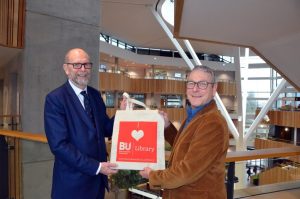
Back in November a repository naming competition was held and from the Faculty of Science & Technology, Paul Cheetham’s suggestion of BORDaR was chosen as the winner by BU’s RDM Steering Group.  As his prize Paul received a much cherished copy of Armin Schmidt’s Earth resistance for archaeologists, from Pro-Vice-Chancellor Professor (Research and Innovation), John Fletcher.

Fake conferences are not fake news: beware predatory conferences

Introduction

Academic have been warned for a decade about predatory Open Access publishers (van Teijlingen 2014). These are commercial organisations charging academics a publication fee on submission of their manuscripts with a promise to publish their work quickly online. The problem is twofold: first, these commercial organisations don’t offer proper peer-review and editorial quality assurance; and secondly, academic are being tricked into believing the journal is a legitimate scientific publication.  The second author receives on average six to eight invitations a week to publish in this kind of predatory journals – see below for examples. The first author, who despite having not worked in an academic institution for over three years, still receives such invitations to publish in ‘Journal X’.

Predatory conferences
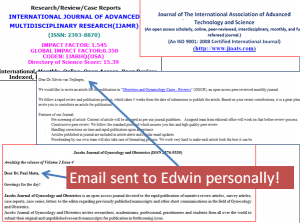
A similar phenomenon to predatory journals is the predatory conference (Moital 2014; Nobes 2017; Grove 2017). These are pretend academic conferences of questionable value, established first and foremost to make money, not for the greater good of the academic discipline.
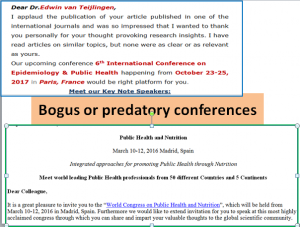
Both authors have received bogus and legitimate invitations to attend conferences. A predicament with such an invitation, which 99% of time arrives by email, is that it is not easy to distinguish between fake and real offers. For example, the first author recently received an offer (at short notice), to attend a conference in Miami in November 2017 (see below). This was on the back of an editorial he had published couple of months earlier. For a career researcher going from contract to contract, the appeal of being invited to present a keynote at a conference can be flattering, far less an honour and a boost for one’s career. Therefore, while the idea that if it seems too good to be true, is a prudent one to hold; there is also a temptation to follow through.

The author replied to the request quizzing the reason for the invite out of the blue. The answer was less than convincing, and a swift email by the author saying “Don’t tell me… You are offering me a keynote with travel and accommodation… Lol!!” called their bluff and ended correspondence.
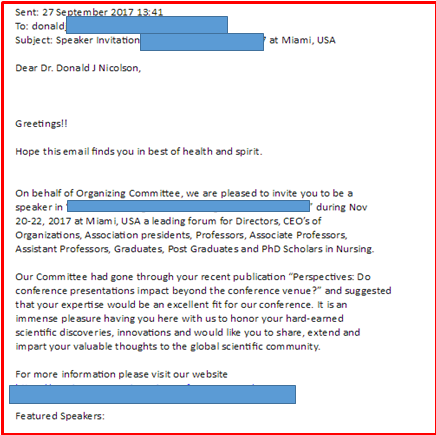
But digging a little deeper he found there was a webpage dedicated to taking payments to attend the conference. In the digital world, a fool can be easily and quickly separated from his or her money.

Of course, it may have been a real conference at a real venue, and they really wanted him to speak. But discerning this is not easy at first…

Some of the warning signs/What to look out for

  • The conference email invitation looks very convincing (if not don’t even read it!).
  • The venue is good location as Nobes (2017) highlighted, “the organizers are more interested in marketing the tourist destination rather than the academic value of the conference”.
  • The conference covers too many different aspects or topics, as if the advert is designed to catch the eye of many people as possible who are vaguely connected to the discipline.
  • Mentions on associated predatory journals and ‘important’ organisations in the discipline.
  • Email and bank accounts that don’t look professional/ official.
  • Little mention of attendance fees, but after acceptance emails demanding a high conference fee and other charges.
  • Conference organisers are not academics, or unknown names.
  • Conference does not peer-review submission/ not provide proper editorial control over presentations
  • Signs of copying of names of existing academic conferences or scientific organisation and even copying of their webpages
  • Even more advertising than normal at a scientific conference.

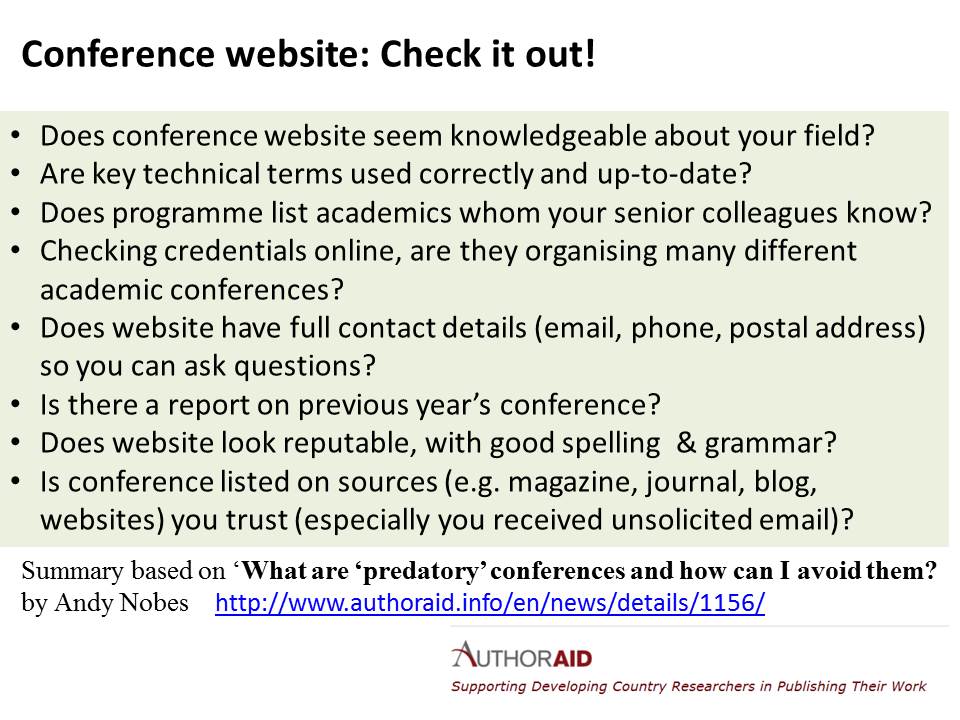
Furthermore, Andy Nobes (2017) offered some helpful advice on quality of the conference websites in the list below. Andy is based at AuthorAID, a global network providing support, mentoring, resources and training for researchers in developing countries.
Who is at risk of falling for predatory conferences?

Academics need to be aware of money-making conferences and meetings without a true commitment to science. But some academics might be more at risk than others. Young researchers, PhD students and fledgling academics, living from contract to contract may feel any conference attendance is a potential career boost. Thus, such an invitation might seem flattering and an opportunity to good to miss. A way to show that he or she is a capable and independent academic.

Final thoughts

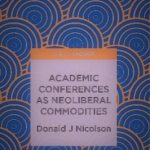
Most academics go to conferences for a combination of presenting their work to get critical feedback, making new contacts, sharing ideas and to be inspired. With such broad combination of motivating factors, the exact purpose of conferences is difficult to ascertain because there is no a priori agreed role and value of conferences (Nicolson, 2017a). However, there is evidence that academic conferences function to facilitate commodity transactions, be that knowledge, tools, skills, reputations, or connections, which reflects the neoliberal ethos in the modern academy (Nicolson 2017b). The predatory conference can be viewed in this light, where academia is more and more focused on generating revenue. It is at best scurrilous, and worst, criminal, for organisations to make money using such a confidence trick.  Always check which conferences are organised and advertised by recognised scholarly organisations in your own discipline. If uncertain ask a more experienced academic, a senior colleague or mentor.


Donald J. Nicolson

(Health Services Researcher, NHS Fife, and Independent Scholar; twitter @_mopster )

Edwin R. van Teijlingen

(Centre Midwifery, Maternal & Perinatal Health)


References:

Moital, M. (2014) Ten Signs of a Bogus/Fake Conference.

Grove, J. (2017) Predatory conferences ‘now outnumber official scholarly events’  (26th Oct.)

Nicolson, D.J. (2017a) Do conference presentations impact beyond the conference venue? Journal of Research in Nursing. 22(5), pp.422-425.

Nicolson, D.J. (2017b) Academic Conferences as Neoliberal Commodities, Palgrave Macmillan

Nobes, A. (2017) What are ‘predatory’ conferences and how can I avoid them?

van Teijlingen, E. (2014) Beware of rogue journals.
 

Help us choose a name for BU’s new Research Data Repository

We are now in the final stages of developing a repository solution for Bournemouth University research data.  Like its partner BURO (Bournemouth University Research Online), BU’s open access research output repository that shares your BRIAN deposits with the world, the new research data repository will provide a secure yet open access place to archive and showcase all of your research data once your research projects are complete.

Now we really need your help and creativity in suggesting a good name for this new Research Data Repository.

Some keywords to consider, but not exclusively, are Bournemouth University, research, data, repository and archive.  Remember, the name will be something that identifies our data repository and BU’s high quality research for many years to come, so think carefully.  Please note Data McDataface has already been discounted!

Please email your suggestions to rdm@bournemouth.ac.uk by Friday 24th November?

If your suggestion is judged to be the winning entry by the RDM Steering Group you will receive a mystery prize!

Find out more about Research Data Management (RDM) at BU via:

You can sign up to attend a RDM workshop here.


Need tips on developing a publication strategy?

Then come along to one of the Writing Academy’s “My publication story so far…” lunchbyte sessions.

The first of 2017, is happening today at midday led by Prof. Matthew Bennett.

Matthew Bennett will be talking about his personal publishing experience, his approaches to research and writing, his tips on developing a publication strategy and working with co-authors, reviewers and editors. He will talk about all types of publishing from journal articles, to books via edited compilations. Drawing on personal experience publishing in Nature, he will also focus on how you target high impact journals.

Click here to book on!

Future sessions:

Prof. Tim Rees – Wednesday 24th May, 12-1.30pm

Prof. Sara Ashencaen Crabtree – Wednesday 28th June, 12-1.30pm

Click here to book on!

Prof. Tim Rees – My publication story so far…

On Wednesday 24th May, the Writing Academy will be hosting a Lunchbyte session with Tim Rees. During the session Tim will talk about his personal publishing experience, his approaches to research and writing, his tips on developing a publication strategy and working with co-authors, reviewers and editors. He will talk about all types of publishing drawing on personal experience.

Aims:

  • Developing a Publication Strategy
  • Dealing with Co-Editors, Reviewers & Editors
  • Targeting high impact Journals

Click here to book on!

Dedicated Time and Space to Write…

As part of the Writing Academy, a series of writing days have been organised to help support BU authors work on their publications by providing some dedicated time and space, away from everyday distractions.

The days will have a collaborative focus on productive writing with other BU authors, the RKEO team will also be on hand to provide authors with help and guidance on all areas of the publication process.

Writing Days have been scheduled on the below dates:

  • Tuesday 9th May
  • Thursday 25th May
  • Friday 9th June
  • Monday 19th June
  • Tuesday 20th June
  • Wednesday 5th July
  • Thursday 27th July

Spaces are limited so please only book on if you are able to commit to attending for the whole day.

Click here to book on!

Publish Open Access in Springer Journals for Free!

Open-Access-logoBU has an agreement with Springer which enables its authors to publish articles open access in one of the Springer Open Choice journals at no additional cost.
There are hundreds of titles included in this agreement, some of which are – Hydrobiologia, European Journal of Nutrition, Annals of Biomedical Engineering, Climatic Change, Marine Biology and the Journal of Business Ethics. A full list of the journals included can be found here

To make sure that your article is covered by this new agreement, when your article has been accepted for publication, Springer will ask you to confirm the following:

  • My article has been accepted by an Open Choice eligible journal
  • I am the corresponding author (please use your institutional email address not your personal one)
  • I am affiliated with an eligible UK institution (select your institutions name)
  • My article matches one of these types: OriginalPaper, ReviewPaper, BriefCommunication or ContinuingEducation

Springer will then verify these details with us and then your article will be made available in open access with a CC BY licence.

Please note that 30 Open Choice journals are not included in this agreement as they do not offer CC BY licensing.

If you have any questions about the agreement or the process, please contact OpenAccess@bournemouth.ac.uk

Publish Open Access in Springer Journals for Free!

Open-Access-logoBU has an agreement with Springer which enables its authors to publish articles open access in one of the Springer Open Choice journals at no additional cost.

There are hundreds of titles included in this agreement, some of which are – Hydrobiologia, European Journal of Nutrition, Annals of Biomedical Engineering, Climatic Change, Marine Biology and the Journal of Business Ethics. A full list of the journals included can be found here

To make sure that your article is covered by this new agreement, when your article has been accepted for publication, Springer will ask you to confirm the following:

  • My article has been accepted by an Open Choice eligible journal
  • I am the corresponding author (please use your institutional email address not your personal one)
  • I am affiliated with an eligible UK institution (select your institutions name)
  • My article matches one of these types: OriginalPaper, ReviewPaper, BriefCommunication or ContinuingEducation

Springer will then verify these details with us and then your article will be made available in open access with a CC BY licence.

Please note that 30 Open Choice journals are not included in this agreement as they do not offer CC BY licensing.

If you have any questions about the agreement or the process, please contact OpenAccess@bournemouth.ac.uk

Publish Open Access in Springer Journals for Free!

Open-Access-logoBU has an agreement with Springer which enables its authors to publish articles open access in one of the Springer Open Choice journals at no additional cost.

There are hundreds of titles included in this agreement, some of which are – Hydrobiologia, European Journal of Nutrition, Annals of Biomedical Engineering, Climatic Change, Marine Biology and the Journal of Business Ethics. A full list of the journals included can be found here

To make sure that your article is covered by this new agreement, when your article has been accepted for publication, Springer will ask you to confirm the following:

  • My article has been accepted by an Open Choice eligible journal
  • I am the corresponding author (please use your institutional email address not your personal one)
  • I am affiliated with an eligible UK institution (select your institutions name)
  • My article matches one of these types: OriginalPaper, ReviewPaper, BriefCommunication or ContinuingEducation

Springer will then verify these details with us and then your article will be made available in open access with a CC BY licence.

Please note that 30 Open Choice journals are not included in this agreement as they do not offer CC BY licensing.

If you have any questions about the agreement or the process, please contact OpenAccess@bournemouth.ac.uk

Open Access in Horizon 2020

horizon 2020Open access to peer reviewed publications has been anchored as an underlying principle in the Horizon 2020 and is explained in the Regulation and the Rules of Participation. If you are a beneficiary or hoping to be a beneficiary of a Horizon 2020 grant, you need to be aware of your obligations to publish open access. Below are some of the key points taken from Horizon 2020 guidance which can be accessed in full here.

Are you supposed to deposit?

All Horizon 2020 beneficiaries are required to deposit and ensure open access.

What to deposit

  • A machine-readable electronic copy of the published version publisher’s final version of the paper, including all modifications from the peer review process, copyediting and stylistic edits, and formatting changes (usually a PDF document)

OR

  • A final peer-reviewed manuscript accepted for publication final manuscript of a peer-reviewed paper accepted for journal publication, including all modifications from the peer review process, but not yet formatted by the publisher (also referred to as “post-print” version).

Where to deposit

Researchers should deposit in a repository for publications of their choice. In order to manage and monitor open access compliance, BU request that all authors publish in our institutional repository (BURO) this can be done easily through BRIAN. Further information on how to do this can  be accessed here.

When to deposit

Each beneficiary must deposit as soon as possible. To comply with HEFCEs Open Access policy this should be on acceptance of the article.

Open-Access-logoWhen should Open Access be provided

Each beneficiary must ensure open access to the deposited publication — via the repository — at the latest: (i) on publication, if an electronic version is available for free via the publisher, or (ii) within six months of publication (twelve months for publications in the social sciences and humanities) in any other case.

For open access publishing, researchers can publish in open access journals, or in journals that sell subscriptions and also offer the possibility of making individual articles openly accessible (hybrid journals).  Where the case, the Author Processing Charges (APCs) incurred by beneficiaries are eligible for reimbursement during the duration of the action. For APCs incurred after the end of their grant agreement, a mechanism for paying some of these costs will be piloted. In the case of open access publishing open access must be granted at the latest on publication.

Beneficiaries must also ensure open access to the bibliographic metadata that identify the deposited publication. The bibliographic metadata must be in a standard format and must include all of the following:

  • the terms [“European Union (EU)” and “Horizon 2020”][“Euratom” and Euratom research and training programme 2014-2018″];
  • the name of the action, acronym and grant number;
  • the publication date, and length of embargo period if applicable, and
  • a persistent identifier.

In all cases, the Commission encourages authors to retain their copyright and grant adequate licences to publishers. Creative Commons offers useful licensing solutions in this regard (e.g. CC-BY, see Creative Commons Licenses).

In the context of the digital era, the notion of’ publication’ increasingly includes the data underpinning the publication and results presented, also referred to as ‘underlying’ data. Beneficiaries must aim to deposit at the same time the research data needed to validate the results presented in the deposited scientific publications, ideally into a data repository, and aim to make open access to this data. But there is no obligation to do so.

Tags:

OpenAIRE Webinars

openaccessweek_logo

For this year’s 9th International Open Access Week, OpenAIRE has scheduled a full week of webinars on various exciting Open Science topics. During the week of October 24-30, join them at lunchtime (12.00 CEST) each day for key insights into the ethics and implementation of Open Science, especially as they relate to the EC’s Horizon2020 programme and OpenAIRE’s mission to foster the social and technical links that enable Open Science in Europe and beyond.

  • MONDAY: “The fundamentals of Open Science”, October 24, 2016 at 12.00 CEST, on key introductory themes in Open Science, with Tony Ross-Hellauer (OpenAIRE, University of Goettingen), Paola Masuzzo (Ghent University) and Chris Hartgerink (Tilburg University).
  • TUESDAY: “H2020 Open Access mandate for project coordinators and researchers”, October 25, 2016 at 12.00 CEST, on Open Access to publications in Horizon 2020, with Eloy Rodrigues and Pedro Principe (University of Minho).
  • WEDNESDAY: “Open Research Data in H2020 and Zenodo repository”, October 26, 2016 at 12.00 CEST, on Research Data Management in Horizon 2020 and the Zenodo repository functionalities, with Marjan Grootveld (DANS) and Krzysztof Nowak (CERN).
  • THURSDAY: “Policies for Open Science: webinar for research managers and policy makers”, October 27, 2016 at 12.00 CEST, on OpenAIRE’s policy activities building on the PASTEUR4OA project, and how to create/implement policies for open science at a local and national level, with Marina Angelaki and Alma Swan (PASTEUR4OA) and Tony Ross-Hellauer (OpenAIRE).
  • FRIDAY: “OpenAIRE guidelines and broker service for repository managers”, October 28, 2016 at 12.00 CEST, on Openaire compatibility guidelines and the dashboard for Repository Managers, with Pedro Principe (University of Minho) and Paolo Manghi (CNR/ISTI).

To participate in any (or all) of these webinars, please register here: https://goo.gl/HIcpJT


Congratulations to Prof. Hundley on her latest systematic review paper

This week Professor Vanora Hundley in the Centre for Midwifery, Maternal & Perinatal Health (CMMPH) published a systematic review form with her international collaborators working on early labour.   The paper is called ‘Diagnosing onset of labor: A systematic review of definitions in the research literature‘ and can be found it the Open Access journal BMC Pregnancy & Childbirth. [1]

Congratulations!

Prof. Edwin van Teijlingen


Reference:

  1. Hanley GE, Munro S, Greyson D, Gross MM, Hundley V, Spiby H and Janssen PA (2016) Diagnosing onset of labor: A systematic review of definitions in the research literature. BMC Pregnancy and Childbirth 16: 71 http://bmcpregnancychildbirth.biomedcentral.com/articles/10.1186/s12884-016-0857-4


Open Access Drop-in Sessions

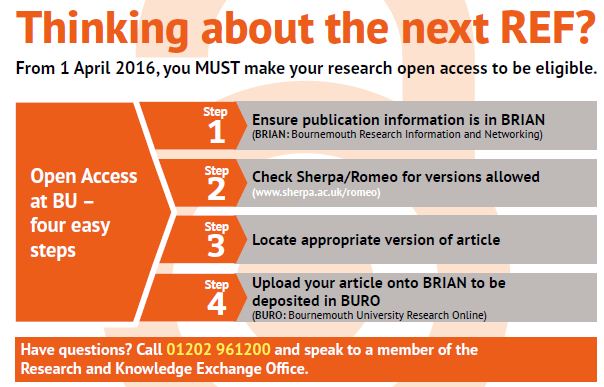
Thinking about the next REF?

On 11th, 12th and 13th of April, RKEO will team up with the Library to provide Open Access Drop-in sessions. Please do pop in to get some hands on support and advice on making your research open access to comply with the HEFCE post-REF2014 Open Access Policy.

Monday, 11th April – 12.30pm to 1.30pm – S117, Studland House

Tuesday, 12th April – 12.30pm to 1.30pm – S117, Studland House

Wednesday, 13th April – 12.30pm to 1.30pm – S117, Studland House

Thinking about the next REF?

153px-Open_Access_logo_PLoS.svgHEFCE’s policy for open access states that all new peer-reviewed journal articles and papers from published conference proceedings (with ISSN) should be deposited in our institutional repository BURO (through BRIAN), in full text form. Full compliance with this policy is now crucial, as HEFCE’s requirements for the next REF include the condition that outputs can only be submitted to the REF if they are published as open access at the point of acceptance.

All researchers need to follow these three steps, to ensure that all your articles can be considered for the next REF.

1. Keep your Authors’ Accepted Manuscript1

  • Keep this version for journal articles and conference proceedings (with an ISSN).  This is not necessary for books, chapters or other output types.
  • This is necessary even if the publisher will make the article Open Access on publication.
  • Whether you are the sole author, a co-author, a postgraduate or a professor, you need to keep this version of your paper.


2. Upload the Authors’ Accepted Manuscript to BRIAN as soon as it is accepted for publication2

  • When your publisher sends you an acceptance notification, log into BRIAN to add the basic publication details and upload the document.
  • The Library will ensure compliance with any embargo date.
  • You are now compliant!


3. Contact the BRIAN or BURO team for help or advice

All researchers must follow this for their work to be considered for the REF, in line with the HEFCE’s policy for open access. A comprehensive list of FAQs on the policy is available.

RKEO and the Library will be available to provide relevant support during these drop-in sessions:

11 April – 12.30pm to 1.30pm – S117, Studland House

12 April – 12.30pm to 1.30pm – S117, Studland House

13 April – 12.30pm to 1.30pm – S117, Studland House

No booking is necessary, just turn up!

1 Authors’ Accepted Manuscript – this is the final peer-reviewed manuscript, before the proof reading starts for the published version.  It is often a Word document, publisher template, LaTeX file or PDF.

2 This is when the publisher confirms to you that your article has been accepted.

(Post adapted from University of Bath, Library resources)

Good week for FHSS publications!

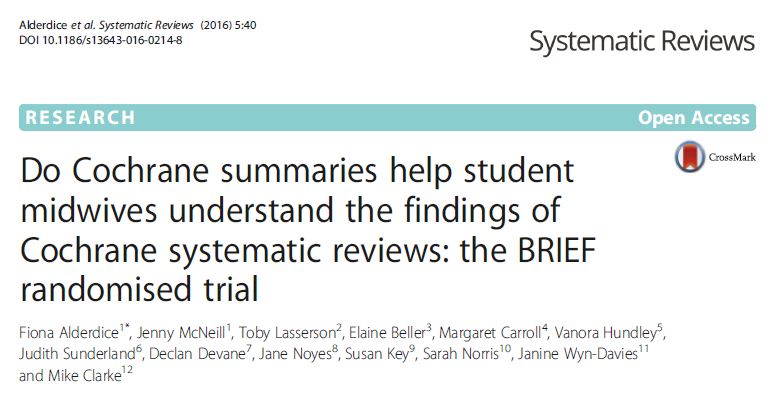
Hundley Cochrane 2016This first week of March has been a good week for FHSS publications.  On March 1st CMMPH Prof. Vanora Hundley published her collaborative paper  ‘Do Cochrane summaries help student midwives understand the findings of Cochrane systematic reviews: the BRIEF randomised trial’.[1]  With colleagues based across the UK and Ireland she surveyed over 800 midwifery students at nine universities.  This results of the study can be found in the journal Systematic Reviews. This is a Gold Open Access journals, hence the paper is freely available for anybody to read across the globe.  To read this paper click here!
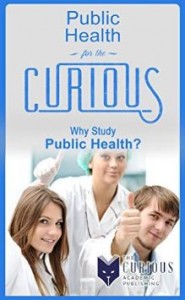
PH curious 2016The second FHSS publication is a chapter in a Kindle book on the Importance of public health in low- and middle- income countries, written by Dr. Puspa Raj Pant,CMMPH’s Prof. Edwin van Teijlingen, and BU Visiting Faculty Prof. Padam Simkhada.[2]  Padam Simkhada is Professor of International Public Health and Associate Dean (Global Engagement) for the Faculty of Education, Health and Community at Liverpool John Moores University.  The chapter is part of the Kindle book  with the long title: Public Health for the Curious: Why Study Public Health? (A Decision-Making Guide to College Major, Research & Scholarships, and Career Success for the College Students and Their Parents) edited by Richard Lee Skolnik from Yale University, USA.
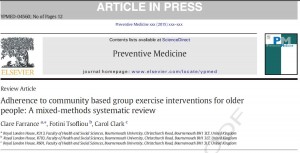

The third paper is by FHSS PhD student Clare Farrance with her supervisors Dr. Fotini Tsofliou and Dr. Carol Clark.  This systematic review ‘Adherence to community based group exercise interventions for older people: A mixed-methods systematic review’ assessed the views and adherence of older participants attending community-based exercise programmes of over six-months duration.  Reporting that evidence is still very limited, although the preliminary limited evidence is positive regarding long-term adherence rates.  This paper is also Open Access, funded by BU’s Open Access fund.Farrance 2016


Prof. Edwin van Teijlingen

CMMPH


References:

  1. Alderdice, F., McNeill, J., Lasserson, T.,Beller, E., Carrol, M., Hundley, V., et al. (2016) Do Cochrane summaries help student midwives understand the findings of Cochrane systematic reviews: the BRIEF randomised trial. Systematic Reviews 5:40 http://systematicreviewsjournal.biomedcentral.com/articles/10.1186/s13643-016-0214-8
  2. Pant, P.R., van Teijlingen, E., Simkhada, P. (2016)  Importance of public health in low- and middle- income countries, In:  Skolnik, R.L. (ed.) Public Health for the Curious: Why Study Public Health? (A Decision-Making Guide to College Major, Research & Scholarships, and Career Success for the College Students and Their Parents) Kindle Edition (for more details click here!) 
  3. Farrance, C., Tsofliou, F., Clark, C. (2016) Adherence to community based group exercise interventions for older people: A mixed-methods systematic review To be published. Preventive Medicine (forthcoming)

BRIAN Upgrade

BU BRIAN logo


We are happy to inform you that Bournemouth Research Information and Networking System (BRIAN) will be upgrading to a new version. The current system will be offline from 8.00am on Thursday 10th March 2016, and will hopefully be restored and functioning fully on Friday 11th March 2016.

Some of the improvements from this upgrade include:

  • Performance improvements to the list pages
  • Publication summaries
  • Pagination

We do apologise for the inconvenience but we hope that these exciting new features will be up and running for you to use on the 11th March 2016.

All relevant guidance notes on the Staff Intranet will be updated in due course. If you need any help using the new system or if you encounter any problems after the upgrade, please do send an email to BRIAN@bournemouth.ac.uk and a member of staff will be able to assist you.

Monthly BRIAN training sessions are also available:

  • Tuesday 8th March 2016
  • Tuesday 5th April 2016
  • Wednesday 25th May 2016

If you are interested to book on to any of these training sessions, please get in touch with OD@bournemouth.ac.uk (dates are subject to change)

Please watch out for announcement on future dates on the RKEO Research blog.

In the meantime, if you do have queries relating to the upgrade, please feel free to get in touch with Pengpeng Hatch at pphatch@bournemouth.ac.uk (01202 961354).

What is Open Access?

Open-Access-logo

Open access is about making the products of research freely accessible to all. It allows research to be disseminated quickly and widely, the research process to operate more efficiently, and increased use and understanding of research by business, government, charities and the wider public.

There are two complementary mechanisms for achieving open access to research.

The first mechanism is for authors to publish in open-access journals that do not receive income through reader subscriptions.

The second is for authors to deposit their refereed journal article in an open electronic archive.

These two mechanisms are often called the ‘gold’ and ‘green’ routes to open access:

  • Gold – This means publishing in a way that allows immediate access to everyone electronically and free of charge. Publishers can recoup their costs through a number of mechanisms, including through payments from authors called article processing charges (APCs), or through advertising, donations or other subsidies.
  • Green – This means depositing the final peer-reviewed research output in an electronic archive called a repository. Repositories can be run by the researcher’s institution, but shared or subject repositories are also commonly used. Access to the research output can be granted either immediately or after an agreed embargo period.

Article first published – http://www.hefce.ac.uk/rsrch/oa/whatis/

To encourage all academic communities to consider open access publishing, Authors Alliance has produced a comprehensive ‘Understanding Open Access‘ guide which addresses common open access related questions and concerns and provides real-life strategies and tools that authors can use to work with publishers, institutions, and funders to make their works more widely accessible to all.

To access and download the guide, please follow this link – http://authorsalliance.org/wp-content/uploads/Documents/Guides/Authors%20Alliance%20-%20Understanding%20Open%20Access.pdf

For any other open access related queries, please do get in touch with Pengpeng Hatch (pphatch@bournemouth.ac.uk) at RKEO.