Leadership is a word often bandied about with many people claiming, assuming or being allocated ‘leadership’ roles, but what does this actually mean when trying to bring about societal improvements? Last week as part of an NHS South of England project BU and Plymouth University
hosted a 2 day workshop for strategic leaders in the NHS, Local Authorities and the voluntary sector responsible for strategic leadership in the world of dementia in Devon, Dorset and Somerset. The aim of this project is to promote improvements in the provision of dementia care at a time of fiscal challenge. Working across organisational and disciplinary boundaries, learning from others and acting rather than just talking about the policy directives and vision that contextualises dementia is key. We had several high profile speakers at the workshop, including the Chief Executive of the Alzheimer Society, Jeremy Hughes; the Clinical Lead for dementia for NHS England, Prof Alistair Burns; the immediate Past President of the Association of Directors of Adult Social Services (ADASS), Sarah Pickup; Angela Rippon a high profile ambassador for the Alzheimer Society as well as BU’s own director of the NCPQSW. Prof Keith Brown who does a lot of leadership training across the country. We also had a person living with dementia reminding us of why it is of utmost importance to ensure that people with dementia can live well with their dementia and really what the workshop was all about. Key messages I took from the 2 days that are perhaps transferable to anyone with a leadership role are first that it sometimes just important to get on and do what you need to do because it is the ‘right thing to do’ and this may be at odds with procedures, other colleagues perceptions and priorities but still worth doing! Good leaders sometimes need to buck the trend and with convention, and there were lots of dementia specific examples about how people have been innovative in challenging times. Another key leadership message related to working together and learning from others rather than reinventing the wheel. None of these are new messages but do highlight the ongoing challenges those with key strategic roles face as they work to address key societal concerns.
/ Full archive
The Research Blog is on the Staff Intranet!
Ever find yourself bumbling around trying to find a link to the Research Blog? Perhaps you delete your daily digests and when you want to re-access the blog you can’t seem to find it anywhere? Have no fear, the Research Blog now has its very own icon on the Staff Intranet, so you’ll never be lost again.
Contacts in Brazil? Funding is available but you need to act super fast!
The Sao Paulo Research Foundation (FAPESP) and the British Council are jointly funding a series of workshops to promote research collaboration between Sao Paulo Estate and the UK with a deadline of 14 July 2013 .
The main themes for the workshops are in the areas of Natural Sciences, Social Sciences and Arts & Humanities (Sports Events and their legacy for the local community could be one of interest at the moment). Each workshop must be coordinated by two leading researchers, one from each country, and target up to 20 early career researchers from each country. Detailed information on the call can be found here .
Using art to engage with the public
Over the last six months BUDI has been working to engage with the public and promote awareness and understanding of dementia. ‘(Don’t) Mention Dementia’ is an innovative exhibition created by BUDI and media artist Derek Eland (http://derekeland.com/), with the aim of giving a voice to people living with dementia.

(Don’t) Mention Dementia is an immersive pictorial exhibition, featuring hand-written postcards and portrait pictures. A diary room approach was used to capture the honest and emotional stories of nearly 600 Dorset residents about dementia, and the views of those living with dementia about their experiences.
The exhibition follows on from Derek’s ground-breaking work with soldiers and civilians on the front line in Afghanistan, and reveals the gap in perception between those who live with dementia and the general public.
Whilst the work was undertaken in Dorset, the response and the messages is universal from those living with dementia, family members, carers and members of the general public, with the postcards and pictures acting as an innovative voice to express their fears, their concerns and their hopes for the future.
The general public were able to view the exhibition as part of Bournemouth University’s Festival of Learning in June. The exhibition was closed by broadcaster and Alzheimer’s Society ambassador Angela Rippon and has received support from The Alzheimer’s Society, Age UK, Brandon Care Homes and local community groups and businesses in Dorset. It has already attracted international interest, and is also due to be displayed in Malta in October 2013.
The (Don’t) mention Dementia exhibition attracted an array of media interest and the article which featured in the Daily Echo can be viewed online:
Please click here for link to Daily Echo article.
Thank FIF for that! Professional services staff can apply too!
Not only does the Fusion Investment Fund provide opportunities for academic staff at BU, there are also options for professional services staff:
Staff can apply to Erasmus which is most appropriate for enabling academic and professional staff based at higher education institutions (HEIs) to spend a period of training or teaching between 5 working days and 6 weeks in a European HEI or enterprise. Under training mobility, the purpose is to allow the staff members to acquire knowledge or skills relevant for their current job and their professional development and to help create cooperation between organisations. There are also opportunities to invite staff from enterprises to Bournemouth University to give presentations and provide teaching. Professional staff can undertake training at a European educational institution.
Another option is to apply to the standard element of the Staff Mobility and Networking (SMN) strand. Non-academic staff must be able to demonstrate through their application how their travel will benefit the academic process within BU and particular focus should be placed on the creation of sustainable collaborative networks of academics or professionals linked to specific outputs or partnership developments.
For more information please read the relevant policy documents and information available on the FIF intranet pages.
The Fusion Investment Fund is managed by Samantha Leahy-Harland and is administered by Natalie Baines. Please direct all initial enquiries to Natalie Baines.
How do I…, Why does it…, I can’t seem to…, What just happened?
Here are the latest BRIAN FAQs (BRIAN is BU’s publications managment system and much more), which also include information on the external profile pages (the information input on BRIAN feeds through to your profile page, giving you complete control over the content).
The FAQs may provide the answer to something that’s been bugging you for a while. If not, the FAQs include the link to the latest guidance documents and videos so that you can find out more about how to use BRIAN.
If you still can’t find the answer to your query then please email us at BRIAN@bournemouth.ac.uk and we will be happy to help.
Wondering what Erasmus Mundus, Erasmus Mobility and other schemes will look like in Horizon 2020
Well, wonder no more! You will know from my previous blogposts that the ‘Erasmus for All’ Programme will combine schemes under the Lifelong Learning Programme such as Erasmus and Erasmus Mundus, as well as Youth in Action, Sport and others.
The EC has published updated its webpages on this programme and you can find a very helpful Erasmus for All factsheet as well FAQs
Bournemouth, Poole and Christchurch – the Silicon Beach of the future?
Bournemouth University hosted a creative and digital economy summit at the EBC on Friday 7 June where leading businesses, entrepreneurs and MPs came together to back a bid to style Bournemouth, Poole and Christchurch as a hub for the creative and digital industry. A manifesto, coordinated by BU with input from a range of local stakeholders, was launched at the event and a host of different businesses and organisations pledged to commit money or their expertise with the aim of growing the local creative and digital sector in the hope the area. The summit featured in the Daily Echo on June 12 which reported that “the area already has above average business start-up and survival rates and is one of the UK’s liveliest digital clusters and this exciting development is a great step forwards”. Read more here. BU will continue to play a central role in taking forward the work set out in the manifesto so watch this space for further developments. If you are interested in finding out more, contact Samantha Leahy-Harland on sleahyharland@bournemouth.ac.uk
Learn more about BRIAN this week
We are running two BRIAN training sessions on Friday 21st June 2013. These are hands-on sessions open to all academics and PGR students who want to learn more about BRIAN.
11:00 – 12:00 Studland House S103
14:00 – 15:00 Christchurch House CG21
If you would like to attend, please email David Biggins at BRIAN@bournemouth.ac.uk to reserve your place.
What the FIF’s it all about? – Another drop-in session today!
Couldn’t get to the drop-in session on Talbot yesterday? Don’t panic! We’re holding another one today at Lansdowne.
Do you have questions about a potential bid for Fusion funding? Don’t know which strand to apply to? Not sure if your idea is eligible? Need more information about Erasmus? Come along to our drop-in session TODAY to get your questions answeredand to find out more about the Fusion Investment Fund (FIF):
TODAY 1-2pm, EB702, EBC, Lansdowne Campus
The Fusion Investment Fund is managed by Samantha Leahy-Harland and is administered by Natalie Baines and we’ll be there along with Moritz Ehlen, BU’s International Mobility Officer, who can provide specific guidance with regards to Erasmus.
There are some fantastic opportunities available under the 3 strands of the FIF and we’re looking forward to receiving lots of really good quality applications in time for the deadline of 1 July. We look forward to seeing you later!
More information about the different strands of the Fund on the Staff Intranet pages.
Please direct all initial enquiries to Natalie Baines.
Want some money?
I thought that might get your attention! The latest call of the FIF (or the ‘Fusion Investment Fund’ for those of you who haven’t yet added this acronym to your vocabulary) is open for 2 more weeks so if you haven’t applied yet or haven’t seen my previous blog posts, let me give you the highlights:
So basically you could be given a pile of cash to enable you to do what you love! Pursue that dream of undertaking world-leading research or travel across the pond to work collaboratively with experts in your field. Become a hero and take your rightful place on that pedestal that your peers and students will put you on.*
Sound good? Find out more.
*BU cannot guarantee this.
The Fusion Investment Fund is managed by Samantha Leahy-Harland and is administered by Natalie Baines. Please direct all initial enquiries to Natalie Baines.
Have you stood up for science? And faced difficulty or hostility in doing so? Nominations for the John Maddox Prize are now open…
2013 John Maddox Prize
The John Maddox Prize rewards an individual who has promoted sound science and evidence on a matter of public interest. Its emphasis is on those who have faced difficulty or hostility in doing so. Nominations of active researchers who have yet to receive recognition for their public-interest work are particularly welcomed.
Nominations for the John Maddox Prize for standing up for science 2013 are now open
- Addressing misleading information about scientific or medical issues in any forum.
- Bringing sound evidence to bear in a public or policy debate.
- Helping people to make sense of a complex scientific issue.
The prize: £2000. The award is presented in November and an announcement of the winner will be published in Nature.
Sir John Maddox, whose name this prize commemorates, was a passionate and tireless champion and defender of science, engaging with difficult debates and inspiring others to do the same. As a writer and editor, he changed attitudes and perceptions, and strove for better understanding and appreciation of science throughout his long working life.
The prize is a joint initiative of Nature, where Sir John was editor for 22 years; the Kohn Foundation; and Sense About Science, where he served as a trustee until his death in 2009.
Candidates for the John Maddox Prize must be nominated. The nominator should normally be an individual who is familiar with the work of the candidate but self-nomination will be considered in exceptional circumstances. This is a global prize: people from and in any country can be nominated.
The deadline for nominations is 11:59pm on 20th August 2013 BST.
Evaluation Criteria
The judging panel will consist of Tracey Brown (Sense About Science), Phil Campbell (Nature), Professor Martin Rees and Professor Colin Blakemore. Candidates will be judged on the strength of their nomination based on the below criteria.
- How clearly the individual communicated good science, despite adversity
- The nature of adversity faced by the individual.
- How well they placed the evidence in the wider debate and engaged others.
- Their level of influence on the public debate.
The Award will be presented in November and the recipient of the Maddox Prize will receive £2000. An announcement of the winner will be published in Nature.Nomination
Researchers in any area of science or engineering are eligible to be nominated by persons based in the UK. Nominations are to take the form of a letter of recommendation and include biographical information on the candidate and a description of the candidate’s work in standing up for science. Permission must be sought from the nominee. The individual nominated may be contacted for more information including references after the deadline has passed.
Staff, trustees and directors of the supporting organisations and previous or current members of the judging panel and their direct relations are not eligible for nomination for the Prize, though they may nominate. It is open to anyone else, including people who have published with or worked with either organisation as contributors, advisers or in other collaborations.
Nomination is by online form. Nominations are now open, and close at 11:59pm on 20th August 2013. The winner will be notified in October 2013, and will be announced at the Sense About Science Annual Reception in November 2013.
eBU staff drop in sessions to be held in each school
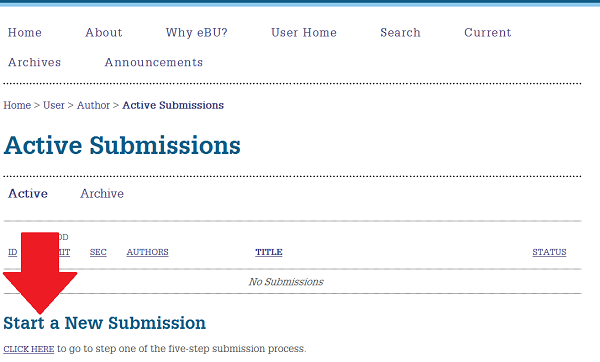
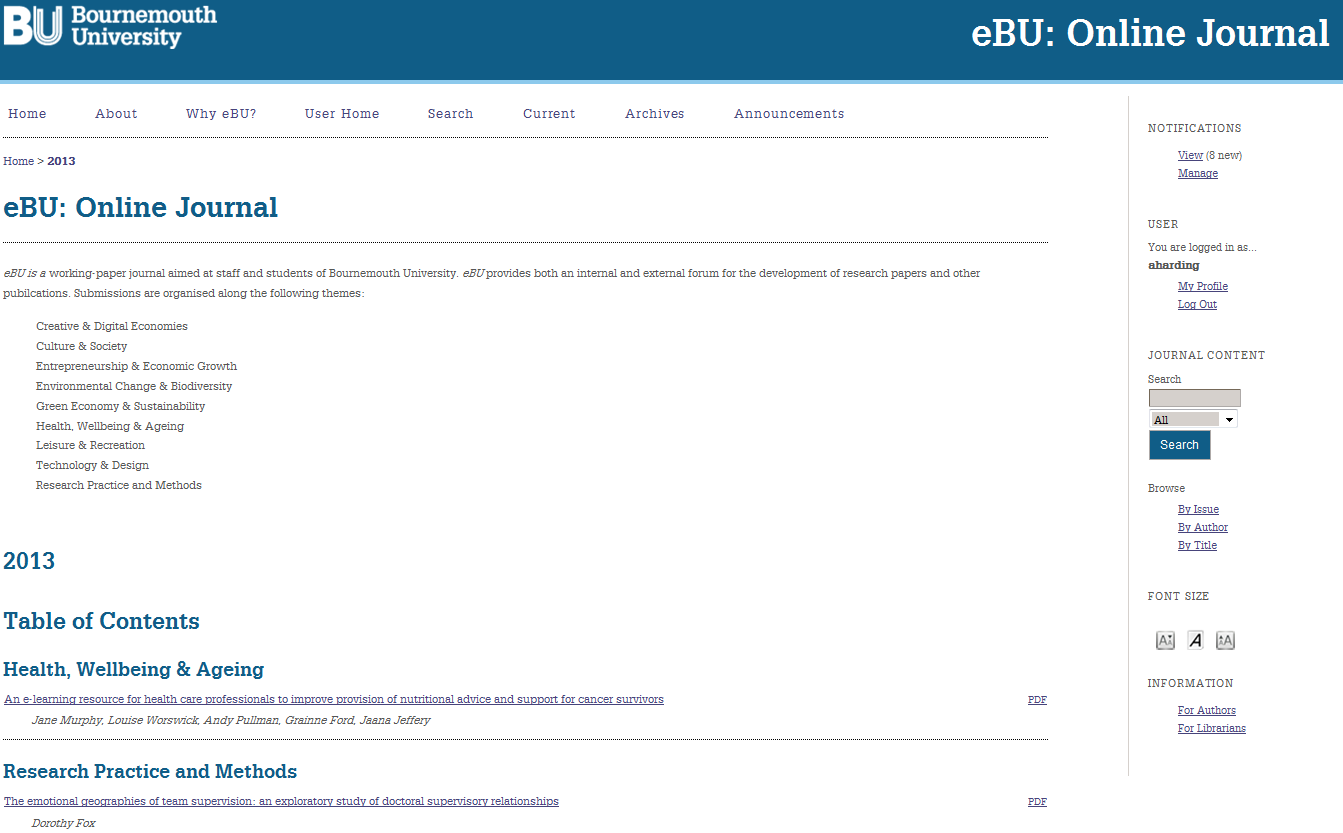
I am pleased to announce that I am holding drop in sessions in each school for the BU community to ask questions about eBU: Online Journal.
These sessions will be:
Mon 24th June – DEC 12 -2pm in P411
Mon 24th June – School of Applied Sciences 2-4pm in C122
Tues 25th June – HSC 9-11am in the Wellbeing Centre, B112 Bournemouth House
Tues 25th June – Business School 2-4pm in EB205
Thurs 27th June – School of Tourism 1.30-3.30 in P410
Fri 28th June – Media School 8-10am in CAG04
What the FIF’s it all about? Find out Today!
Do you have questions about a potential bid for Fusion funding? Don’t know which strand to apply to? Not sure if your idea is eligible? Come along to our drop-in session TODAY to get your questions answered and to find out more about the Fusion Investment Fund (FIF) on:
TODAY 12-1pm in P411, Poole House, Talbot Campus
The Fusion Investment Fund is managed by Samantha Leahy-Harland and is administered by Natalie Baines and we’ll be there along with members of the strand committees and Moritz Ehlen, BU’s International Mobility Officer, who can provide guidance with regards to Erasmus.
There are some fantastic opportunities available under the 3 strands of the FIF and we’re looking forward to receiving lots of really good quality applications in time for the deadline of 1 July. We look forward to seeing you later!
More information about the different strands of the Fund on the Staff Intranet pages.
Please direct all initial enquiries to Natalie Baines.
PechaKucha – presenting research in a fast and furious manner!
The Normal Labour and Birth Conference allowed me to experience a novel way of showcasing research and exchanging ideas – the PechaKucha. Pronounced “peh-chak-cha”, the PechaKucha session is made up of a series of short presentations. Presenters must use 20 slides, each of which must be displayed for exactly 20 seconds – no more, no less. The concept, conceived by two young architects (Astrid Klein and Mark Dytham) in Japan in 2003, is to enable individuals to exchange their ideas in a fast moving, concise and exciting format. Not one to ignore the call to try something new, I decided to undertake this challenge as a double act with my colleague Professor Helen Cheyne from the University of Stirling. We presented our team’s work on the media’s portrayal of labour and birth, which was also being displayed as a poster.

- Research team includes Ann Luce, Marilyn Cash, Vanora Hundley, Helen Cheyne, Edwin van Teijlingen and Catherine Angell
The PechaKucha was quite an undertaking, as the slides move automatically and you cannot stop them moving on! However, it really focused the mind and helped us identify the key messages from our work. The session was very lively and the energy generated a lot of discussion that continued into the coffee break afterwards. As for the PechaKucha method, I’d say that it is definitely a useful tool for our community research meetings, and perhaps also for our doctoral students to use as they prepare for their vivas.
The conference was also an opportunity to catch up with colleagues from the International Early Labour Research Group. The group have been involved in producing a series of research papers featured in a special issue of Midwifery. We also discussed future research and opportunities for research collaboration.
European media history network
I am delighted to report that the Centre for Media History together with the University of Lund and the Hans Bredow Institute at the University of Hamburg, has won a research grant from the Swedish ‘STINT’ fund. The Swedish Foundation for International Cooperation in Research and Higher Education (STINT) was set up in 1994 by an act of the Swedish Parliament to promote the internationalisation of Swedish higher education.
My colleague, Kristin Skoog and I helped write a successful bid together with our partners in Lund and Hamburg. Out of 95 applications to the fund only 10 were awarded grants.
The aim of the award is to establish a network of media historians to study aspects of European media history and in particular the idea of historical ‘entanglement’. Another aim is to focus on sometimes neglected European influences in the media and indeed to reflect the European turn in media and cultural studies away from an over-emphasis on North America.
The Bournemouth part of the network currently comprises of Kristin Skoog, Maike Helmers and me as well as three of our PhD students, Tony Stoller, Kathryn McDonald and Gloria Khamkar. The network will meet in Bournemouth, Lund and Hamburg and the events will be in the spring and autumn each year. The award runs from 2014 to 2018.
By the end of our networking activity we hope to have learned a great deal more about each other’s research and ideas and together we will be in a strong position to bid for a larger European grant.
If you would like to know more about the STINT project please get in touch with me.
Hugh Chignell hchignell@bournemouth.ac.uk
Pragmatic but theoretically informed solutions to the challenges facing collaborative practice and education
In-2- theory Group members delivered a workshop at the CABIV Conference in Vancouver this week on how to operationalise psychosocial theory in collaborative practice and interprofessional education settings to assist practitioners in their critical reflection and problem solving skills in this area. The workshop offered a taster of a knowledge exchange model to be developed through a Canadian Institutes of Health Research (CIHR) grant held by the Universities of New Brunswick, Bournemouth University, University of British Colombia and others. In this model the domains of practitioner knowledge collected through participant narratives overlap with academic theoretical knowledge, in the coproduction of new narratives retold through a theoretical lens. Our aim is the development of pragmatic but theoretically informed solutions to the challenges facing collaborative practice and education. For further discussion, Contact Sarah Hean Shean@bournemouth.ac.uk or Shelley Docuet, sdoucet@unb.ca
BU paper in top ten in the international journal Midwifery
The paper ‘Risk, theory, social and medical models’ published in 2010 co-authored with Dr. Helen Bryers made it into the top ten most downloaded articles in the past 90 days from the journal Midwifery. See http://www.journals.elsevier.com/midwifery/most-downloaded-articles/
It is also in the top 12 most quoted papers published in Midwifery. This interesting as all 11 papers that have been cited more often are older, i.e. have been in print longer and therefore had more time to be cited.
The Abstract of the paper reads:
Background: there is an on-going debate about perceptions of risk and risk management in maternity care. Objectives: to provide a critical analysis of the risk concept, its development in modern society in general and UK maternity services in particular. Through the associated theory, we explore the origins of the current preoccupation with risk Using Pickstone’s historical phases of modern health care, the paper explores the way maternity services changed from a social to a medical model over the twentieth century and suggests that the risk agenda was part of this process. Key conclusions: current UK maternity services policy which promotes normality contends that effective risk management screens women suitable for birth in community maternity units (CMUs) or home birth: however, although current policy advocates a return to this more social model, policy implementation is slow in practice. Implications for practice: the slow implementation of current maternity policy in is linked to perceptions of risk. We content that intellectual and social capital remains within the medical model. © 2010 Elsevier Ltd.
The full reference this paper is MacKenzie Bryers, H. & van Teijlingen, E. (2010) Risk, theory, social and medical models: A critical analysis of the concept of risk in maternity care. Midwifery 26(5): 488-496.
Prof. Edwin van Teijlingen
Centre for Midwifery, Maternal & Perinatal Health


New Nepal scoping review on maternal & neonatal health
Fourth INRC Symposium: From Clinical Applications to Neuro-Inspired Computation
Writing policy briefs
Upholding Excellence: The Concordat to Support Research Integrity
ECR Funding Open Call: Research Culture & Community Grant – Application Deadline Friday 12 December

MSCA Postdoctoral Fellowships 2025 Call

ERC Advanced Grant 2025 Webinar
Horizon Europe Work Programme 2025 Published
Horizon Europe 2025 Work Programme pre-Published
Update on UKRO services
European research project exploring use of ‘virtual twins’ to better manage metabolic associated fatty liver disease