Dr Samuel Nyman and Yolanda Barrado-Martín from the Psychology Department and Ageing and Dementia Research Centre (ADRC) attended the 4th EU Falls Festival in Manchester on 2nd and 3rd July 2018.
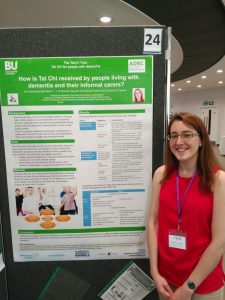
International researchers met in Manchester to learn about current projects under the theme, “New Solutions to Old Problems: Ensuring sustainability of falls prevention interventions”. Yolanda Barrado-Martín presented a poster entitled: “How is Tai Chi received by people living with dementia and their informal carers?” Attendants showed interest in the poster over the two day conference and voted Yolanda´s as the second best poster of the conference!
This year’s conference included sessions around Cochrane Updates on falls preventions, the use of new technologies to prevent falls, epidemiology and the implementation of research into practice. This year there was also a space for specific conditions such as dementia and the use of “qigong” to improve balance and prevent falls amongst older adults, which made this conference particularly relevant for the TACIT Team.

You can learn more and keep updated about the TACIT Trial via the following links:
The TACIT Trial Facebook page.
The TACIT Trial YouTube video:







 ECR Opportunities: New Development Programme, Research Grants & Upcoming Events
 Help us capture BU’s knowledge exchange activity HE-BCI survey 2025–26
 Verbal autopsy paper published two days ago
 ESRC Studentships for 2027 Entry: Opportunity Now Open
 SONAMONI contributions to Safety Conference 2026 in South Africa
 Horizon Europe Cluster 3 (Civil Security for Society) 2026 Calls Now Open
 MSCA Doctoral Networks 2026 Call Information Webinar
 ESRC Festival of Social Science 2026: Application Deadline Extended to Thursday 25 June 2026
 Reminder: Register for the ESRC Festival of Social Science 2026 Information Session
 ECR Funding Open Call: Research Culture & Community Grant – Apply now
 ERC Advanced Grant 2025 Webinar
 Update on UKRO services
 European research project exploring use of ‘virtual twins’ to better manage metabolic associated fatty liver disease