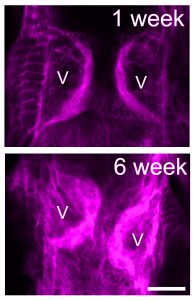
 Research funded by the British Heart Foundation looking at tissue fibrosis (scarring), will soon be published in Experimental Gerontology, one the world’s leading journal on ageing. Fibrosis occurs naturally as part of our injury response process but also develops in ageing and chronic disease. Treatments are scant despite fibrosis leading to organ failure and increased risk of death.
The image shows valves (v) in the hearts of young and ‘late middle aged’ fruit flies that have been genetically engineered to express fluorescent collagen, an key ‘scar protein’. Although the fly heart is just two cells wide it represents a lot of the genetic machinery for a human heart. Amazingly, the function of human and fly hearts declines as they age – and they both accumulate collagen.
Our previous work linked heart function with SPARC – a protein associated with fibrosis in humans. We’ve now demonstrated that the heart’s ‘health-span’ during ageing can be significantly lengthened if the expression SPARC is reduced. We also show that if SPARC levels increase – fibrosis is increased too. Hence, we’ve nailed a cause-and-effect relationship between SPARC and heart function which supports the idea of targeting SPARC clinically to control cardiac health and fibrosis.
Paul S. Hartley (Department of Life and Environmental Science).








 International Open Access Week: BU support for open access
 Food Price Research Shortlisted for Civil Service Prize
 3C Event: Research Culture, Community & Connections – Wednesday 11 November 3-4pm
 ECR Opportunities: New Development Programme, Researcher Grants & Upcoming Events
 Help us capture BU’s knowledge exchange activity HE-BCI survey 2025–26
 Horizon Europe Cluster 3 (Civil Security for Society) 2026 Calls Now Open
 MSCA Doctoral Networks 2026 Call Information Webinar
 ESRC Festival of Social Science 2026: Application Deadline Extended to Thursday 25 June 2026
 Reminder: Register for the ESRC Festival of Social Science 2026 Information Session
 ECR Funding Open Call: Research Culture & Community Grant – Apply now
 ERC Advanced Grant 2025 Webinar
 Update on UKRO services
 European research project exploring use of ‘virtual twins’ to better manage metabolic associated fatty liver disease