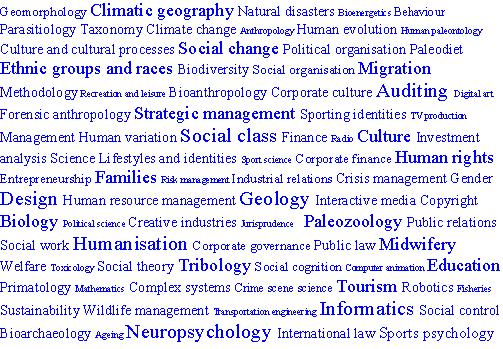
 A couple of weeks ago I added version 3 of the BU research ontology to the blog and asked for your advice as to whether this adequately reflected the breadth of your disciplines and expertise (see BU’s keywords for research – is everything included?). Thank you to everyone who responded to this – all of your comments and suggestions have been incorporated into version 4.
Rather than using the rigid 3-level structure, Version 4 includes the first attempt of mapping the keywords to the four broad areas of:
- Business & Management
- Media & Culture
- Health & Society
- Science & Technology
These areas will then map to the 8 emerging BU research themes. The aim of this is to provide a more flexible ontology that is adaptable to the complexities of inter- and multi-disciplinary research and that can be used to make relationships between people and disciplines (and therefore news stories, projects, outputs, etc) internally and also via the new external research webpages.
You can access Version 4 here: Research ontology v4
We’re very interested in your feedback as to whether the mapping in Version 4 is fit for purpose or whether any changes need to be made. Please add your comments to this post by Friday 2 September 🙂
Thanks to Katarzyna Musial for her help in visualising how this could work.
 Matthew’s previous blog post (







 Official book launch at Bournemouth University
 Take a Break: Join the Creative Wellbeing Event
 Psychology, Psychiatry and Neuroscience academics – would you like to get more involved in preparing our next REF submission?
 Three Minute Thesis (3MT®) 2026: Register to Support our PGRs
 Horizon Europe Cluster 3 (Civil Security for Society) 2026 Calls Now Open
 MSCA Doctoral Networks 2026 Call Information Webinar
 ESRC Festival of Social Science 2026: Application Deadline Extended to Thursday 25 June 2026
 Reminder: Register for the ESRC Festival of Social Science 2026 Information Session
 ECR Funding Open Call: Research Culture & Community Grant – Apply now
 ERC Advanced Grant 2025 Webinar
 Update on UKRO services
 European research project exploring use of ‘virtual twins’ to better manage metabolic associated fatty liver disease