Yesterday we received the proofs of the recently accepted paper ‘Improved Water, Sanitation and Hygiene Facilities at School and their Effect on Educational Achievement in Basic Level Students in Nepal’ [1]. Luckily these are only the proof pages as my family name is misspelt, and the paper still lists the old name of our Centre for Midwifery and Women’s Health, which was, of course, the correct name at the time of submission.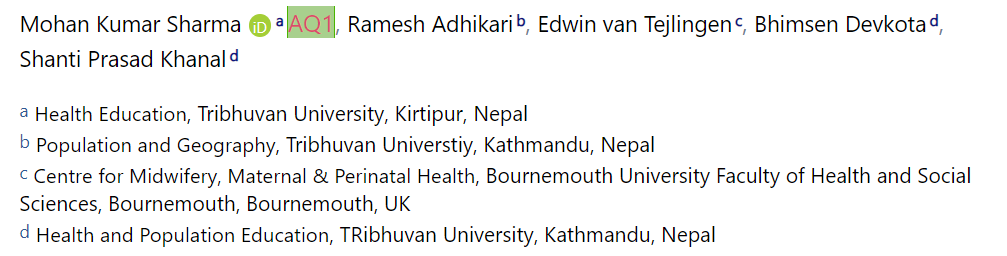
The last time I published a paper on hygiene was also with colleagues in Nepal seven years ago, this time it was on menstrual hygiene [2].
Prof. Edwin van Teijlingen
Centre for Midwifery & Women’s Health 
References:
- Sharma, M., Adhikari, R., van Teijlingen, E., Devkota, B., Khanal, S. (2024) Improved Water, Sanitation and Hygiene Facilities at School and their Effect on Educational Achievement in Basic Level Students in Nepal, International Journal of Health Promotion & Education (accepted). https://doi.org/10.1080/14635240.2024.2314459.
- Budhathoki, S.S., Bhattachan, M., Pokharel, P.K., Bhadra, M., van Teijlingen, E. (2017) Reusable sanitary towels: Promoting menstrual hygiene in post-earthquake Nepal. Journal of Family Planning & Reproductive Health Care 43(2): 157-159.







 Verbal autopsy paper published two days ago
 ESRC Studentships for 2027 Entry: Opportunity Now Open
 SONAMONI contributions to Safety Conference 2026 in South Africa
 Three CMWH presentations at Berlin conference
 Horizon Europe Cluster 3 (Civil Security for Society) 2026 Calls Now Open
 MSCA Doctoral Networks 2026 Call Information Webinar
 ESRC Festival of Social Science 2026: Application Deadline Extended to Thursday 25 June 2026
 Reminder: Register for the ESRC Festival of Social Science 2026 Information Session
 ECR Funding Open Call: Research Culture & Community Grant – Apply now
 ERC Advanced Grant 2025 Webinar
 Update on UKRO services
 European research project exploring use of ‘virtual twins’ to better manage metabolic associated fatty liver disease