The Royal College of Midwives (RCM) has organised a conference today to celebrate the International Day of the Midwife in Edinburgh. The conference ‘Midwives for a Better Tomorrow’ has a very international focus. Speakers include: Frances Day-Stirk, president of the International Confederation of Midwives, Mary Renfrew, who led The Lancet series on midwifery, and Frances McConville from the World Health Organization. The conference also reported on the RCM Global Midwifery Twinning Project, which was funded by THET and included three low-income countries: Nepal, Cambodia & Uganda. In attandance was BU Visiting Faculty (and Poole midwife) Ms. Jillian Ireland, who was one of the volunteers who went out to Nepal.
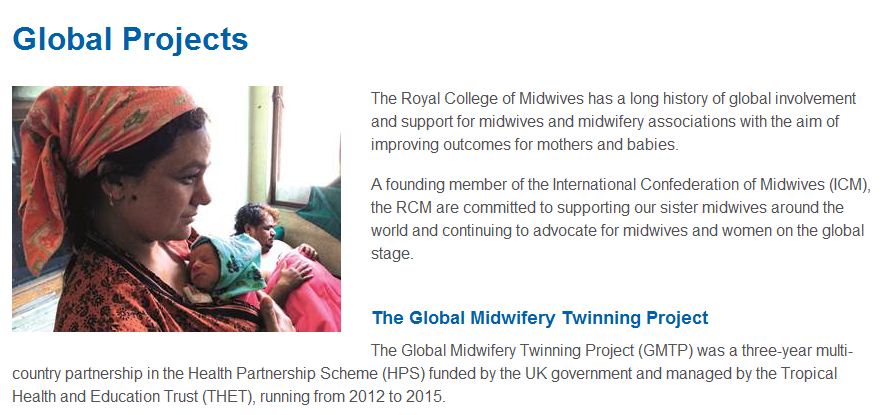
This year’s International Day of the Midwife conference co-incides with the centenary of the 1915 Midwives (Scotland) Act. This celebration reminds us of the importance to have government recognition and regulation for the profession of midwifery. The latter is still lacking in many low-income countries, such as Nepal. There is a large body of evidence which supports that skilled midwifery care has the potential to significantly reduce maternal and child mortality and increase wellbeing.
Prof. Edwin van Teijlingen
CMMPH
 BU celebrates International Day of the Midwife 2021
 BU academics at Virtual International Day of the Midwife







 ESRC Studentships for 2027 Entry: Opportunity Now Open
 SONAMONI contributions to Safety Conference 2026 in South Africa
 Three CMWH presentations at Berlin conference
 New interdisciplinary paper on Nepal
 Horizon Europe Cluster 3 (Civil Security for Society) 2026 Calls Now Open
 MSCA Doctoral Networks 2026 Call Information Webinar
 ESRC Festival of Social Science 2026: Application Deadline Extended to Thursday 25 June 2026
 Reminder: Register for the ESRC Festival of Social Science 2026 Information Session
 ECR Funding Open Call: Research Culture & Community Grant – Apply now
 ERC Advanced Grant 2025 Webinar
 Update on UKRO services
 European research project exploring use of ‘virtual twins’ to better manage metabolic associated fatty liver disease