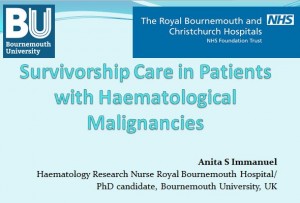
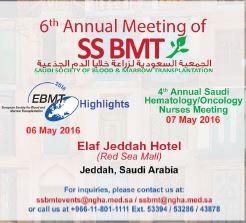
 BU PhD student Anita Immanuel has been invited to speak at the 4th Annual Saudi Hematology/Oncology Nurses Meeting in Jeddah, Saudi Arabia this Saturday (May 7th). Anita’s Ph.D. study examines the quality of lives of adults who have survived cancer of the blood or lymphatic system. Patients with haematological cancers have frequently reported lack of care-coordination as an unmet need following their intensive treatment. With the increase in the number of cancer survivors and possible long-term side effects that could impact on the quality of life, it is important to have (a) good post-treatment follow up; and (b) seamless coordination between health care providers.
 Dr. Helen McCarthy (The Royal Bournemouth and Christchurch Hospitals NHS Foundation Trust), Anita’s clinical Ph.D. supervisor at congratulated her on this invitation. Dr. McCarthy said: “This talk in Saudi Arabia gives Anita the opportunity to present some of her preliminary Ph.D. findings.”
FHSS’s Dr. Jane Hunt commented: “Anita’s research is addressing a growing issue with more people living longer with cancer. Her Ph.D. identifies key quality of life issues and helps us to understand the needs surrounding survivorship care better.”
Prof. Edwin van Teijlingen
CMMPH
 Winston Churchill Memorial Trust Travel Fellowship: Anita Immanuel







 SONAMONI contributions to Safety Conference 2026 in South Africa
 Three CMWH presentations at Berlin conference
 New interdisciplinary paper on Nepal
 Horizon Europe Cluster 3 (Civil Security for Society) 2026 Calls Now Open
 MSCA Doctoral Networks 2026 Call Information Webinar
 ESRC Festival of Social Science 2026: Application Deadline Extended to Thursday 25 June 2026
 Reminder: Register for the ESRC Festival of Social Science 2026 Information Session
 ECR Funding Open Call: Research Culture & Community Grant – Apply now
 ERC Advanced Grant 2025 Webinar
 Update on UKRO services
 European research project exploring use of ‘virtual twins’ to better manage metabolic associated fatty liver disease