Still plenty to share in this PGR Virtual Poster Showcase:
Chris Williams, PhD student in the Faculty of Management with this poster entitled:
‘Accreditation of higher education in the UK: The rise of PSRBs & potential influence.’
Click the poster below to enlarge.
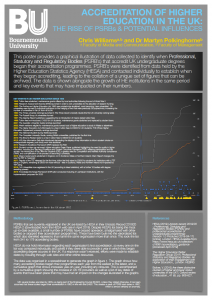 This poster will provide a graphical illustration and analysis of data collected as part of my PhD. The data collected identifies when Professional, Statutory and Regulatory Bodies (PSRB’s) that accredit UK undergraduate degrees began their accreditation programmes. PSRB’s were identified from data held by the Higher Education Statistics Agency (HESA) and contacted individually to establish when they began accrediting, leading to the collation of a unique set of figures. HESA’s data is used as part of the Key Information Set (KIS) that HE institutions display on their web pages and other printed material. The information is also held by the Office for Students (OfS), the independent regulator of HE in the UK. Further, the poster identifies key events impacting the UK HE sector and provides a brief analysis of any correlation with the commencement of the accreditation schemes that responded.
If this research has inspired you and you’d like to explore applying for a research degree please visit the postgraduate research web pages or contact our dedicated admissions team.
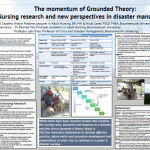 PGR Virtual Poster Showcase | Kelsie Fletcher
 PGR Virtual Poster Showcase | Hina Tariq
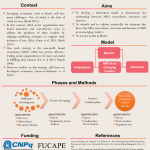 PGR Virtual Poster Showcase | Lara Christ







 Expressions of Interest invited from senior academics to join the BU REF Appeals Panel
  ESRC Festival of Social Science 2026: Application Deadline Extended to Thursday 25 June 2026
 First publication for two CMWH PhD students
 Reminder: Register for the ESRC Festival of Social Science 2026 Information Session
 ECR Funding Open Call: Research Culture & Community Grant – Apply now
 ECR Funding Open Call: Research Culture & Community Grant – Application Deadline Friday 12 December
 MSCA Postdoctoral Fellowships 2025 Call
 ERC Advanced Grant 2025 Webinar
 Update on UKRO services
 European research project exploring use of ‘virtual twins’ to better manage metabolic associated fatty liver disease