In a follow-up to BU’s recent research investigating the current state of the UK television industry’s workforce (State of Play), we are excited to be working once again with the TV union Bectu. This time we are examining the experience of disability, joining forces with the actors’ union Equity, and the group Deaf and Disabled People who work in TV (DDPTV).
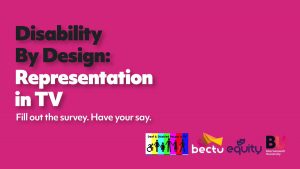
Disability by design: Representation in TV – our new survey launched earlier this week – is part of a wider effort to address concerns about the under-representation of deaf and disabled professionals in the TV workforce. The outcome of our survey will help to inform approaches to amplify the voices of deaf and disabled professionals, educate on legal obligations and provide examples of lived experience. The project is part of an evolving package of work within FMC focused on the experience of media work (and work in the television industry in particular) which is highlighting some of the more problematic and often overlooked structural issues that beset these industries.
For further information about this and related research into work in the TV industry, contact Dr Christa van Raalte or Dr Richard Wallis.







 ECR Opportunities: New Development Programme, Researcher Grants & Upcoming Events
 Help us capture BU’s knowledge exchange activity HE-BCI survey 2025–26
 Verbal autopsy paper published two days ago
 ESRC Studentships for 2027 Entry: Opportunity Now Open
 SONAMONI contributions to Safety Conference 2026 in South Africa
 Horizon Europe Cluster 3 (Civil Security for Society) 2026 Calls Now Open
 MSCA Doctoral Networks 2026 Call Information Webinar
 ESRC Festival of Social Science 2026: Application Deadline Extended to Thursday 25 June 2026
 Reminder: Register for the ESRC Festival of Social Science 2026 Information Session
 ECR Funding Open Call: Research Culture & Community Grant – Apply now
 ERC Advanced Grant 2025 Webinar
 Update on UKRO services
 European research project exploring use of ‘virtual twins’ to better manage metabolic associated fatty liver disease