Today, Discover Public Health, published our latest academic paper on maternity and neonatal care in Nepal [1]. Our latest paper ‘A scoping review of interventions to improve maternal and neonatal care in Nepal‘ is lead by Dr. Sharada Prasad Wasti at the University of Greenwich and co-authored by Bournemouth University’s Prof. Edwin van Teijlingen. 
For this scoping review we found 418 studies, and twenty were included, which used various interventions that aimed to improve maternal and neonatal health. Five overarching interventions were identified: (1) community-based maternal health literacy; (2) health facility strengthening, including health staff training, (3) mobilisation of female community health volunteers (FCHV) for birth preparedness and identifying danger signs; (4) mobile health messaging, and (5) involving husbands in improving the uptake of maternal and neonatal care. Most interventions were a mixture of activities with a combination of interventions rather than a single intervention.
The authors note that no single intervention is sufficient on its own; indeed, a combination of approaches is needed to improve the uptake of maternal and neonatal care services.
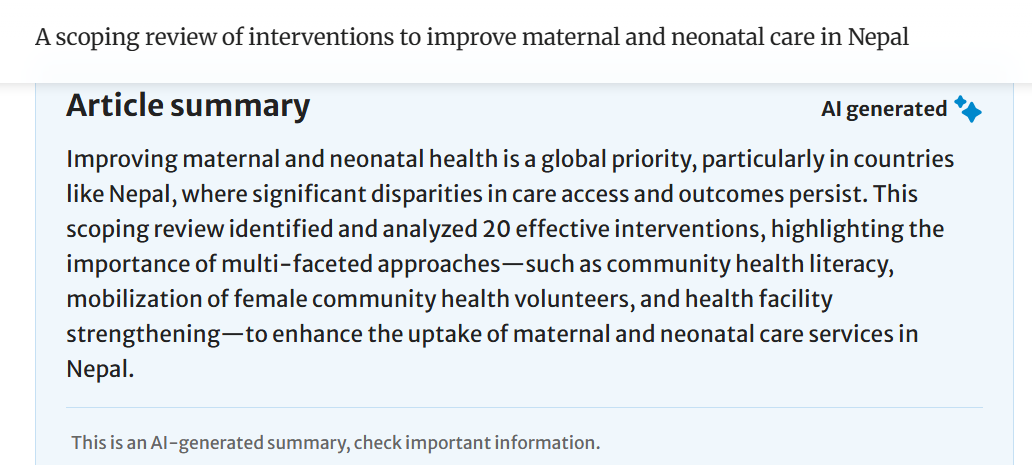
This scientific paper in Discover Public Health is open access and, therefore, freely available worldwide to anybody with internet access. Interestingly, the journal has added an AI generated summary, despite the fact that we as authors had provided a perfectly useful abstract.
Reference:
- Wasti, S.P., van Teijlingen, E., Adhikari, N. Morgan, J. (2025) A scoping review of interventions to improve maternal and neonatal care in Nepal. Discover Public Health 22, 855 . https://doi.org/10.1186/s12982-025-01241-x
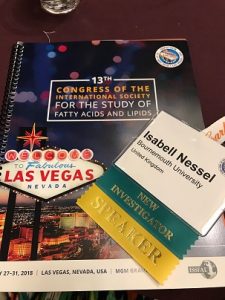
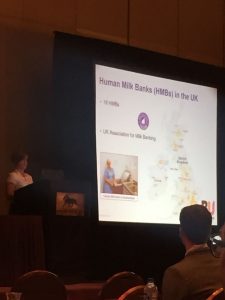 Methodology and Ketoneurotherapeutics. In between, well-known researchers in the field presented their research in plenary talks. Dr Michael Crawford obtained an omega-3 research award and Dr Maria Makrides was awarded with the Alexander Leaf Award. Her presentation entitled “Standing on the shoulders of giants: great women role models, mentors and advocates” was really inspiring.
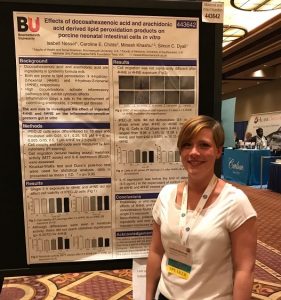 banking practices and recommendations for improvement”, presenting the results of our UK Milk Bank survey, which is now extended internationally. Furthermore, I had two posters displaying our work on preterm formula milk storage conditions and lipid degradation; and the effects of lipid degradation products on intestinal cells in vitro. These presentations gave me the possibility to position myself in the fatty acid research world and to make valuable contacts.
 I had the pleasure of spending the last three weeks in the Department of Life Sciences (University of Roehampton), working with Dr Giulia Corona and Dr Volker Behrends. We successfully validated an ultra-high performance liquid chromatography coupled with triple quadrupole mass spectrometry (UPLC-MS/MS) method to analyse lipid peroxidation products (breakdown products of fats) in human urine samples.
 hod had to be tested and validated, using adult urine samples.
 provided the standards used in this analysis. I am grateful that I had this opportunity to further develop my research skills and to learn a new state-of-the-art technique and would like to thank all involved for making this possible!
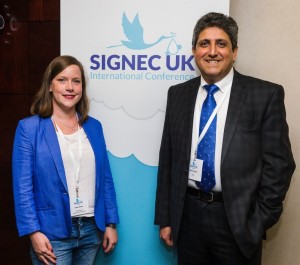 My supervisor Dr Simon Dyall and I were delighted to be invited to attend this event, since, together with Minesh, we are looking at the role of essential fatty acids in perinatal health. As stated above, NEC is a major health concern in the perinatal period, which potentially benefits from essential fatty acids. Furthermore, the event was a perfect opportunity to network with people working in the field of perinatal health and to get more ideas for future research.
 If you would like to learn more about SIGNEC UK or attend next year’s conference, please contact Prof Minesh Khashu at
  The April issue of the Journal of Neonatal Nursing will publish the latest article written by a combination of Faculty of Health & Social Sciences staff and Visiting Faculty. The paper ‘Experiences of fathers with babies admitted to neonatal care units: A review of the literature’







 3C Event: Research Culture, Community & Canapés-Tuesday 19 May 1-2pm
 New chapters published in maternity book on risk
 The British Academy European Research Council Grant Support Sessions
 Grant Writing Workshops: Master the Art of the Winning Proposal
 UKCGE Recognised Research Supervision Programme: New Application Window
 Apply now to take part in the 2026 ESRC Festival of Social Science
 Reminder: Register for the ESRC Festival of Social Science 2026 Information Session
 ECR Funding Open Call: Research Culture & Community Grant – Apply now
 ECR Funding Open Call: Research Culture & Community Grant – Application Deadline Friday 12 December
 MSCA Postdoctoral Fellowships 2025 Call
 ERC Advanced Grant 2025 Webinar
 Update on UKRO services
 European research project exploring use of ‘virtual twins’ to better manage metabolic associated fatty liver disease