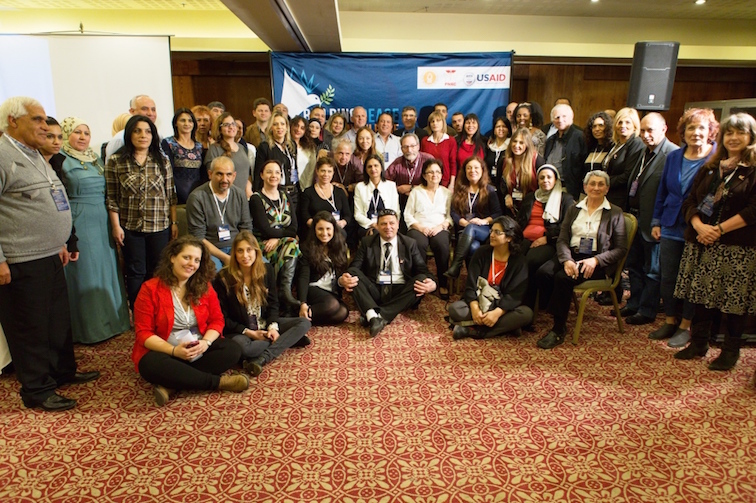
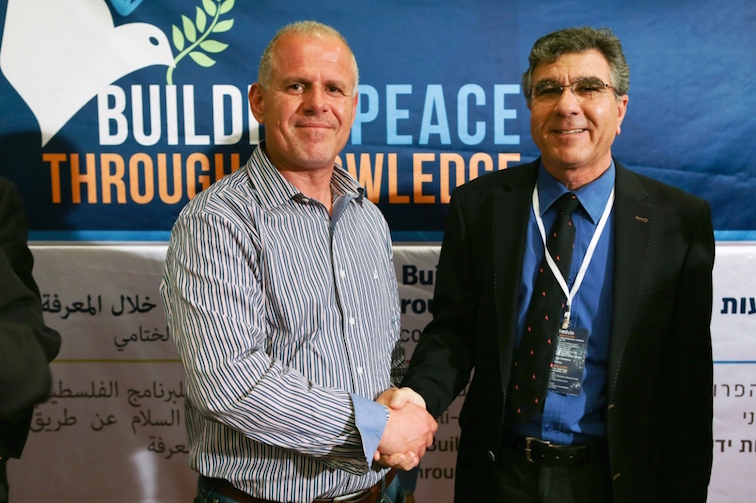
 A few days ago I wrote a BU blog reporting on a Palestinian-Israeli peace and reconciliation conference where I had invited to give a keynote lecture – a great and challenging honour. As stated, I was greatly impressed by the openness of the mixed group of participants to engage in very difficult discussions.
Following the workshop, however, one of the participants, a Palestinian health professional, expressed his sense of disillusionment that the Israeli participants seemed to know little of the realities of the lives of Palestinian in Jerusalem. That therefore the dialogues, although constructive, were self-referential in merely speaking parallel discourses without achieving a breakthrough into true awareness of the other. If this were so here, in this welcoming forum, what hope was there beyond that in wider Israel?
‘People don’t want to see what it is really like for Palestinians in Jerusalem’ he said despondently.
‘I do!’ I replied.
He brightened up. I did? I really did? How much time did I have? One morning only before I left for London but it would have to be enough.
The next day I met Mas’ud in the hotel lobby. I witnessed him being interrogated by our tough looking Israeli security man before being allowed in. I was uncomfortably aware of the hard stares we were given as I got into his car. I had no doubt at all that the car’s registration number was being taken down. None of this seemed to mar Mas’ud’s happy mood to have me travelling with him. He stopped and drew a map of the country on a scrap of paper. ‘I shall not call it Israel,’ he said meaningfully to me. ‘This is a map of Palestine.’ We passed by a Court of Law and Masu’d said how Palestinians hated this place: ‘all our sons are judged here’ under Israeli law. Even ‘ten, twelve-year-old-children – for throwing stones’.
From the Jerusalem escarpment we saw the great panorama of the outskirts of the city with its ancient boundaries. The Mount of Olives rises from a deep valley and all down the side of the valley one can see small white houses on a vertical rise. The view from this high vantage point is incredible. It might be thought colourfully picturesque in a primitive way if one did not know what it meant. The most compressed space imaginable for the Palestinians, where blocks of residences cling to the side of the mountain precariously like birds nesting on a sheer cliff face. I am told that all the lands behind the Mount of Olives are occupied by Jewish settlers.
The golden dome of the Russian Orthodox Church glints in the sunlight. Below that is the Church of the Last Supper, full of tourist pilgrims as usual. Mas’ud says he doesn’t know much about Christianity but says he knows that Christ walked and preached in these hills. Mas’ud tells me that not only are Christians liked but more, they are ‘loved’. Indeed I have seen with what great reverence the Christian monks and nuns are held in here in Jerusalem. He confirms something I have already observed that Muslims send their children to Christian schools and that the children of both religions mix happily together without problems. From what I have read in my visit to churches here in the Holy Lands the oppression of Muslims and Christians is felt to be shared – and thus the bond between them is very close as two of the three offspring of the Abrahamic legacy. But I am also told that the Palestinian Christians and Muslims cannot access the holy sites even on special holy days if they live outside of the checkpoints. To pass through is infinitely complex, uncertain and fraught and full of ritual mortification – the pain and humiliation of which some Palestinians tried to express in the conference.
From birds-eye viewpoints we can see a sinister grey tentacle that winds itself around Jerusalem. What it can be is hard to make out from here, as indeed is the scale of it. We pass by the Hebrew University – ‘built on Palestinian land’ is the cold comment. The big hospital ‘over there’ is built on Masu’d’s village land that the families are unable to return to. He also tells me that they are trying to protect it from being built on by Jewish settlers, not on the grounds of legal ownership but because of archaeological interest – it isn’t stated as such but the implications are very clear, archaeology is seen as a more legitimate claim.
We drive up the road and pass Al Aqsa – the ancient and deeply venerated mosque. It is large, imposing, simple and sand-coloured. There was a footbridge that can still be seen to which the faithful could travel from this side where we are, but the bridge is now adjacent to a police checkpoint, where it is illegal to park. We cannot stay there long, a quick look and then we must go. The Israeli guard was hesitant to let us in to the compound in the first place but being a British citizen still carries some weight. I ask Masu’d if I can enter, but no apparently foreigners cannot go in – but it is not the Palestinians who would keep me out though, he says.
Very close by there is the so-called ‘City of David’, a compound opposite Al Aqsa, for Jewish Israelis only. In the valley along the road close by is a Jewish cemetery. When it is Jewish holy days the entire area is closed down and no Palestinian can move there. Given its proximity to Palestinian enclaves this must be an intolerable curfew. The Israeli Star of David flag is spotted everywhere in this tightly packed Palestinian residential area. Masu’d tell me that the police set up surveillance areas on top of living quarters. Therefore families of Palestinians literally have the Israeli police above them – I am left to contemplate how that must feel for those families daily.
It would seem as though there has been a major bombing raid round here, so many houses lie in ruins, demolished. They have actually been demolished by the Israeli State. Apparently Palestinians find it very hard to get a building license and this costs 200,000 shekels (approximately £34,000) (prior to any construction costs). Without that the building gets demolished (residents are given the choice of pulling it down themselves) and then, incredibly, the State sends a bill to the luckless resident for the bulldozing charges!
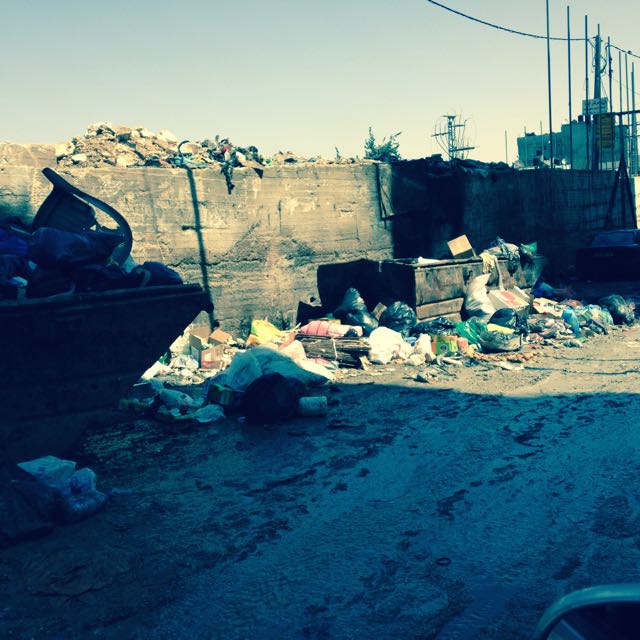
Incredibly the Palestinians have to pay the same taxes as ever other Israeli and yet not only is life so oppressed and tenuous, in many places they have no amenities either. By amenities, Masu’d means, rubbish removal, pavements, any kind of half civilised housing, playgrounds, a single miserable patch of grass, security. Some neighbourhoods we pass through are completely devoid of any security measures at all and every other welfare facility to boot. Needless to say it attracts many criminals and all manner of crimes are carried out and go unpunished.
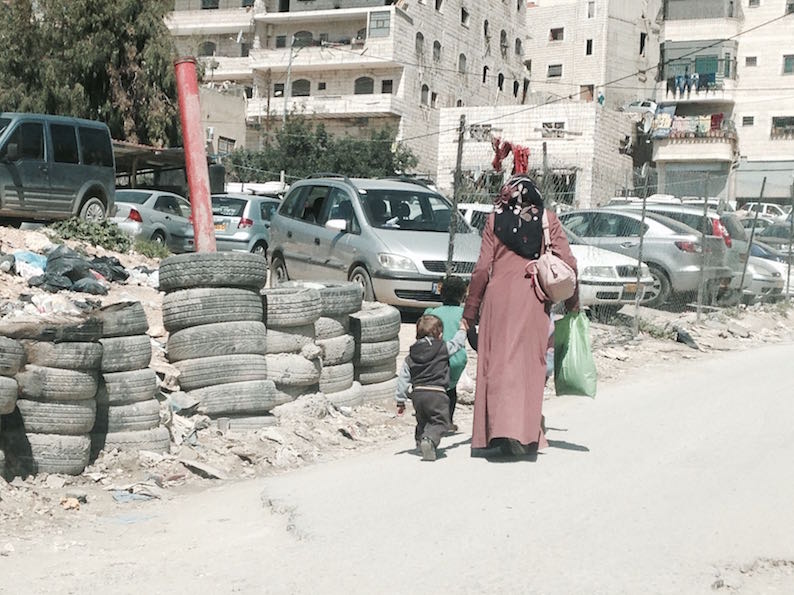
I am stunned by the numbers of families living in these unutterably compressed and squalid places, Here is one miserable, dirty, dusty enclave where families live on top of each like stacked shoeboxes in some long forgotten warehouse. Here there are 55,000 people living, there 40,000, somewhere else (I see a distant view of dystopic high-rises behind the ubiquitous wall), 70,000, and so it goes on. We pass a Palestinian mother with three little tots stumbling along – they have no choice but to walk on the road, there is no paving. We drive on winding around the babies and the cars, and the overflowing mess of un-emptied bins, rubbish everywhere, a few miserable ducks drinking from a filthy puddle, pass a sign for the UAE Red Crescent charities. We pass a Christian priest hurrying along to catch a bus. We pass another ghetto down the hill where no car can pass as there is only one entrance impeded deliberately by huge boulders and, guarded by the ubiquitous Israeli police.
We pass Israeli apartments, a few times. The contrast between these and the Palestinian homes is completely and brutally stark. One typical example is a row of apartments or townhouses of good architecture with wide terraces on pleasant streets with trees and flowers. An excellent recycle waste-disposal unit stands ready for use by residents. In another such area a children’s playground with good equipment is a hop-and-skip from pleasant homes. Orthodox Jewish children dressed in black play sedately here. Three minutes by car stands another neighbourhood – graced by incredible poverty, filth and deprivation. No doubt these Israeli children go to nice, well-equipped schools, but in Jerusalem Palestinian children can take hours to travel through the checkpoints in the morning although the school incredibly actually stand within sight. They are the lucky ones, thousands of others have no school to go to.
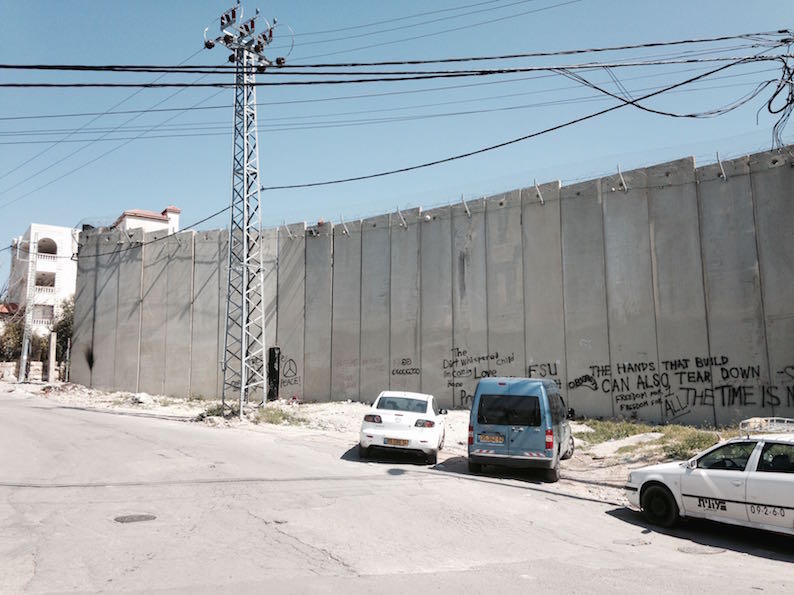
And everywhere we go winds the great, grey wall that divides neighbourhoods, communities and families from each other. Even, and this is quite incredible – one house from another – the wall extrudes from a house – simply cuts it off. The wall is huge, immense and topped by fencing and wire. The perfect canvas of course for furious, anti-Israeli slogans although oddly I don’t see many. What happens to graffiti artists here? I wonder nervously.
Masu’d asks with passionate rhetoric, ‘How can the kids in this place put their hands into that of the Israelis?” He goes on. ‘The Israelis say they want peace after they have taken everything, everything from us! The wall in Berlin was destroyed’, he says, ‘but here they think it brings them security. It won’t. I have my work, I have my kids but those who have nothing, because a man cannot get work – because he cannot pass through the checkpoints that day, he has no food, he has no schooling for his children, nothing!’…. What has he to lose? Is the message. ‘Better to die once than die every day!’
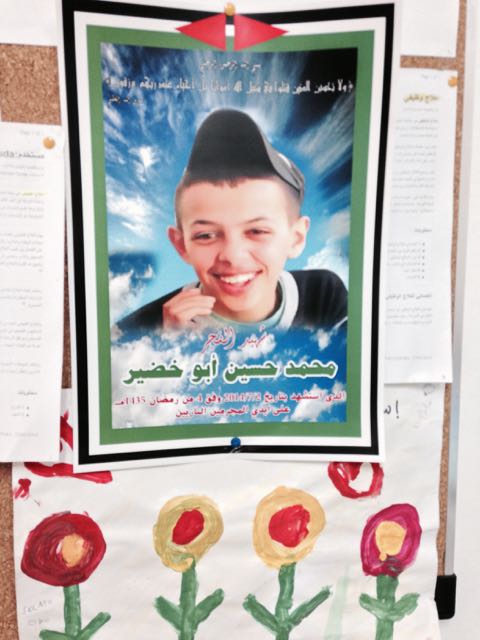
We end our tour in the most agonising way imaginable. Mas’ud’s neighbours wish us to visit them to speak of their recent loss. Mohammed was their fourteen-year-old son (their photos show a skinny little lad with a sweetly gormless grin). Last July during Ramadan, while sitting outside his parent’s shop waiting for the mosque to open for dawn prayers, he was forcibly abducted by three young Israelis bent on revenge for the shooting of three Israeli youths.
The family show me harrowing but brief CTV footage they still have of the beginnings of the abduction. Mohammed was driven off to a nearby forest. His mouth was filled with petrol and his head set alight, the family tell me. When he didn’t expire quickly enough the rest of him was burned alive. When his body was found Jerusalem went wild with protests. Shimon Perez offered to meet the family but they regard Israeli policy as directly complicit in Mohammed’s death and refused to meet him, although have received condolences from Israeli sympathisers.
I also hear that there has been no formal help given to this family at all to help them cope with appalling trauma. Needless to say the younger siblings are completely traumatised as well as the parents. Even Mas’ud’s three-year-old child knows of Mohammed’s death. Mas’ud says he misses hearing Mohammed’s step on the stairs – it is a reminder of not only what close proximity the people here live in but in all ways, the trauma is a collective one. As we leave the family press on me gifts of beads that they brought back from the hajj as mementoes – the pilgrimage made on behalf of Mohammed who will never now make the journey. They press on me a bag of sage, a poster of their beloved son. They tell me I always have a home in Jerusalem now – their home. They break my heart.
Within an hour, Moishe, my friendly, Iraqi-Jewish-Israeli taxi driver is driving me to Tel Aviv Airport. We pass the West Bank, even I am becoming used to the sight now of all the gun turrets and armed checkpoints we pass by. I remember something Mas’ud said to me earlier: ‘Every family here has lost someone, a son, a daughter.’
‘Arab village’ Moishe says, waving to his left as we drive by. Now on the right, ‘Here, Settlement!
What do you think of the all these walls all over Jerusalem, Moishe?’ I ask.
‘Oh, you need walls, for roads,’ he says, adding after a pause, ‘and to keep the Palestinians out.’
‘Do people feel safer with all these walls everywhere?’
‘Well, better to have peace of course,’ he says. ‘But first have the peace and then the walls can go down.’
‘Perhaps there would be peace more quickly if the walls came down first.’
No reply. I leave it – for now.

Professor Sara Ashencaen Crabtree

 We have been commissioned by the Centre of Workforce Intelligence funded by the Department of Health, to model the future demand of the health and social care workforce over the next 30 years. Professor Keith Brown and Emily Rosenorn-Lanng were invited to participate in the Elicitation workshop facilitated by DoH with a host of Social Care Workforce leaders and specialists to look at the current and future impacts on the workforce and what this may be more care planning in the future. Emily in particular sourced and analysed the national data for the level of demand and availability of the current workforce.
 We were commissioned by the London Borough of Enfield to evaluate their Making Safeguarding Personal Strategy in order for them to apply for Gold Standard status from the Local Government Association. Dr Gary Barrett and Sarah Wincewicz were invited to spend time with the teams at Enfield to explore safeguarding practice. As part of this work we are collaborating with Enfield and other local authorities to create a Safeguarding App, which will allow practitioners to access the most current safeguarding information on a mobile device.
 and subsequently his writing the story for the film.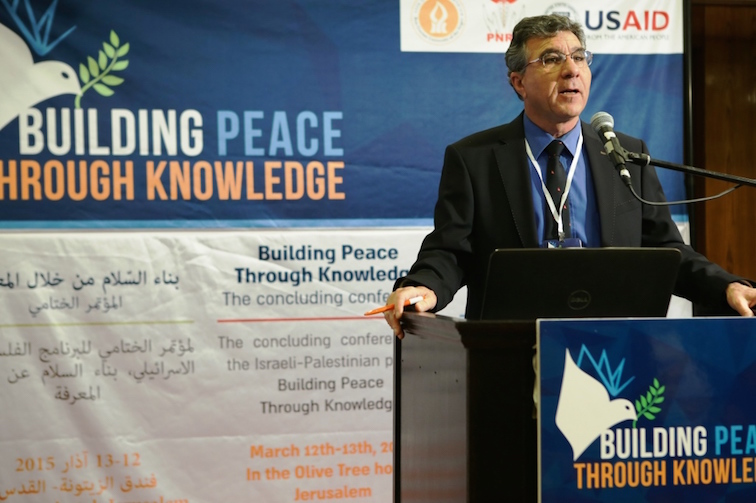










 ESRC Festival of Social Science 2026: An Opportunity to Engage New Audiences
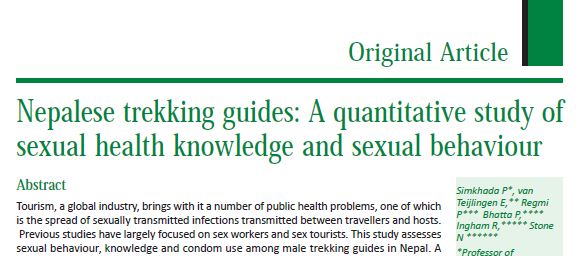
 New HIV paper by BU PhD student
 BU Annual Research Conference: Poster Exhibition Call for Applications
 Vitae Three Minute Thesis (3MT®) Competition: Applications Now Open
 3C Online Social: Thursday 26 March 1–2pm – Research Culture, Community & Can you Guess Who?
 ECR Funding Open Call: Research Culture & Community Grant – Apply now
 ECR Funding Open Call: Research Culture & Community Grant – Application Deadline Friday 12 December
 MSCA Postdoctoral Fellowships 2025 Call
 ERC Advanced Grant 2025 Webinar
 Update on UKRO services
 European research project exploring use of ‘virtual twins’ to better manage metabolic associated fatty liver disease