Tagged / impact

BU academics contribute to initial findings from Covid-19 expert database

In March, POST launched the Covid-19 outbreak expert database, inviting anyone who wanted to support Parliament in its work, and had expertise in COVID-19 and/or its impacts to sign up. In April, more than 1,100 experts on this database responded to a survey put out by POST, asking them to share their immediate, short, medium and long term concerns relating to COVID-19 and its impacts. Having analysed the responses, and determined there to be 15 broad areas of concern, POST is now publishing syntheses in these 15 areas.


The 15 areas of concern are listed here, along with the methodology for both conducting the survey and synthesising the insights. The 15 syntheses are being published on POST’s Horizon Scanning pages.

Those respondents who said they would be happy to be publicly acknowledged are listed in full here and the list includes the following BU academics:

  • Professor Katherine Appleton – Psychology
  • Dr Emily Arden-Close – Psychology
  • Professor Christopher Hartwell – Financial Systems Resilience
  • Professor Ann Hemingway – Public Health and Wellbeing
  • Dr Sarah Hodge – Psychology
  • Dr John Oliver – Media Management
  • Dr Karen Thompson – Leadership Strategy and Organisations
  • Dr John McAlaney – Psychology
  • Professor Lee Miles – Crisis and Disaster Management
  • Dr Andy Pulman – Digital Health and User Experience
  • Professor Barry Richards – Political Psychology

You can still sign up to the expert database here.


How the C-19 lockdown has affected the work-life balance of BU academics (Part 2)

Our blog Part 1 (posted on Friday May 15th) provided a very crude overview of the preliminary results from the survey we have launched to collate data on the impact of C-19 lockdown on the work-life balance of academics. This Part 2 focuses on differences between groups of respondents and identifying whether particular groups have been more negatively affected. We are yet to do any statistical tests on these data, so please consider differences between groups with care.

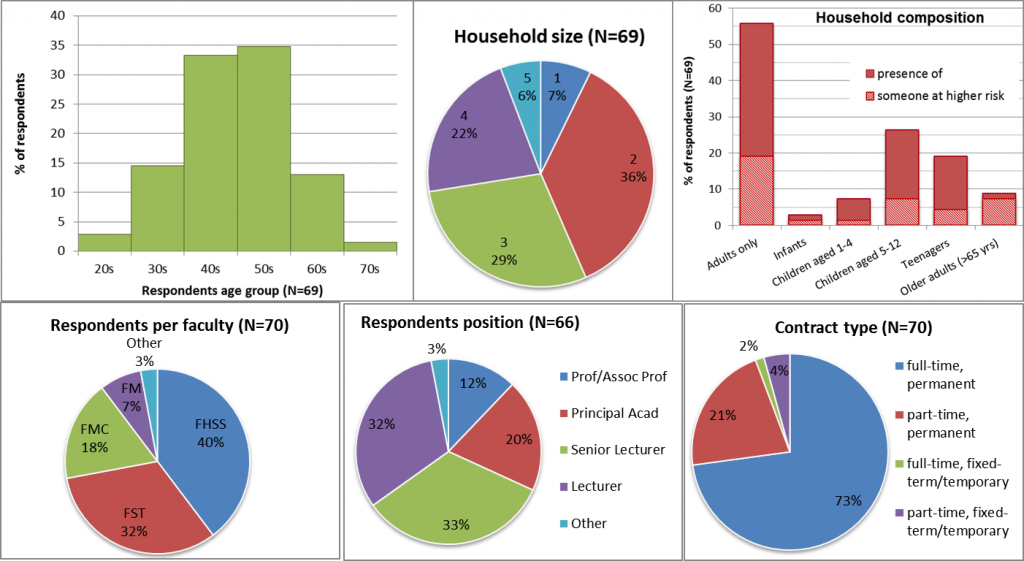
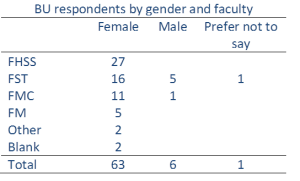
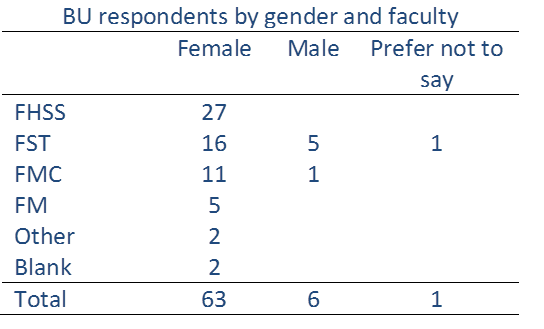
We have received 170 responses to date, 70 we could identify as being from BU staff (63 from female colleagues). If you have not yet contributed to this survey, you can still to do so here: https://bournemouth.onlinesurveys.ac.uk/impact-of-lockdown-on-academics, and please do share with your networks, as the survey is open to all academics. If you want us to be able to identify that you are BU staff, you will need to mention BU in one of the open questions. This research is a cross-faculty collaboration conducted by Sara Ashencaen Crabtree (FHSS), Ann Hemingway (FHSS) and myself (FST).

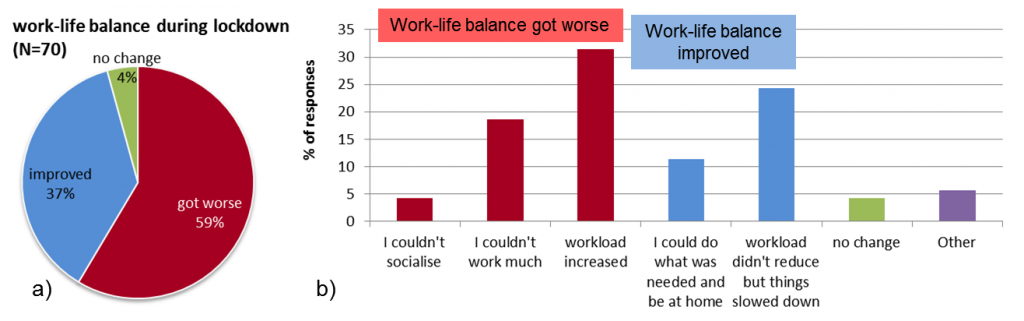
Work-life balance during lockdown got worse for the majority of respondents (59%) and improved for 37%. The most common reason for worsening or improving work-life balance were ‘workload increased’ (31%) and ‘I could do what was needed and be at home/with family’ (24%), respectively (Figure 1a). Although there are differences across gender (Figure 1b), any differences between male and female respondents should not be considered representative of the wider community due to the small number of male respondents.
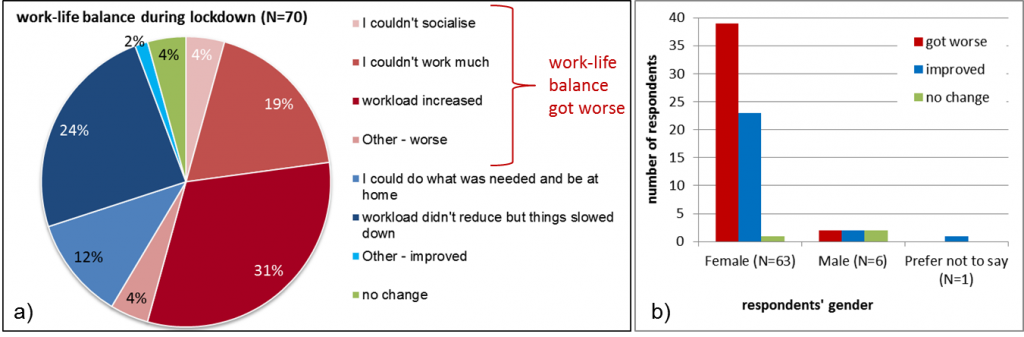
Figure 1. Changes in work-life balance of respondents during Covid-19 lockdown and the selected reasons for identifying positive or negative change (a) and reported changes per gender of respondents (b). Blue shades indicate work-life balance improved and red shades indicate it worsened.

A higher proportion of academics under the age of 40 (82%) indicated that their work-life balance has worsened during lockdown when compared with other age groups (Figure 2a). Most of these academics reported that work-life balance worsened because they couldn’t work much. For academics in their 50s or older, the key reason for worsening of work-life balance was the increase in workload.
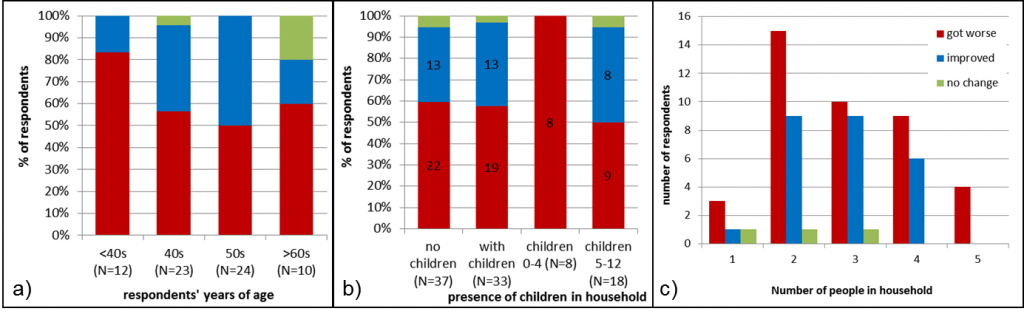
Figure 2. Changes in work-life balance of respondents during Covid-19 lockdown per age group (a); presence of children in the household (b) – the group ‘with children’ includes children ages 0-12 and teenagers; and household size (c).

Balancing work and childcare and/or homeschooling  was mentioned as a negative effect on work-life balance during lockdown by 18% and 7% respectively. However, this does not seem to be the main cause affecting respondents under the age of 40, when responses between groups with and without children are compared. In fact, 87% of respondents in their 40s live in a household with children 12 years old or younger and yet the proportion of this age group reporting worsened work-life balance was lower (55%) than the proportion of respondents with no children (60%). However, respondents who live in a household with younger children seem to be more negatively affected.

All respondents (N=8) who live with children under the age of 5 years have reported that their work-life balance have worsened (Figure 2b), the majority indicated an increase in workload as the main reason. However, no major differences were found when comparing groups of respondents who live with children (all ages under 19 included) and households without children. Interestingly, a lower proportion of respondents who live with children aged 5-12 years report worse work-life balance (50%) than respondents who do not have children in their household (60%) (Figure 2b). Further, work-life balance has improved for a higher proportion of respondents who live in a household of three people (45%) than in other household sizes (<40%) (Figure 2c).

In all faculties, a higher number of respondents reported work-life balance getting worse than improving, except FST (Figure 3a), where work-life balance has improved for 50% of respondents and worsened for 36%. Professors were the only group with more respondents indicating work-life balance improved (50%) than worsened (25%); in contrast, all associate professors reported worsened work-life balance (Figure 3b), but the small sample in both groups may not be representative.
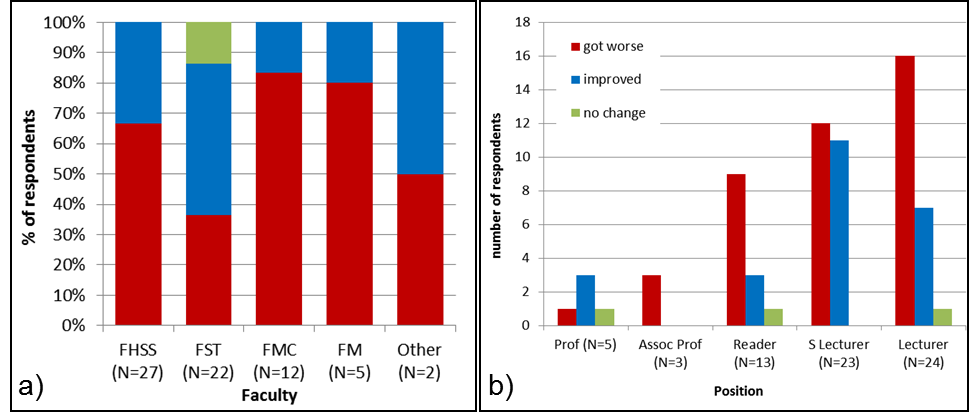
Figure 3. Changes in work-life balance of respondents during Covid-19 lockdown per faculty (a) and position (b).

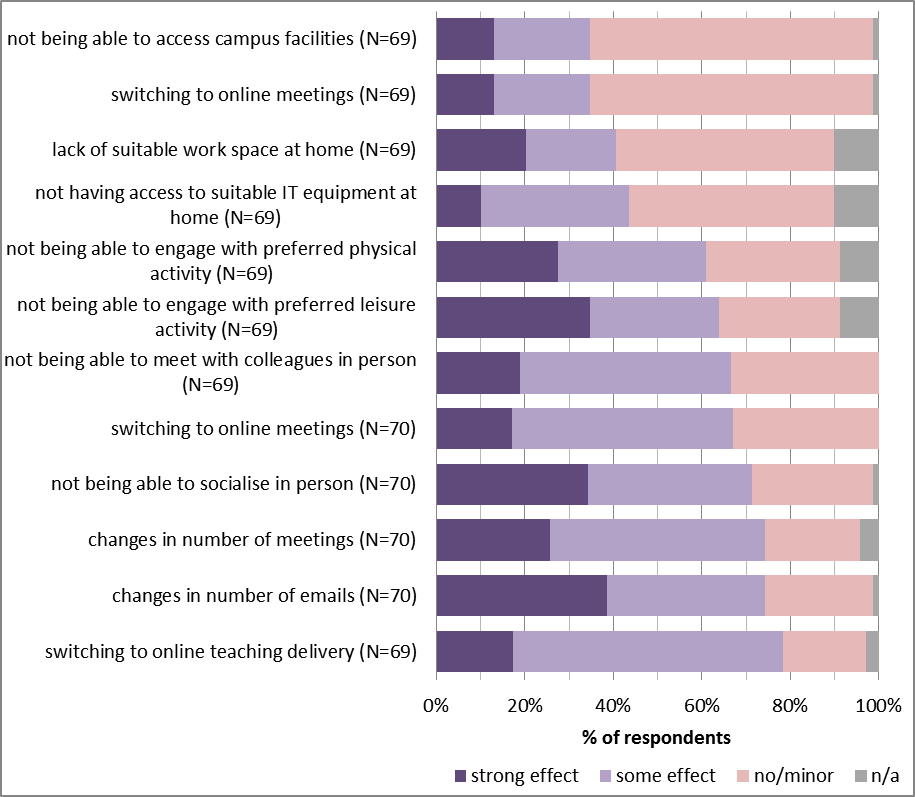
Switching to online teaching and not being able to meet with colleagues in person, socialise and engage with preferred leisure activity were the factors affecting negatively more than 50% of respondents (Figure 4).When lockdown restrictions are lifted, two of these factors (socialise and engage with preferred leisure activity) will have less effect on academics work-life balance, but more could be done to support colleagues negatively affected by the switch to online teaching and missing the contact with colleagues while working remotely.

More respondents have indicated a positive than negative impact from changes in the number of meetings and switching to online meetings emails (Figure 4). Fewer and more effective meetings were reported as the positive impacts. However, for some respondents, there are too many online meetings and they are getting tired of (avoidable) prolonged screen time (an effect that has been called Zoom fatigue). Therefore, guidance on how best to use, organise and participate in online meetings and how to manage and reduce screen time/tiredness may be useful.
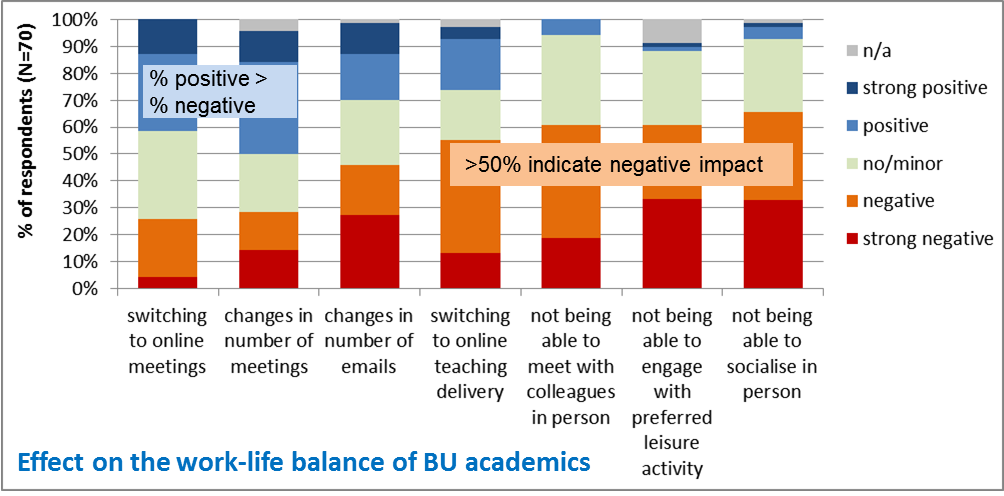
Figure 4. The impact of selected factors on the work-life balance of respondents during lockdown.

A considerably higher proportion of respondents under 40 years of age report negative effect from switching to online teaching (75%), change in the number of emails (58%) and changes in the number of meetings (50%) in relation to other age groups (Figure 5). This age group also shows lower proportion of staff indicating positive effect from these three factors.
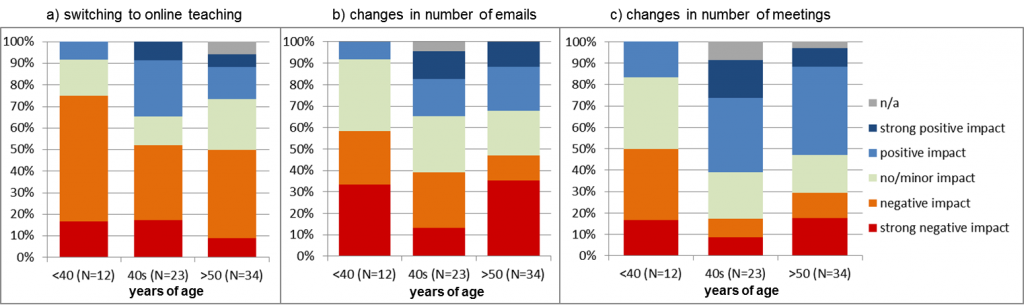
Figure 5. Reported impact per age group from (a) switching to online teaching; (b) changes in number of emails; and (c) changes in number of meetings.

FMC is the only faculty with more than 50% of respondents reporting negative effect from switching to online teaching (58%), change in the number of emails (58%) and changes in the number of meetings (67%). FST and FM are the faculties with 50% of respondents reporting positive impact from changes in the number of meetings.  FHSS has the largest proportion of respondents indicating negative effect from switching to online teaching (62%) and strong negative effect due to changes in the number of emails (54%). Increased number of emails from students has been reported, particularly by FHSS staff who support students who were asked to work for the NHS.
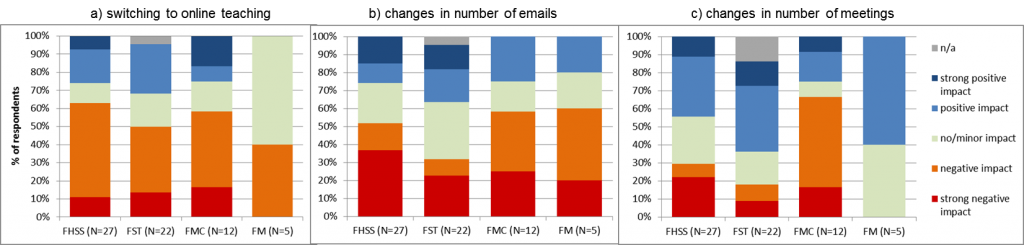
Figure 6. Reported impact per faculty from (a) switching to online teaching; (b) changes in number of emails; and (c) changes in number of meetings.

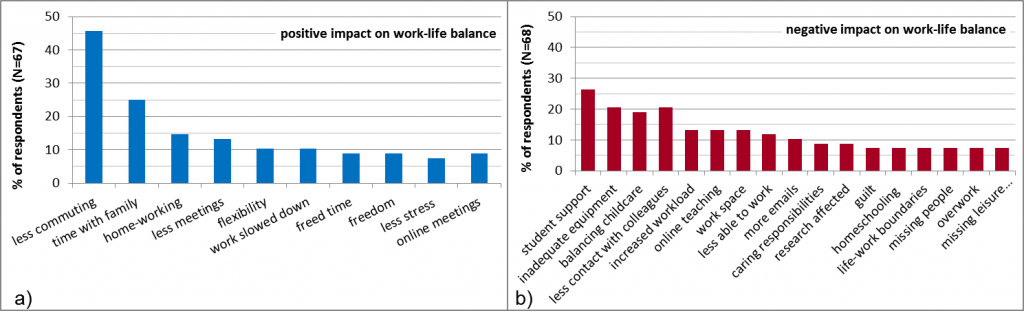
Figure 7 shows word clouds based on responses to the open questions asking for the two most important factors leading to negative and positive impacts on their work-life balance during lockdown. Increased demand for student support was the most cited negative factor (by 27% of respondents), followed by missing contact with colleagues and inadequate equipment (e.g. IT, desk, chair) and balancing childcare (19%). Less commuting or travel for work was the most cited factor affecting work-life balance positively (46% of respondents), followed by time with family (25%) and enjoying working from home (15%).
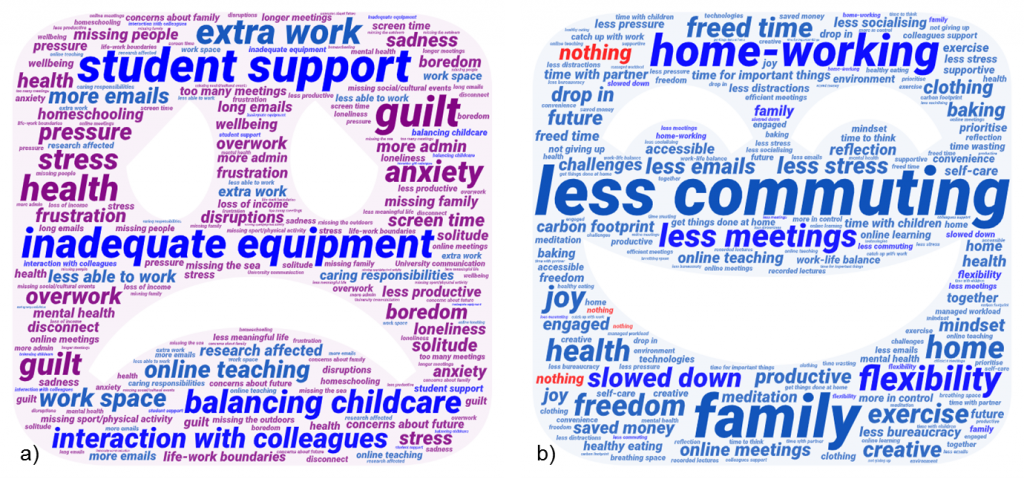
Figure 7. Word cloud showing how respondents expressed the negative (a) and positive (b) factors affecting their work-life balance during C-19 lockdown.

In responses to open questions, it is apparent that many negative aspects of the lockdown relate to aspects that are likely to subside when restrictions are lifted (e.g. reopening of schools, meeting with family and friends, enjoying leisure activities). Other negative aspects relate to the fast pace in which academic staff had to switch to online activities, sometimes without adequate workspace, equipment and/or training, leading to overwork. On the other hand, respondents report many substantial advantages of working from home, many wishing that this can continue (at least for part of the time) in the longer term. This is a summary of the advantages respondents have identified:

  • No travelling = more control over time + less exhaustion + less expense + better for the environment + spending more time with family
  • Healthier – nutritionally better, more physical rest, more exercise
  • Staying safe – better protected at home, avoiding traffic hazards
  • Gaining extra hours to work
  • Slower pace = more time to concentrate; a breathing space
  • Greater autonomy to manage time and priorities
  • Greater flexibility = ingenuity and novelty, new ways of teaching and supporting students remotely
  • Less stress and physical/mental wear-&-tear
  • Stripping back work dross – basic priorities reveals a lot of bureaucracy that can be avoided

 Who are the respondents?

Exposure to Covid-19

  • 7% of respondents (5 out of 68) had severe symptoms of Covid-19 or tested positive or live with someone who did. All are female respondents in their 20s, 30s and 50s. Two of these households had someone at higher risk for severe illness from COVID-19.
  • 22% of respondents (15 out of 68) had close family members, friends or colleagues who had severe symptoms of Covid-19 or tested positive. All are female respondents in their 30s, 40s and 50s (the majority, 9 respondents).
  • 41% of respondents (28 out of 68) live in a household where there is at least one person at higher risk for severe illness from COVID-19.

HE Policy Update for the w/e 15th April 2020

Hi all, a short update this week, with a couple of important updates

Office for Students update

The Office for Students issued another update to providers on 14th April.

They confirm the on-going uncertainty on access to government schemes for HE providers – there are hopes that this will be resolved (in a positive way) later this week. The update says:

  • We understand that the two coronavirus Business Interruption Loan Schemes and the COVID-19 Corporate Financing Facility are open to higher education providers, although final confirmation about eligibility for these schemes has still to be determined. We will continue to work with the Department for Education and HM Treasury to get further information about eligibility and will provide further information as soon as we can.


And this on the TEF:

  • As you will be aware, we were previously planning to develop and consult on a new framework for the TEF during the first half of 2020. The impact of the coronavirus crisis means that we do not currently have a date for the next TEF exercise. We will provide further information as soon as we can. We intend to consult on the future TEF scheme after the government has published the Independent Review and its response to the Review’s recommendations. Publication of the subject-level TEF pilot reports has been delayed as a result of the coronavirus pandemic.


Some commentators (see Johnny Rich here) are seeing this as a major step – an indefinite postponement of TEF using the virus as cover. After all, there are rumours that the Pearce review is not very positive about the TEF.

But this could be over-egging things. The OfS has postponed all its consultations and hasn’t yet set new deadlines for any of them – so this is just the OfS being consistent. Don’t read too much into the postponement, folks – we would be very surprised if TEF goes away, even though the 2020 data will be weird.

There is comment from Wonkhe here:

  • From the looks of the scant paragraph we get it would seem that this is a temporary measure, and that there would be every expectation that we would get a new date in time. But it is not hard to imagine this indefinite pause as a quiet death for a basket of metrics that has failed to capture the imagination of the audience it sought…..
  • It could, of course, be argued that the current situation suits everyone involved perfectly well. The Government seems in no hurry to publish a review of TEF that is likely to have been less than glowing, the OfS doesn’t need to respond to it or consult on it (making it easier to integrate TEF into the mainstream of regulation), and TEF remains on pause forever. Nobody loses face, the decision to cancel TEF is never explicitly taken (so the government never goes back on a manifesto promise) but it is quietly understood that no future work will be done on an indicator that signally failed to indicate anything.


[PS there is still no news from UKRI on the KEF deadline extension]

The Office for Students has a webpage which brings together all their guidance, FAQs and the Ministerial letters, which is a useful resource. They keep adding to the FAQs – what we are all waiting for now is the next news on admissions, due on 20th April

  • We have created a provider guide to coronavirus which includes information about our regulatory requirements, FAQs, and links to all letters and guidance issued by the OfS. There is also a student guide with FAQs and signposting to sources of information beyond the OfS.


Support for Universities

Universities UK issued a package of measures to address concerns in the sector – and shared it with Gavin Williamson in a telephone call.

They highlighted the many challenges to the sector, the work that we are doing to support the national effort and our staff and students. They asked for specific confirmation that confirmation that universities are eligible for the Job Retention Scheme (furloughing staff), and the Business Interruption Scheme and the Corporate Financing Facility and recommended a range of actions, including:

  • increasing funding for research and covering the full economic cost for UKRI funded research;
  • introducing a one year “stability measure” in the form of a student number cap equal to the number of UK and EU students forecast for 2020-21 plus 5% and a new sector agreement on fair admissions practices that would, amongst other things, restrict unconditional offers at volume;
  • provide further funding for courses that support key public sector services, including nursing and healthcare and some short and part-time courses;
  • a transformation fund to support universities to reshape and consolidate through federations and partnerships or mergers;
  • bridging loans and support for changes in lending terms, reprofiling funding allocations including the student finance payments towards the beginning of the academic year, and halting the planned cuts in teaching grant; and
  • mitigating the impact on international recruitment by providing flexibility of visa requirements and delaying changes that would apply to EU students after Brexit who would join in the 2021 academic year.
  • We don’t know when there will be a response, if at all.

The Opposition view

Research Professional has an interview with Emma Hardy, shadow Universities Minister. It’s an interesting read:

  • The model of intense competition is failing. Having read Universities UK’s submission to the government, letters from the University and College Union and other higher education organisations and interest groups, what is not surprising is the amount of consensus there is. If we continue down the same path of “unseemly competition” as UCU has warned, then some universities will face financial failure and as it stands the Office for Students has been clear that it will not bail them out.
  • As highlighted by UUK, the likelihood is that ‘cold spots’ will develop, exacerbating the regional inequalities and putting already disadvantaged students at a greater disadvantage.
  • There is a consensus around the need for change, and we should look to create a more collaborative system. UUK has already acknowledged that changes need to be made and that these could include “federations and partnerships”. Labour believes there should be greater collaboration between higher education, further education and adult community learning, to anchor those institutions in their communities and reform their governing structure.
  • Institutions offering similar academic courses in the same region could cooperate with the aim of staff development and educational improvement to benefit students and our national interest.


  • There needs to be a collective acknowledgement of the unpalatable idea of asking mature students who find themselves unemployed as a result of this crisis to commit to a lifetime loan of over £27,000 for a degree which the government knows they will never repay. Labour will continue to argue for free education for all as we face of challenge of upskilling our country in a post-Covid-19 world.


  • A higher education system funded by government, industry and commerce has the power to hold universities to a higher standard, and it should use this power to radically reform the terms and conditions of university staff and in particular the use of insecure contracts.
  • If we wish the UK to maintain its reputation as a world leader in research, then research grants must be balanced and distributed regionally to create regional institutions of excellence.
  • The Research Excellence Framework has been discredited nearly as frequently as the Teaching Excellence and Student Outcomes Framework and the space provided by the suspension of the REF due to Covid-19 opens the discussion on what makes for effective accountability. If we are to build a future based on cooperation, and universities acting in the national interest, then market-based accountability measures serve no purpose.


This follows an intervention by Rebecca Long-Bailey, the new shadow Education lead, who wrote to Gavin Williamson last week, as reported by Research Professional

  • In a missive dated 9 April, that also addresses schools and further education policy, Long-Bailey—who finished second to Keir Starmer in the recent Labour leadership election—asks Williamson if he believes universities are “likely to require additional financial support” as a result of the Covid-19 outbreak, and how decisions on such support will be made? She also asked the Department for Education to protect institutions from closure “for the duration of this crisis”.


  • She also asked if overseas staff working in universities would be offered the same one-year visa extension available to NHS staff and sought reassurances that international students’ visas will be extended where required.
  • “I believe in the current circumstances some additional support should be given to students,” Long-Bailey writes. Specifically, she calls for ministers to immediately suspend all interest on loans, waive tuition fees for the period that students are not receiving full tuition, and give students the opportunity to “defer to next academic year without needing to pay extra tuition fees”.
  • There should also be an assurance that students do not have to pay for accommodation that they are no longer able to use, Long-Bailey wrote, while those in receipt of a maintenance grant should be able to return all or part of it in exchange for it being written off.
  • The shadow education secretary also calls for clarity on student assessment practices during the Covid-19 outbreak and asks the government to “urgently consider” creating a student hardship fund for those who encounter financial difficulty as a result of the pandemic.


Opportunities

Finally, we are delighted that two members of academic staff have submitted evidence to an All Party-Parliamentary Group this week and we are very proud of the work that staff across BU are doing to support the national effort, and to contribute to the national debate.

If you haven’t done so before, now may be a good time to explore the APPGs active in your area of expertise and see if they are doing interesting work – the full list is here. Look under subject groups and follow the links  Some APPGs don’t update their websites very often (or have them at all) but some are very active.

And if you have a news story or a plan for research, or a solution to a practical problem linked to the virus, speak to the M&C press team or Becca Edwards.

Subscribe!

To subscribe to the weekly policy update simply email policy@bournemouth.ac.uk.

JANE FORSTER                                            |                       SARAH CARTER

Policy Advisor                                                                     Policy & Public Affairs Officer

Follow: @PolicyBU on Twitter                   |                       policy@bournemouth.ac.uk


Coming soon – POST’s Parliamentary Academic Fellowship Scheme – Open Call


Advance notice that the Parliamentary Academic Fellowship Scheme Open Call will be launching in June 2020, when expressions of interest will be sought.

Securing a prestigious fellowship with POST provides researchers with unique access to Parliament as well as direct potential for impact. It’s open to all employed academics with a PhD, and applicants propose their own project for Parliament to conduct. Click here for the complete timeline for applications, full details and testimonials from previous fellows.

If you’re interested,  you will need to inform your Faculty Dean/Deputy Dean, to discuss potential sources of funding, and also let the policy team and your faculty impact officer know, so applications can be tracked, and support and guidance provided.

Look out for a post next week on this blog, with details of specific points to consider if you would like to take up this opportunity.

Free interactive training on impact and UKRI/Horizon 2020 funding bids

If you would like to take the opportunity of online impact training as it relates to the UKRI Case for Support or writing the impact sections of Horizon 2020 proposals, Professor Mark Reed of Fast Track Impact is offering free, interactive webinars, giving you access to his most popular training sessions. Due to a high level of interest, there are now a further 100 tickets available for each of the two courses below:


How to integrate impact into your UKRI Case for Support
A highly interactive opportunity to learn about research impact and discuss example proposals integrating impact into their Case for Support
14.00-15.00, UK time (BST), Wednesday 15th April 2020

  • Learn exactly what impact is (and is not) based on evidence from The Research Impact Handbook
  • Discuss two contrasting examples of applied research proposals that have integrated impact into their case for support, identifying which of the two is best and why (using the break-out room function in Zoom), and report back key features of good practice to the wider group
  • Get a masterclass in integrating impact to bids from Professor Reed
  • Get the option to join free follow-up training to learn more about impact via email over the next 5 weeks
  • Get a free PDF copy of Prof Mark Reed’s book, The Research Impact Handbook (second edition), and access to a video recording of the whole session (exclusive to those attending the webinar)
  • Access is on a first-come-first served basis, with up to 100 spaces available. Book now to avoid disappointment.

How to write the impact sections of a Horizon 2020 proposal
A highly interactive opportunity to learn about research impact and discuss impact sections of funded and rejected Horizon 2020 proposals
15.00-16.00, Central European Time (CET), Friday 3rd April 2020

  • Learn exactly what impact is (and is not) based on evidence from The Research Impact Handbook
  • Discuss two Horizon 2020 proposals (impact sections only) in small groups (using the break-out room function in Zoom), identifying key features of good practice to work out which one was funded
  • Get a masterclass in writing the impact sections of a Horizon 2020 bid by Professor Reed
  • Get the option to join free follow-up training to help you embed what you’ve learned via email over the next 5 weeks
  • Get a free PDF copy of Prof Mark Reed’s book, The Research Impact Handbook (second edition), and access to a video recording of the whole session (exclusive to those attending the webinar)
  • Access is on a first-come-first served basis, with up to 100 spaces available.  to avoid disappointment.

New study published comparing high-scoring and low-scoring impact case studies from REF2014

A paper titled: Writing impact case studies: a comparative study of high-scoring and low-scoring case studies from REF2014 was published in Nature this week.

The authors have analysed the content and language of the impact case studies submitted to REF2014 and concluded that: “implicit rules linked to written style may have contributed to scores alongside the published criteria on the significance, reach and attribution of impact”. The article is enlightening, with many useful tables comparing high and low-scoring impact case studies which show a clear difference in content and language between them.

From the abstract: “The paper provides the first empirical evidence across disciplinary main panels of statistically significant linguistic differences between high- versus low-scoring case studies, suggesting that implicit rules linked to written style may have contributed to scores alongside the published criteria on the significance, reach and attribution of impact. High-scoring case studies were more likely to provide specific and high-magnitude articulations of significance and reach than low-scoring cases. High-scoring case studies contained attributional phrases which were more likely to attribute research and/or pathways to impact, and they were written more coherently (containing more explicit causal connections between ideas and more logical connectives) than low-scoring cases. High-scoring case studies appear to have conformed to a distinctive new genre of writing, which was clear and direct, and often simplified in its representation of causality between research and impact, and less likely to contain expressions of uncertainty than typically associated with academic writing.”

The authors analyse each section of impact case studies and find differences in language and content in the research, impact and evidence sections of high and low scoring case studies. As they say: “The findings of our work enable impact case study authors to better understand the genre and make content and language choices that communicate their impact as effectively as possible”.

SciVal – Research Performance Tool Training

Elsevier, the manufacturers of SciVal, will be coming to BU to deliver a number of workshops on their research performance online tool.

SciVal shows bibliometric data for individuals and organisations and is used by some funders and organisations when assessing research grants, informing research evaluation and identifying collaborators worldwide.

27th February 2020 at Talbot Campus

There are two sessions running during the day as follows:

09:30 – 11:00 SciVal for REF purposes

11:30 – 12:30 SciVal Introduction (for Researchers and Professional Support Staff)

13:30 – 14:30 SciVal Introduction (for Researchers and Professional Support Staff)

15:00 – 16:30 SciVal for REF purposes

To register book your place for one of these workshops, please e-mail Organisational Development stating which session(s) you wish to attend.

If you have any queries, please contact RKEDF@bournemouth.ac.uk


New BU paper published on Plos One

Congratulation to Dr Francesco Ferraro, who published his latest paper on Plos One. 

The paper “Comparison of balance changes after inspiratory muscle or Otago exercise training” comes from Dr Ferraro`s PhD where, under the supervision of Professor McConnell, Dr Gavin and Associate Professor Wainwright, he looked at the effects of inspiratory muscle training on balance and physical performance with older adults.

This latest paper looks at the potential benefit of inspiratory muscle training as an alternative to standard balance training intervention.  The findings of this pragmatic parallel study support the hypothesis that 8 weeks of unsupervised, individual, home-based inspiratory muscle training, improves balance ability to a similar extent to supervised, group-based balance training in healthy older adults.

The article is now fully available as open access here

https://doi.org/10.1371/journal.pone.0227379


Dr Ferraro.

fferraro@bournemouth.ac.uk

www.ferrarotrainer.com


‘Research adrenaline junkie: how clinical research energised my career’

The Royal College of Physicians have recently published a set of articles that reflect the crucial role clinical research plays in the NHS.

This article comes from a Consultant Gastroenterologist at the Royal Wolverhampton NHS Trust in which he talks about the transformational effect that clinical research had on his career.

You can see the article here.

Remember – support and guidance is on offer at BU if you are thinking of conducting clinical research, whether in the NHS, private healthcare or social care  – get in touch with Research Ethics. You can also take a look at the Clinical Governance blog for resources and updates.

Happy reading!

Introduction to Impact Workshop 5th February

The societal and economic impact of research is becoming increasingly important in academia, not only for REF purposes, but in funding applications. UKRI announced this week that they are removing impact pathways from their funding applications because impact should be embedded into the research process.

Together with Dr Katey Collins, Impact Champion for HSS, I am running a two hour workshop to explain what impact ‘outside of academia’ means, why it’s important, how to create pathways to impact, and how to evidence the impact your research has created.

If your research is already having an impact, the workshop will give you tools to help accelerate and capture that impact.

If you would like to attend the workshop, you can book here.

New Resolutions for Researching

There are some great opportunities coming up this month to enhance your research skills.

Writing Academy –  Tuesday 14th – Thursday 16th January

This popular training event will enable you to develop the skills required to improve the quantity and quality of your publications and to develop a publication strategy which best represents you as an academic. Taking place offsite in Bournemouth, this comprises two days in-depth training followed by a supported writing day.

Writing Day – Systematic And Scoping Reviews – Monday 27th January

Systematic and scoping reviews are a great way of publishing quality publications. They are highly valued as REF submissions, especially, but not only, in the health field. One of the most important aspects for a systematic review is to create an effective and professional search strategy. This session will provide information on effective search strategies and advice on writing scoping and systematic reviews from academics with experience in this field.

Introduction to Impact – Wednesday 29th January

This workshop will explain what research impact is, why it matters, and how to build impact into your research from the beginning of a project.

Environment Narrative Writing Day – Friday 31st January

For those who are currently writing their environment narratives for REF submission.

Even more great research training opportunities from the RKEDF can be found on the event calendar.

Women academics, social media and gender-based violence.

Dr Emma Kavanagh and Dr Lorraine Brown (FoM) have just published a paper entitled ‘Towards a research agenda for examining online gender-based violence against women academics’. Work on this topic was inspired by Emma’s research on the online violence experienced by female athletes and further influenced by work on sexual harassment by the Women’s Academic Network (WAN), which ran a symposium on the topic in June this year. The writing of the paper was supported through writing retreats organised by WAN. The focus of this paper builds upon the critical mass of research being conducted exploring inter-personal violence and gender-based violence in sporting spaces by members of the Department of Sport and Event Management, and the work of the Bournemouth University Gender Research Group.

There is an increasing call for academics to promote their research and enhance their impact through engaging in digital scholarship through social media platforms. While there are numerous benefits concerned with increasing the reach of academic work using virtual platforms, it has been widely noted that social media sites, such as Twitter, are spaces where hostility towards women and hate speech are increasingly normalised. In their paper, Emma and Lorraine provide a review of the current literature concerning violence toward women academics online and further provide suggestions for a research agenda which aims to understand the phenomena of gender-based violence more clearly and work toward safeguarding (female) academics engaging in digital scholarship. As they rightly state: “institutions such as universities that are increasingly placing pressure on women academics to engage in virtual platforms to disseminate their work have a responsibility in the prevention and protection of harm”.

CoPMRE Visiting Faculty bi-annual event

Yesterday CoPMRE welcomed 30 colleagues to our Visiting Faculty bi-annual event showcasing the exciting medical developments at BU from the new Bournemouth Gateway Building to the Institute of Medical Imaging and Visualisation. The key priorities to support delivery of BU2025 were presented by Dr Clare Wedderburn, Interim Head of Department of Medicine & Public Health presented.  Juan Campos-Perez, Clinical Research Co-ordinator, BUCRU spoke about Biobanks which were highlighted in Professor Emma King’s research presentation on immunotherapy.  Professor Jeffrey Wale, Lecturer in Law encouraged innovative medical cross faculty collaboration demonstrated by his recent research collaboration with Professor Sam Rowlands, Visiting Professor resulting in four co-authored papers. The main focus of the meeting centred around Visiting Faculty engagement in research and education to help us achieve our aims.  The audience reported that they were ‘very excited’ about these new developments at BU and were keen to support this vision.