The Centre for Qualitative Research welcomes new members and invites them to contribute to our on-going and successful Seminar Series in the coming Academic Year.
Doctoral Students and Academics from across disciplines and Faculties are welcome to join CQR. You can become a Full Member, meaning your publications and research income will be counted through CQR, or you can be an Associate Member. You can be an Associate Member of several research centres at once. Doctoral students generally join the Centre where their First Supervisor is a member.
One way to participate in the Centre is to give a presentation at one of our seminars. Information on how to do this follows.
“Go create!”
CQR Seminar Series, 2018-2019
BU 2025: “Advancing knowledge, creativity and innovation”
How have you used/are you using creative approaches in your qualitative research?
Sign up now to share your experience in our well-attended CQR Seminar Series for the next Academic Year!
Some possibilities:
1. Gathering data
Novel approaches to interviewing
Participant involvement in producing data (dance, poetry, media, etc)
Visual methods of collecting data (film, drawing, etc,)
Tell us how you might share your creative approach “in conversation” with CQR Seminar participants. This could be by sharing knowledge from a completed or on-going research project, or it could be a hands-on, participatory demonstration of a particular method.
There are nine monthly 50 minute seminars (usually the first Wed of each month) beginning in September. We need to have your input in terms of title/subject now in order to book rooms and promote the series as a whole. You may present alone or with a partner.
Please get back to Kip Jones asap with your ideas and to join CQR! kipworld@gmail.com
Includes interview with BU’s Professor Keith Brown discussing confidence artists in financial scamming. [31:50 – 36:38]
This episode of The Anthill podcast digs into the concept of confidence. We start by finding out how scientists define confidence and how it works in the brain.
Producer Gemma Ware takes a confidence calibration test with the help of psychologist Eva Krockow at the University of Leicester, who also shares some of her research findings on whether expressing confidence about something is a good marker of being right about it. And neuroscientist Dan Bang from the Wellcome Trust Centre for Neuroimaging, UCL, helps explain how a person’s brain computes their level of confidence about certain tasks – and why we need to be aware of the variety in people’s levels of confidence when making decisions as a group.
Then we take a look at how confidence can get us ahead in life – and in the workplace especially. Can you really fake it until you make it? Westminster University’s Chantal Gautier shares some of the findings from her book, The Psychology of Work, where she interviewed a number of industry leaders to discover what it is that makes organisations successful. Confidence is important. But that includes the confidence to admit your shortcomings and ask for help when you need it, she says.
With numerous studies suggesting that men show more confidence than women, we also examine the extent that this explains the gender pay gap. Are women just not leaning in enough?
Lean on in. Shutterstock
Recent research by Amanda Goodall at Cass Business School found that women are actually asking for pay rises at the same rate as men. They’re just not getting them. She helps us unpick the idea that you can fake it ‘til you make it and explains why leaders that are real experts in their field are better than those who aren’t.
Lastly, we turn to the dark side of confidence. The Conversation’s Holly Squire delves deep into the murky world of confidence tricksters, to find out what makes a con man (or woman) tick. Professional magician Gustav Kuhn at Goldsmiths University of London, details the deception involved in card trick scams. And Keith Brown from Bournemouth University explains the reality of financial scamming – and the terrible impact it can have on victims.
The Anthill theme music is by Alex Grey for Melody Loops. The song “I Have Confidence” is sung by Julie Andrews from the musical The Sound of Music by Rogers and Hammerstein. Music in the confidence definition segment is Into the Clouds by Nicolai Heidlas Music via YouTube.
Music in the confidence trickster segment is Curtains are Always Drawn by Kai Engel, and Land of Magic by Frank Dorittke from the Free Music Archive.
Click here to listen to more episodes of The Anthill, on themes including Twins, Intuition, and Pain. And browse other podcasts from The Conversation here.
Thank you to City, University of London’s Department of Journalism for letting us use their studios to record The Anthill.
Shamal Faily has just published the textbook Designing Usable and Secure Software with IRIS and CAIRIS with Springer.
The book was written to help practitioners, be these UX designers, security architects, or software developers, ‘build in’ security and usability. The ACM Code of Ethics states that True security requires usability – security features are of no practical use if users cannot or will not use them. This book explains how usable and secure software can be designed using the IRIS framework and the CAIRIS software platform, and provides real case studies where security and usability is incorporated into software designs at an early stage. This is something most people agree should be done, but few people give advice on how to do it. This book helps fill this gap.
The book also helps educators and students by providing a resource for a course on Security by Design. As explained in the preface, this book was written to support our undergraduate and postgraduate Security by Design unit at BU, and pointers are included on how different parts of this book can support this or similar courses.
More information about this book can be found here. As the book will be used to support teaching at BU, soft and hard copies should be available from the library soon.
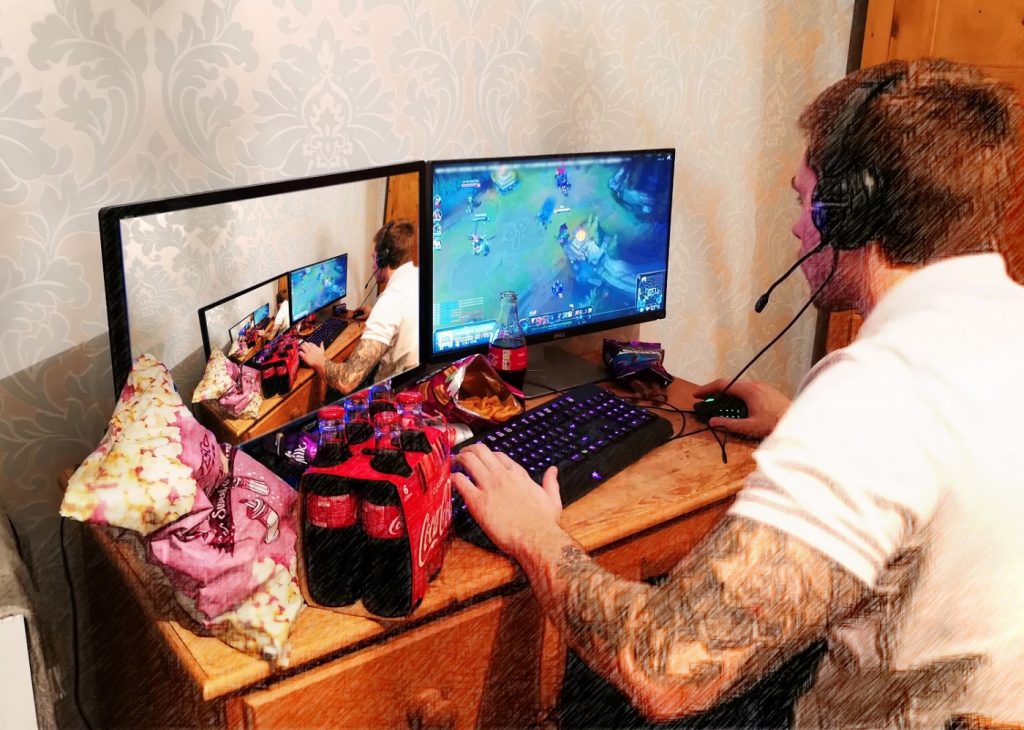
Digital Tethering: Understanding Digital Immersion within Streaming and E-Sports
Our Photo of the Week series features photo entries from our annual Research Photography Competition taken by BU academics, students and professional staff, which gives a glimpse into some of the fantastic research undertaken across the BU community.
This week’s photo of the week is by Charlie Simmons, a final year undergraduate student on a BA (Hons) Business Studies with Marketing programme. This project was co-created with Dr Elvira Bolat, Senior Lecturer in Marketing in the Faculty of Management, and won a prize for the Centre for Excellence in Learning (CEL) co-creation awards. Charlie’s work is around digital tethering, particularly in understanding digital immersion.
Immersion is used outside of digital space as a term to measure the degree of involvement in a specific activity. Digital immersion is now a ubiquitous phenomenon that can be observed in all human activities starting with consumption of services and products as well as professional tasks. Overall academic literature, in particular business and management literature, lacks understanding of digital immersion, perhaps due to methodological challenges associated with researching this area. Using the context of e-sport, this research study revealed that in the context of digital connectivity immersion is not only a feeling but a state of mind; it causes behavioural changes in its e-sport players and keeps them habitually absorbed. At the heart of digital immersion are people, streamers (influencers) and community whom have the power to manipulate individuals’ behaviour.
At the heart of digital immersion is community; the more an individual is experiencing community and feels part of that community, the more likely they are to be immersed in the digital environment. Entertainment within content is also irrelevant to the digital immersion, which is contrary to existing research. Content allows users to escape from reality and forget about real world problems, and learning in combination with community factors found to have a strong and positive impact on digital immersion. Findings of this research have implications beyond its contextual focus, e-sports. Businesses can utilise learning, escape and community effects to improve online presence and stimulate much more meaningful engagement with a digital content.
—
For more information about this research, please contact Dr Elvira Bolat here.
Digital Me is an online collection of research publications/narratives within the domain of digital, written by BU academics and students. This research covers various disciplines, i.e. management and marketing, health and social science, computing and media, education and more; and spreads through various topics, i.e. digital consumption, digital business, education and digital and more. Find out more here.
‘Enhancing Employability in Higher Education through Work Based Learning’ has just been published by Palgrave Macmillan. Edited by Dawn Morley, formerly of BU and now at Solent University, there were the following contributions by BU academics, staff and students:
Dr Sue Eccles and Vianna Renaud (Bournemouth University)
Chapter Title: Building Students’ Emotional Resilience through Placement Coaching and Mentoring
Dr Mel Hughes and Angela Warren (Bournemouth University)
Chapter Title: Use of simulation as a tool for assessment and for preparing students for the realities and complexities of the workplace
Dr Dawn Morley (Solent University), Dr Anita Diaz, Deborah Blake, Grace Burger, Tom Dando, Suzanne Gibbon, Kate Rickard (Bournemouth University)
Chapter Title: Student experience of real-time management of peer working groups during field trips
I attended Susanne and Curie’s ‘Facilitating with Lego’ workshop in early June and found it really insightful. There are lots of ways it can be used. It’s great for team building events but could also be used for personal development. The workshop gave some really good hints and tips of using Lego in group settings but also on an individual basis; along with ideas of probing questions to get people to open up and share their thoughts and feelings about a particular subject or even themselves in a relaxed, informal and fun environment.
In the session we used Lego to build a model that represented our personal strengths. It was really interesting to hear everybody’s explanations in the group and look at their weird and wonderful creations. Some included tall towers to illustrate, not a person in power as you might imagine but a person working in a role that requires them to see the bigger picture, having an overview. Other people’s models included propellers which were linked to ‘leading the way’, also extended ‘bendy’ arms showing the strength of flexibility. There were also several little pink ‘creative’ hats to express how some roles require some creativity… and many little green flags but I can’t recall any ’strengths’ from these pieces, I think we all just agreed they were mostly for decoration! Whilst we didn’t all have identical pieces in front of us they were very similar, although I was quite jealous of the person with the Superhero Lego person which had its own cape!
This workshop was a great pre curser to BUCRU’s upcoming Festival of Learning interactive session ‘Demystifying research: helping us make a difference’ and really helped with inspiration, which is the reason I signed up to it.
Our Festival of Learning event was comprised of several interactive sections looking at ways in which members of the public can get involved in clinical research. The Lego was used to demonstrate how complex the research design stage of a project can be.
The audience were split into 2 teams and asked to examine our ready-made ‘medical device’.
(We had built our own ‘device’ prior to them entering the room). Their task was to copy the device exactly to the best of their ability within a timeframe. However some bricks/pieces weren’t quite the same and they had to do some improvisation!
Afterwards we discussed how successful they felt they were, what problems they may have encountered, what strategies they implemented (if any) and if they would do anything differently in the future. They reported that having the correct resources was essential; that having the model closer would’ve also made life easier, instructions would also have improved the situation… but we didn’t want to make life too easy for them! All of this illustrated how important it is for someone else to come along, see what you’ve done, replicate it and get the same results that you got.
The clearer we can be and the more input we can get from the public, the better – it is an essential part of designing a study, also referred to as PPI (Patient and Public Involvement).
We also drew some comparisons with a real life research project team. How each person has something to contribute: statistician, research nurse, patient etc. And how there are often many bumps in the road to a successful research project and sometimes you need to take everything apart and ‘build’ from scratch again.
Don’t forget BU Clinical Research Unit (BUCRU) are based on the 5th floor of Royal London House also incorporating your local branch of the NIHR Research Design Service. Feel free to pop in and see us, call us on 61939 orsend us an email.
The NIHR Clinical Research Network have shared a checklist, based on themes identified from the feedback collected via 4,665 patients during 2017/18.
The feedback highlighted what’s important to people when participating in studies, so it is hoped that the document will aid researchers in enhancing patient experience.
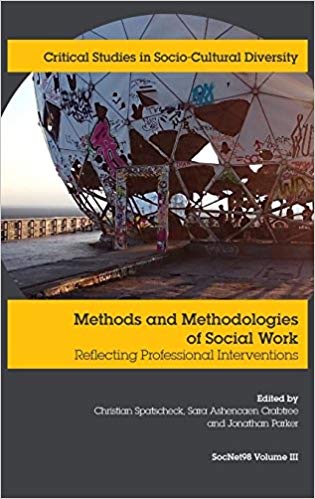
As a discipline and a profession, social work builds on a wide variety of methods and techniques for its practice. The broader frameworks of social work methodology guide social workers through the process of developing and creating interventions with different service users, carers and other professionals.
This book aims to provide an overview of current debates concerning social work methods and methodologies from an international perspective. It provides and enables exchanges about the variety of approaches and reflects the knowledge base for bringing social work theory into practice in different European settings and welfare contexts. It is a timely and welcome addition to the literature at a time when European cooperation and solidarity is much needed.
Edited by Professor Spatscheck from Germany, and Professors Ashencaen Crabtree and Parker from the UK, this book comprises chapters selected from presentations held at the 17th SocNet98 International University Week at Hochschule Bremen and includes further contributions from throughout the SocNet98 network. The work includes a chapter by the editors co-authored with past BU Sociology & Social Policy students Emilie Reeks, Dan Marsh and Ceyda Vasif.
“SocNet98 – European Network of Universities/Schools of Social Work” provides highly successful International University Weeks for social work students and academics from across Europe to learn from and share with one another. These study weeks have enriched social work education for 20 years and continue to do so.
Callum Cole, BA Events and Leisure Marketing Graduate
BU Alumnus Callum Cole had his research featured at the Fan Studies Network (FSN) Conference 2018 last month. Callum graduated with First Class Honours in 2016 from the BA Events and Leisure programme. His dissertation, which also received a first, entitled The Twitter Force Awakens: An Exploratory Analysis of E-WoM around a Sci-Fi Movie Releasewas presented at the FSN Conference by his dissertation supervisor Dr Nicole Ferdinand. His research was featured in a panel dedicated to Events of Fandom which approached sci-fi from the perspectives of event, tourism and leisure studies.
Callum who is currently working as a Marketing Executive at Haven Holidays was previously a placement student for Vue Entertainment, which provided the inspiration for his research.
Other papers presented were:
Form/Con-tent: Defining the Con as Cultural and Organizational Form by Dr Benjamin Woo, Carleton University, Canada
Constructing Queer Sci-Fi Fan Identities: the Negotiation of Representation in Online Spaces by Monique Franklin, PhD Candidate, Flinders University, Australia
Performing Sci-Fi through debating Controversy: Communicative Leisure, Collective Memory and Rouge One: A Star Wars Story Below the Line at The Guardian by Professor Karl Spracklen, Leeds Beckett University, United Kingdom
Left: Monique Franklin, Top right: Karl Spracklen, Bottom right: Benjamin Woo
Callum, along with the other presenters in this panel have been invited contribute to a special issue for the Journal of Fan Studies.
Callum’s dissertation supervisor Dr Nicole Ferdinand with panel chair Professor Karl Spracklen
Upon the invitation of Prof Hongnian Yu, the team from Chinese Academy of Sciences was visiting Bournemouth University to conducted a Newton funded project, Adaptive Learning Control of a Cardiovascular Robot using Expert Surgeon Techniques, from 26 June to 7 July 2018. Two teams have exchanged the ideas, the project progress and the future plan. They had several meetings and discussion sessions.
Prof Hongnian Yu and Dr Carol Clark visited Chinese Academy of Sciences in May 2017, and visited their labs and organized a project workshop. This Newton funded project is closely related to three of BU2025 strategic areas – medical sciences, assistive technology and animation, simulation & visualisation. The project has potential to generate some real impacts to our society and manufacturing industry which can be used for the future REF impact case.
The European Media Management Association Doctoral Summer School is a bi-annual event that has previously been run by institutions in Germany, Spain, Sweden, Portugal and Zurich. This year the Advances in Media Management (AiMM) research group hosted an international group of doctoral students at BU.
Dr John Oliver, Associate Professor of Media Management, said that “our aim was to create a community of learning where doctoral students, media industry professionals, BU faculty and professional services staff fused media management theory and practice to define the next generation of media management challenges”.
On the social side, delegates were given a Dorset cider tasting experience, an opportunity to see the grave site of Mary Shelley (author of Frankenstein) and a Gala Dinner in The Library of the Miramar Hotel in Bournemouth.
Dr Oliver would also like to thank the Doctoral College for their support and those members of the AiMM team that helped plan and deliver what can only be considered to be an “excellent event” that has contributed to BUs international profile and reputation. Many thanks to: Dr Joyce Costello, Dr Chris Chapleo, Melanie Gray, Graham Goode, Maria Musarskaya, Muridzo Searchmore and Conor O’Kane.
Hai Luu (PhD student working with Prof Genoveva Esteban and Dr Iain Green in the Department of Life and Environmental Sciences, SciTech) travelled to her home country of Vietnam where she organised a seminar on microscopic life for 20 undergraduate students of the Aqua-Agriculture Faculty at Travinh University. Students collected samples from freshwater ponds, and observed the single-celled and other microscopic organisms that thrive in such habitats; they also studied their diversity in soil samples. Hai Luu gave a presentation about the diversity of organisms that constitute the unicellular protists, including micro-algae, protozoa, and slime molds. This event was a great opportunity for the students to recognise the biodiversity of micro-organisms in soils and fresh waters, and to understand the important role they play in food webs. The seminar was the first of its kind at Travinh University, and a unique opportunity to disseminate the research we do in this field at BU to a wider audience. Excellent feedback was received from the enthusiastic group of students.
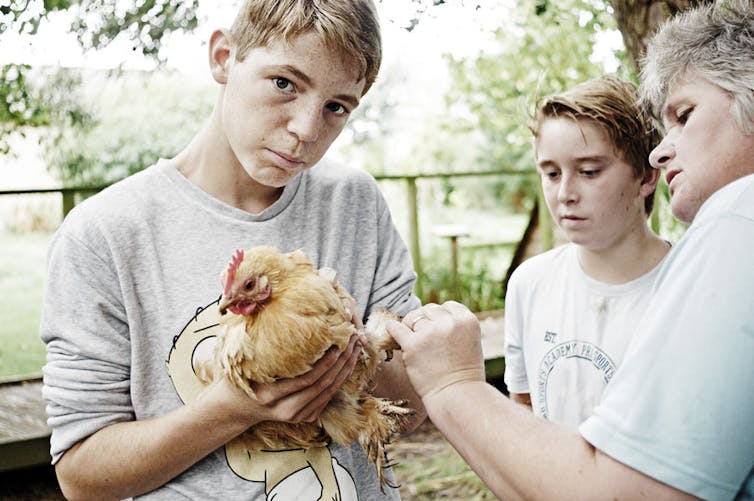
A couple of years ago, I met Adam (not his real name) at a farm in Dorset. Adam was 14 and had been excluded from mainstream education due to behavioural difficulties and a disruptive home life. He had consequently become involved in regular underage drinking and antisocial behaviour. Adam was being exploited and groomed as a drug runner for a London drug gang infiltrating rural areas. He told me that he had been given a knife by gang members and encouraged to use it to protect himself if necessary against rival gangs or local drug dealers.
The farm where I met him is not a normal farm, but a social one, where the therapeutic use of farming practices and animal assisted therapy is used to provide health, social and educational care services for disadvantaged young people that have become disengaged with mainstream education. Stories such as Adam’s are growing increasingly familiar to staff at the farm he attended, who see other vulnerable young people referred to their service.
Learning new skills. Sarah Hambidge
Many of the young people living in rural Britain who are being exploited by these gangs are, like Adam, those who are disengaged with mainstream education and are at risk of becoming, or currently are, NEET (not in education, employment or training). There are 808,000 young people (aged 16-24) in the UK who are NEET.
Being NEET has a long-term impact on a young person’s life, leaving them vulnerable to substance misuse, offending behaviour, physical and mental health problems, academic underachievement and reduced employment. These young people are subsequently regarded as a concern to the police, health, education and social care professionals.
Yet current interventions are failing to reduce the number of young people becoming NEET. These interventions typically focus on providing the young person with vocational education, despite the fact that the most common vocational qualifications in the UK have very little or no relevance to the labour market.
Interventions that offer a restorative approach, with therapeutic support and a focus on learning, however, are acknowledged to be more successful.
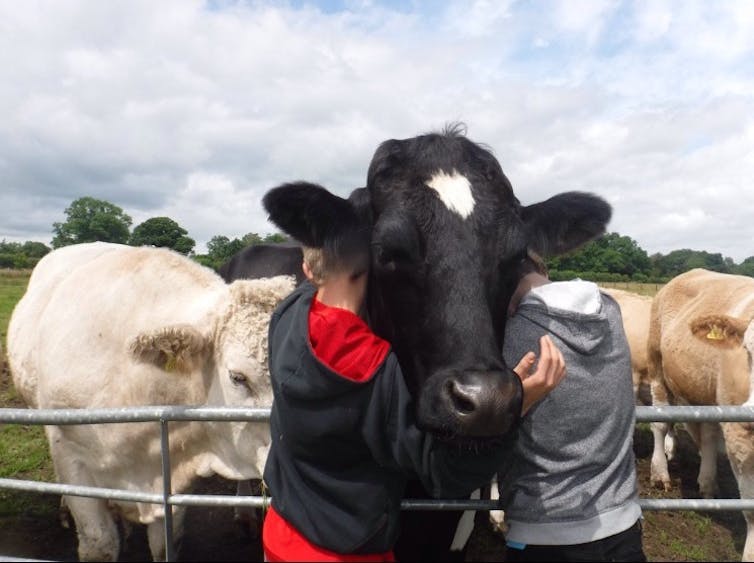
Farm animal therapy. Sarah Hambridge
A green future
Earlier this year, the government launched a 25-year environment plan. The plan acknowledged the importance of connecting children and young people to nature through learning, as well as the benefits of a physical, hands-on experience as a pathway to good health and well-being. The government has pledged £10m to support local strategies which use the natural environment and has further committed to a national expansion of social farming by 2022. This will treble the number of available places to 1.3m per year for children and adults in England.
On social farms, health, social or specialist educational care services for vulnerable people are delivered through structured programmes of farming-related activities. Social farming is established in numerous European countries. Norway currently operates 1,100 social farms, compared to 240 in the UK.
Taking a break on the farm. Sarah Hambidge
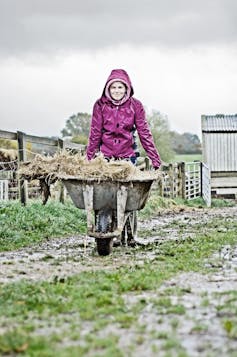
Young people participate in a variety of seasonal farming-related activities, including animal husbandry, crop and vegetable production and woodland management. Social farming has been found to have a positive impact on physical and mental health along with the opportunity to develop transferable skills, personal development, social inclusion and rehabilitation.
Social farming
When I met Adam, I was in the midst of a research project evaluating whether a year-long farming intervention can prevent disengaged young people from low-socioeconomic backgrounds becoming NEET. Participants typically attend a four-hour session once a week at the farm.
Future roots, the farm I researched, employs a mix of teachers, youth and social workers and therapists. It offers a different model of learning for those struggling in mainstream education. My research demonstrated that the use of the natural environment as a mechanism for change was effective in reducing the risk of becoming NEET.
The young people learn to care for a variety of animals. Sarah Hambidge
The young people I followed displayed a significant reduction in self-reported mental health risks and behavioural regulation difficulties; improved social relationships and coping; improved life and work skills; and re-engagement with learning. All of the young people were in employment or training six months after their time at the social farm finished.
Indeed, the social farm was the only place where Adam said he felt safe. He was able to develop a sense of belonging and trust which enabled him to talk about the difficulties he was experiencing in his life. Without the social farm intervention, staff said that Adam would likely have proceeded to harm himself or others. The farmer refers to the changes seen in the young people as a “chrysalis butterfly effect”: the positive transformation seen in these young people as they turn their lives around to look to the future are truly inspiring.
Dr Samuel Nyman and Yolanda Barrado-Martín from the Psychology Department and Ageing and Dementia Research Centre (ADRC) attended the 4th EU Falls Festival in Manchester on 2nd and 3rd July 2018.
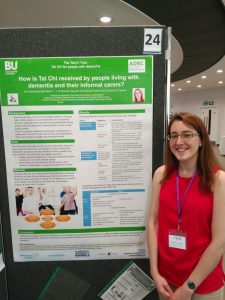
International researchers met in Manchester to learn about current projects under the theme, “New Solutions to Old Problems: Ensuring sustainability of falls prevention interventions”. Yolanda Barrado-Martín presented a poster entitled: “How is Tai Chi received by people living with dementia and their informal carers?” Attendants showed interest in the poster over the two day conference and voted Yolanda´s as the second best poster of the conference!
This year’s conference included sessions around Cochrane Updates on falls preventions, the use of new technologies to prevent falls, epidemiology and the implementation of research into practice. This year there was also a space for specific conditions such as dementia and the use of “qigong” to improve balance and prevent falls amongst older adults, which made this conference particularly relevant for the TACIT Team.
You can learn more and keep updated about the TACIT Trial via the following links:
Bournemouth University, together with a consortium of European universities and industry, has been successful in securing funding from the Interreg 2Seas Programme. The project, Smart Ports Entrepreneurial Ecosystem Development (SPEED) with an overall budget of over 4 million Euros was approved by the 2 Seas Monitoring Committee on 12th July 2018. Reza Sahandi in the Department of Computing and Informatics is the lead for BU and the overall BU budget for this project is 393,783.75 Euros. In the current European climate, this is quite an achievement!
My name is Natalia Lavrushkina and I am a member of staff in the Faculty of Management at Bournemouth University and a postgraduate research student at the University of Southampton and before sending you invitations to take part in a short online survey, as a part of this research, I would like to introduce the ResNET Research Network Project to the BU research community.
ResNET is a Doctoral Research project undertaken in collaboration with the Doctoral College and it is being mentored by Dr John Beavis.
The aim of this research project is to investigate and understand the development and operation of social networks amongst the internal research community within Bournemouth University. Its objectives are:
to explore the concept of ‘institutional collegiality’ as a measure of the degree of cooperativeness and collaborative interaction within the organisation;
to map expertise distribution within BU.
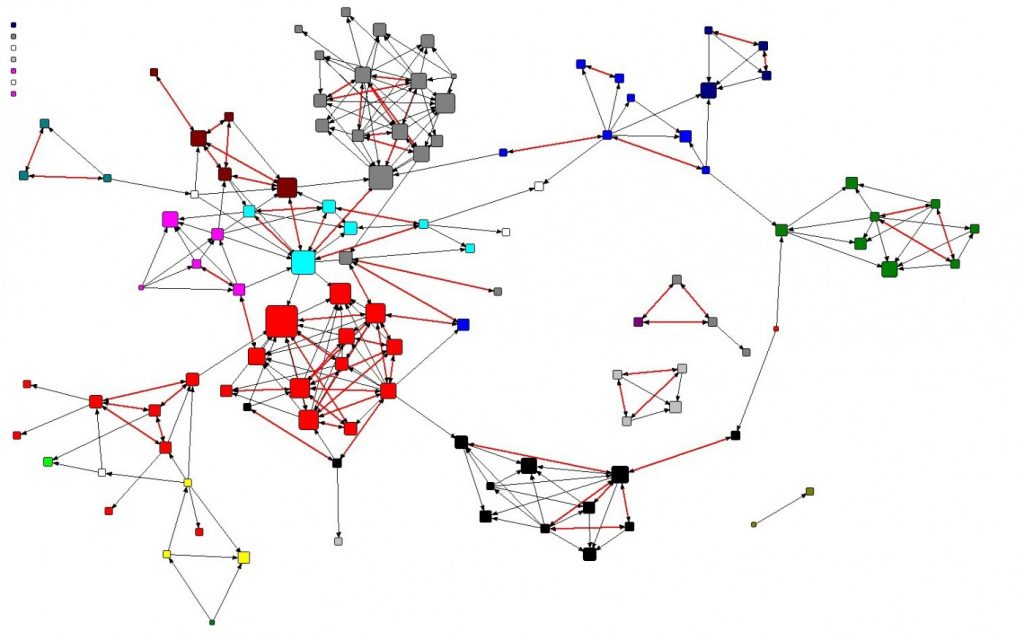
Once data has been collected, I will make social network charts like this one below.
The chart shows the organisation with the squares representing individuals in different subject areas.
I will be using specialist Social Network Analysis software for my data analysis which graphically shows communications points through our community. It links people working together and demonstrating density of the communication. It also shows the difference between external and internal communication flow. Additionally the longitudinal data analysis allows reflection on the dynamics of the research network’s development.
I will send individual survey links via BU emails to ask BU researchers and related staff to complete a short online survey through three rounds of data collection approximately 3 months apart. The questions seek to identify levels of communication flows, the presence of communication hubs and brokers, the closeness and strengths of ties and levels of network’s cohesiveness.
As you can see from my diagram it isn’t about looking at individuals per se – I am not concerned with who particular people are or what their job titles are. It is the network composition and the nature of communication flows that are being analysed not the communications of any named individual(s) within the network.
All data will be analysed and reported anonymously using the specialist SNA software.
I anticipate that the research findings will benefit Bournemouth University by informing strategies and innovative practice related to the improvement of collaboration in knowledge creation and transfer.
It will benefit Faculty research activity and research support through a deeper understanding of institutional research network dynamics and through a greater understanding of communication flows and research process and expertise mapping.
This study has been approved by the University of Southampton Ethics Committee (ERGO number: 31376) with Bournemouth University support and agreement. BU Academic and Research Staff are the population of this study.
I am hoping that my peers and colleagues at BU will support me on my doctoral journey by investing some of your very precious time and effort in participation in ResNET project’s survey.
I know that completing surveys can be time and effort-consuming, so I would like to say thank you by offering to provide you and the whole BU Research Community a summary of the research findings through this research blog.
I am happy to answer any query regarding this project and can be contacted via my university email address: nlavrushkina@bournemouth.ac.uk.
Are you currently undertaking research within the NHS and your Good Clinical Practice (GCP) training is due to expire? Or has it expired recently?
GCP certification lasts for two years, so if your training is due to expire, has expired, or you want to validate your learning, then take advantage of the upcoming refresher half day session, taking place at Dorset County Hospital, Dorchester, Wednesday 15th August, 9am – 12:30pm.
Spaces are still remaining and the closing date for bookings will be 8th August – so if you’d like to enrol, get in touch with researchethics@bournemouth.ac.uk
BU staff can login below:
Other services
Don’t miss a post!
Subscribe for the BU Research Digest, delivered freshly every day.
 The Centre for Qualitative Research welcomes new members and invites them to contribute to our on-going and successful Seminar Series in the coming Academic Year.
 Some possibilities:

 Digital Tethering: Understanding Digital Immersion within Streaming and E-Sports




 Hai Luu (PhD student working with Prof Genoveva Esteban and Dr Iain Green in the Department of Life and Environmental Sciences, SciTech) travelled to her home country of Vietnam where she organised a seminar on microscopic life for 20 undergraduate students of the Aqua-Agriculture Faculty at Travinh University. Students collected samples from freshwater ponds, and observed the single-celled and other microscopic organisms that thrive in such habitats; they also studied their diversity in soil samples. Hai Luu gave a presentation about the diversity of organisms that constitute the unicellular protists, including micro-algae, protozoa, and slime molds. This event was a great opportunity for the students to recognise the biodiversity of micro-organisms in soils and fresh waters, and to understand the important role they play in food webs. The seminar was the first of its kind at Travinh University, and a unique opportunity to disseminate the research we do in this field at BU to a wider audience. Excellent feedback was received from the enthusiastic group of students.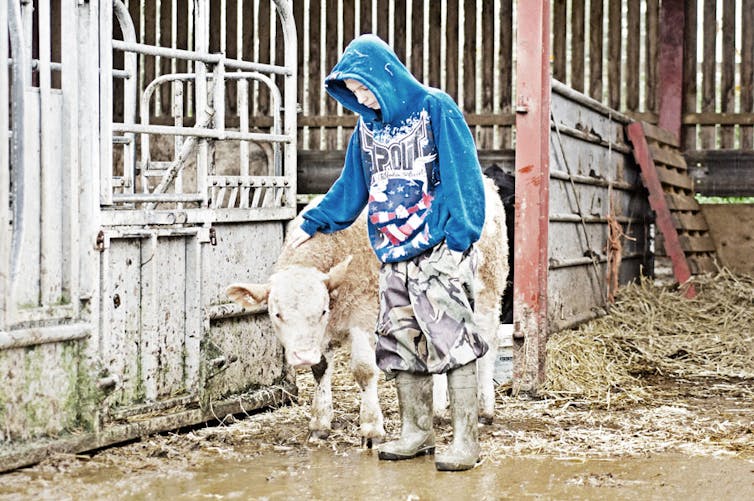

 The chart shows the organisation with the squares representing individuals in different subject areas.







 National Postdoc Appreciation Week 2026: The Changing Landscape of Postdoc Careers
 NIHR Insight South West Central Conference 2026 at Bournemouth University
 BU PhD student presented at World Safety Conference in South Africa
 National Research Supervision Recognition: Apply Now & Join the Supporting Workshop on 16 September
 Horizon Europe Cluster 3 (Civil Security for Society) 2026 Calls Now Open
 MSCA Doctoral Networks 2026 Call Information Webinar
 ESRC Festival of Social Science 2026: Application Deadline Extended to Thursday 25 June 2026
 Reminder: Register for the ESRC Festival of Social Science 2026 Information Session
 ECR Funding Open Call: Research Culture & Community Grant – Apply now
 ERC Advanced Grant 2025 Webinar
 Update on UKRO services
 European research project exploring use of ‘virtual twins’ to better manage metabolic associated fatty liver disease